I was not surprised, reading Francesco Moneta‘s article in “Il Corriere Vinicolo,” to find that, wandering through the pavilions of this latest edition of Vinitaly, he encountered only a few companies committed to communicating their investment in sustainability.
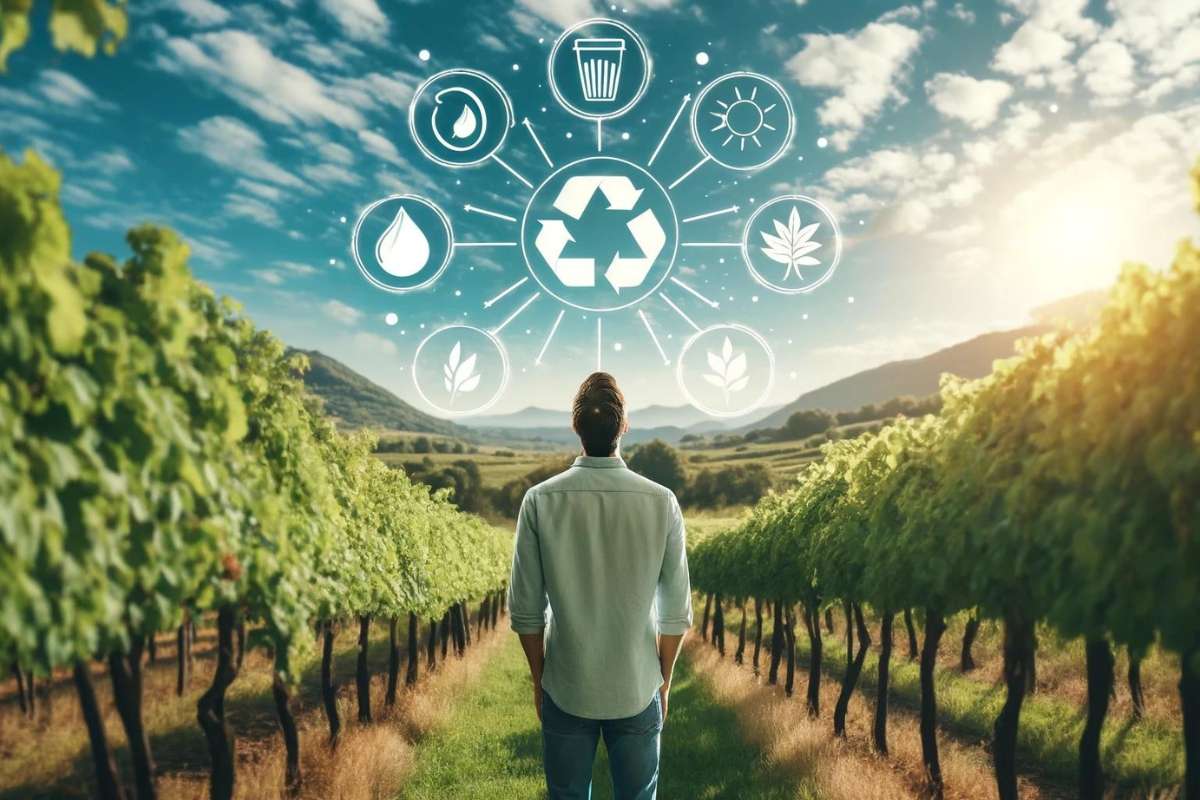
For some time, I have indeed perceived a real difficulty, even among our wine companies, in effectively communicating their sustainable “creed.” And it could not be otherwise because we are now facing a new and complex phase on the topic of sustainability.
On the one hand, consumer expectations for sustainable companies and products are indeed growing. At the same time, it is becoming increasingly difficult for companies to be credible in their eyes.
Supporting this observation are the results of many surveys. For example, the recent “Consumer survey by Wine Monitor Nomisma” shows that 85% of the Italian consumers interviewed consider wines with sustainable certification to be those that will grow the most in the next three years. The percentage rises to 93% when focusing on Gen Z consumers (born between 1995 and 2010).
But the same percentages are also found in other sectors of the agri-food industry, and beyond, showing that sustainability is increasingly becoming a sort of prerequisite for a growing number of consumers.
Moreover, numerous analyses also highlight the growing percentage of consumers who are willing to pay more for a sustainable product.
Among the most recent, one by BlueYonder shows that 65% of consumers would be willing to pay more for a sustainable product, with 40% willing to pay an additional 5% and 25% an additional 10%.
However, it is still BlueYonder’s survey that delivers a cold shower, as it reveals that only 17% of consumers would trust the sustainability messages of brands.
I use the conditional because, despite coming from authoritative observers, these are decidedly partial samples of consumers globally.
Nevertheless, it would be at least naïve to pretend not to know that the communication of sustainability by companies has long been a delicate, if not sore, point.
And this is not only due to the severe damages caused by the so-called “greenwashing” but also the excessive proliferation of sustainable certifications and the objective difficulty for companies to concretely demonstrate their investment in sustainability.
I do not wish to appear presumptuous, but since 2020 we have titled our training course on sustainability communication as “From ‘certified’ sustainability to ‘demonstrated‘ sustainability.” This is not to delegitimize the importance of certifications, far from it, even though some have really only created confusion, but to make it clear that being certified is not enough; one must also be able to demonstrate concretely how one is sustainable.
In this direction, I often cite the exemplary case of the Sostain Sicilia Foundation, which, in my opinion, represents one of the best examples of how to communicate sustainability effectively, including through very concrete actions like the agreement with Plastic Free Onlus for “cleaning up the countryside” from plastics recklessly abandoned in the fields, or the creation of a light glass bottle (450 g) 100% Sicily for all the member companies of the Foundation.
These are just two examples of how “good practices” are the best way to communicate and demonstrate one’s sustainability.
But there is also a final path, already undertaken by some companies, such as Arnaldo Caprai or Fantini Wines, which consider sustainability a “life” choice, indispensable and as such not necessarily something to be communicated.
Fundamentally, the idea is gaining ground that sustainability is not and should not be a marketing asset but something intimately linked to a company’s philosophy, its identity, and as such should not be subject to any specific type of communication.
Certainly, this is a visionary attitude that anticipates the times of an era that will undoubtedly arrive and in which saying one is sustainable will appear an obviousness.