The negative news that arrives almost annually from Oltrepò Pavese is no longer surprising. And this, I would say, is the worst part because when people stop having positive expectations from a wine territory, it means that even hope has faded.
The latest blow to the territory, in terms of time, came last July 5th with the official resignation from the Board of Directors of the Consortium for the protection of five important companies: Vinicola Decordi, Agricola Defilippi Fabbio, Losito e Guarini, Az. Vitivinicola Vanzini, and Società Agricola Vercesi Nando e Maurizio, which together represent over 30% of the Oltrepò Pavese production protected by the various denominations.
The five directors resigned—in protest, according to a press release—against a management of the Consortium that was allegedly non-transparent, guided by partial interests and characterized by conduct not always respectful of the statutory rules.
In response to these serious accusations, the Consortium’s presidency decisively stated that the resigning companies represent 12.4% of the DOC/DOCG production and reaffirmed its commitment to achieving its goals of transparency, ethics, and loyalty among all members. “Our commitment,” reads a statement from the Consortium, “is to ensure transparent management, respectful of legal norms and focused on the collective interest of all the categories represented by the Consortium. Our Board of Directors has embarked on a path aimed at making the Consortium’s actions increasingly efficient and effective, adopting strategic decisions to achieve institutional goals.”
Entering the merits of the umpteenth conflict is now very difficult because when a war drags on for so long, one inevitably risks not understanding correctly the issues at stake, the problems that have plagued this historic denomination for too long.
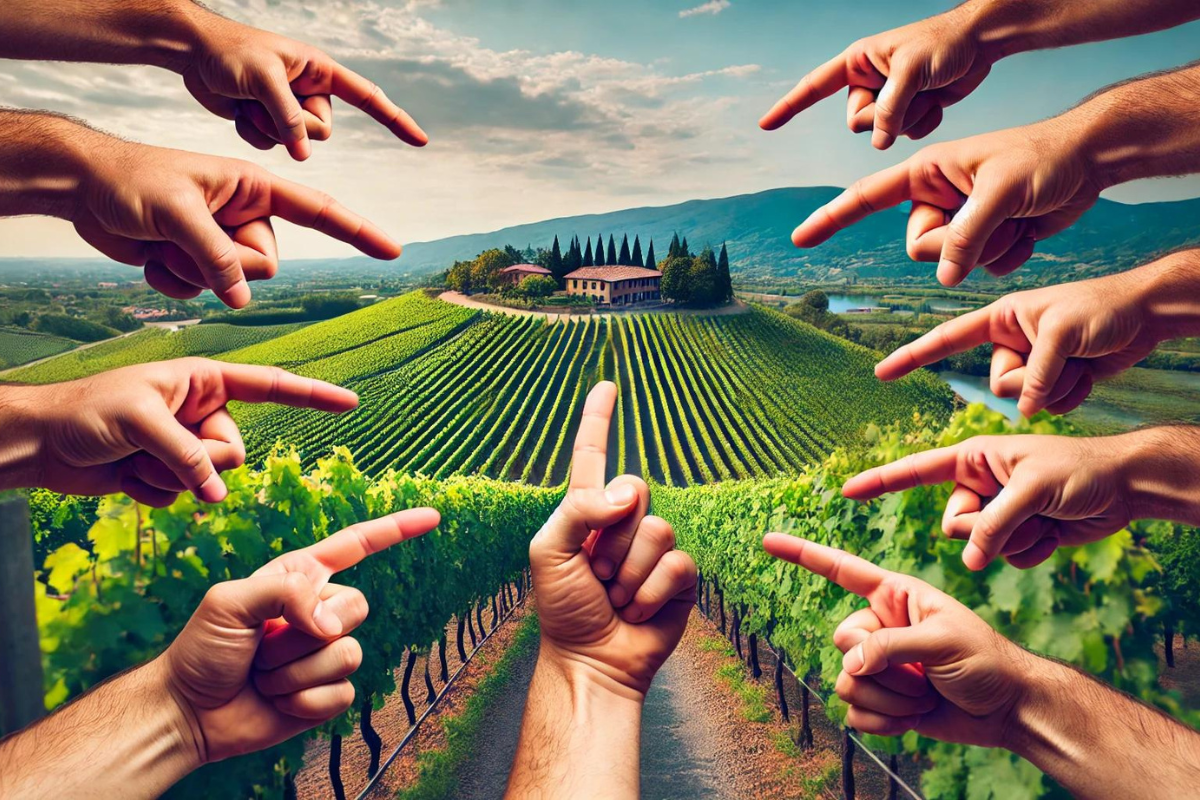
But when the inability to adequately convey the values of a denomination becomes almost a constant in a territory, the responsibility must be attributed to the entire system, to all the protagonists of the production chain.
This is also evidenced by the many directors and presidents of the Consortium who have succeeded over the years. Each one was assigned a sort of mission impossible because they were ultimately left alone in the hope or illusion that there existed a man or woman who could work miracles.
I have tried several times to dialogue with numerous entrepreneurs and operators in this territory, and individually I have always found people who were open and aware of the potential of this land and its many opportunities, but at the same time, I then encountered a sort of fatalism that led them to not have a true and concrete hope of restoring the image of their denomination.
An attitude that has also led, in my opinion, enlightened producers to create nothing concrete to change the course.
I have tried several times to build a sort of group of “visionaries” among the entrepreneurs who were willing to “put their face on it,” to design a new concrete perspective for Oltrepò Pavese, but after many words, no one was truly willing to take the plunge.
There are many Italian denominations, in fact, that have been able to “resurrect” or have been able to gain a good reputation thanks to the initial effort of a few without the expectation that everyone would be aligned, but it takes courage and initiative, characteristics that, unfortunately, I have seen too little of in Oltrepò Pavese for too long.
I am not so naive as to not know that it is not easy to make different souls coexist within a denomination. Cooperatives, bottlers, small winemakers, and medium-sized private companies with a long history are, however, also the DNA of much of our Italian denominations and, despite the difficulties, in many of them, coexistence is possible through the sharing of some basic principles, with reputation and honorability—I would dare say—of one’s territorial brand being at the top.
In Oltrepò Pavese, however, it seems that even the basic principles of a civil and profitable coexistence among the various stakeholders have been lost, and at this point, I believe that no one has a precise recipe to get out of this paradoxical situation.
The only thing certain is that if everyone does not feel responsible at various levels, it will never be possible, in this state of affairs, to find the right corrections and the right people to carry them forward.
If once again we seek a single culprit or some scapegoats here and there, for Oltrepò Pavese it will still be a long night.