There are places where, as soon as you see them, you feel privileged. Just the first impression is enough to realize you are immersed in something unique. This is the case with Bad Schörgau, a beautiful hotel located in Val Sarentino(Bolzano), probably the most unspoiled and least developed valley in South Tyrol.
An extraordinary corner of peace where the lovely structure of the hotel is well integrated into an alpine landscape that has few equals.
When I meet Gregor Wenter, the hotel owner, I understand how this place, both in terms of hospitality (only 22 rooms renovated in 2018) and cuisine, is deeply connected to the philosophy of this man and his family.
A philosophy that, since the hotel’s inception, has led him to prioritize the well-being of guests and sustainability, sometimes at the cost of putting economic interests in the background.
“I’m not saying that we want to incur losses,” explains Gregor, “but for us, putting the well-being of our guests at the center is not only an absolute priority but also perfectly aligns with our way of life.”
Everything at Bad Schörgau speaks of well-being and sustainability, and it was very interesting to understand from Gregor Wenter the principles on which he bases his hospitality, wellness, and, of course, his wine selection.
What kind of choices have you made in the development strategy of your hotel regarding the theme of sustainability, and in what areas do you consider your tourist offer to be a sustainable one?
I don’t think we should talk about specific areas. Sustainability, even outside of gastronomy, should be seen as a set of complex and circular systems, where every single aspect is essential to achieving an overall balance. I stopped thinking of my hotel as a collection of separate areas and compartments, and I began to see it as a whole. Since adopting this holistic view, I perceive a completely different harmony. The most gratifying thing is that our guests were the first to notice it, making me realize the importance of this small but significant change.
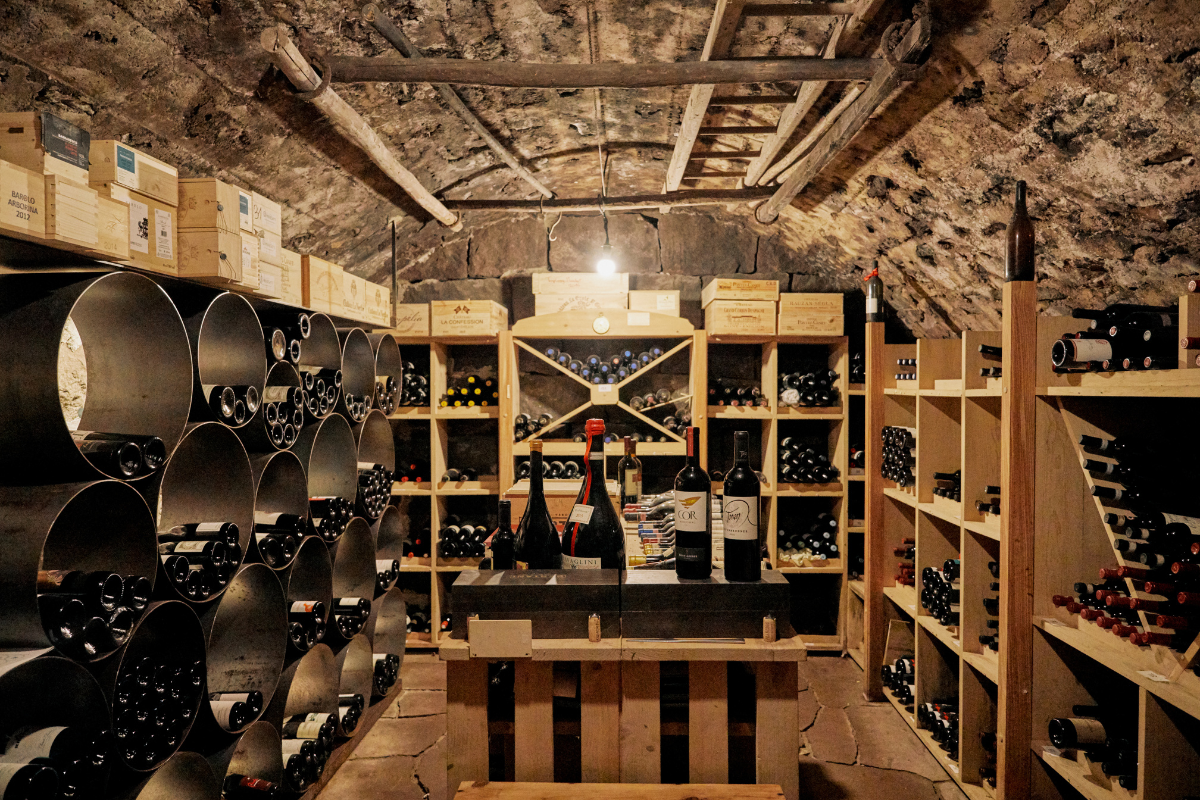
What criteria do you use to create your original and interesting wine list?
It’s very simple to explain: we try to choose wines according to our feeling. We try to understand what feeling the wine leaves us with, and we also consider the taste, which is obviously fundamental but also subjective and individual.
Additionally, to better understand the wines, we have personally met almost all of our vignerons. It’s essential to be in contact with those behind the wine.
Lastly, we strive to offer a wine list consisting solely of natural wines, starting from South Tyrol in Italy, then moving through Austria, Germany, and France, with 5% coming from the rest of the world.
With the arrival of Chef Mattia Baroni, what kind of culinary choices have been made, and for what reasons?
With Mattia’s arrival, the gastronomic offerings have perfectly harmonized with the rest of the hotel. It’s not just about sustainability but also about identity. Every corner of the hotel tells a very specific story: from the soil of the foundations used for the roof tiles to the old cast iron kitchen hood now used as the hood for the fireplace in the lobby.
Mattia shares this spirit and believes that cooking local ingredients, enhancing their intrinsic flavors, is the best way to express the identity of the place. Moreover, he develops fermentation techniques with the aim of giving new value to the raw materials, just as happened with the old kitchen hood when the new one arrived.
The value we place on our work is the result of a thought that seems innovative but is actually deeply rooted in our authentic traditions. Guests notice it and appreciate it.
The valley where the hotel is located is one of those that opposes the development of mass tourism. How important is this to you?
Certainly, being in one of the last valleys not overwhelmed by mass tourism like the rest of South Tyrol has its peculiarities. On the one hand, we are driven to constantly improve to offer our guests an authentic and identity-based experience, in order to capture their attention. On the other hand, the fact that few tourists are seen here means that only those who are looking for something unique come to spend full and unforgettable moments with us.
The clientele is international. What differences do you notice between the approach of international clients and Italian guests on the topic of sustainability? Where do you perceive greater awareness?
I must admit that everyone is particularly impressed by what we do here and how natural it seems for us to do it. Perhaps what surprises the most is the almost total absence of inconsistencies; the few that do exist, we are the first to point out because we are constantly trying to improve.
If I had to express a preference, I would say that foreigners seem to be more aware that change is happening and must be supported in every possible way. However, Italian customers are also showing growing awareness of sustainability, increasingly appreciating our efforts in this direction.