The project
In 2019, Cantina di Solopaca, led by President Agr. Carmine Coletta, launched the “Identitas” project in collaboration with enologist Vincenzo Mercurio. The aim was to thoroughly study the wine-growing region, map and enhance the unique characteristics of the Telesina Valley, focusing on the areas where the vineyards of the winery’s members are located.
Founded in 1966, the winery now consists of over 600 members, representing 1,100 hectares of vineyards, processing 10,000 tons of grapes per year, and producing four million bottles.
The wines
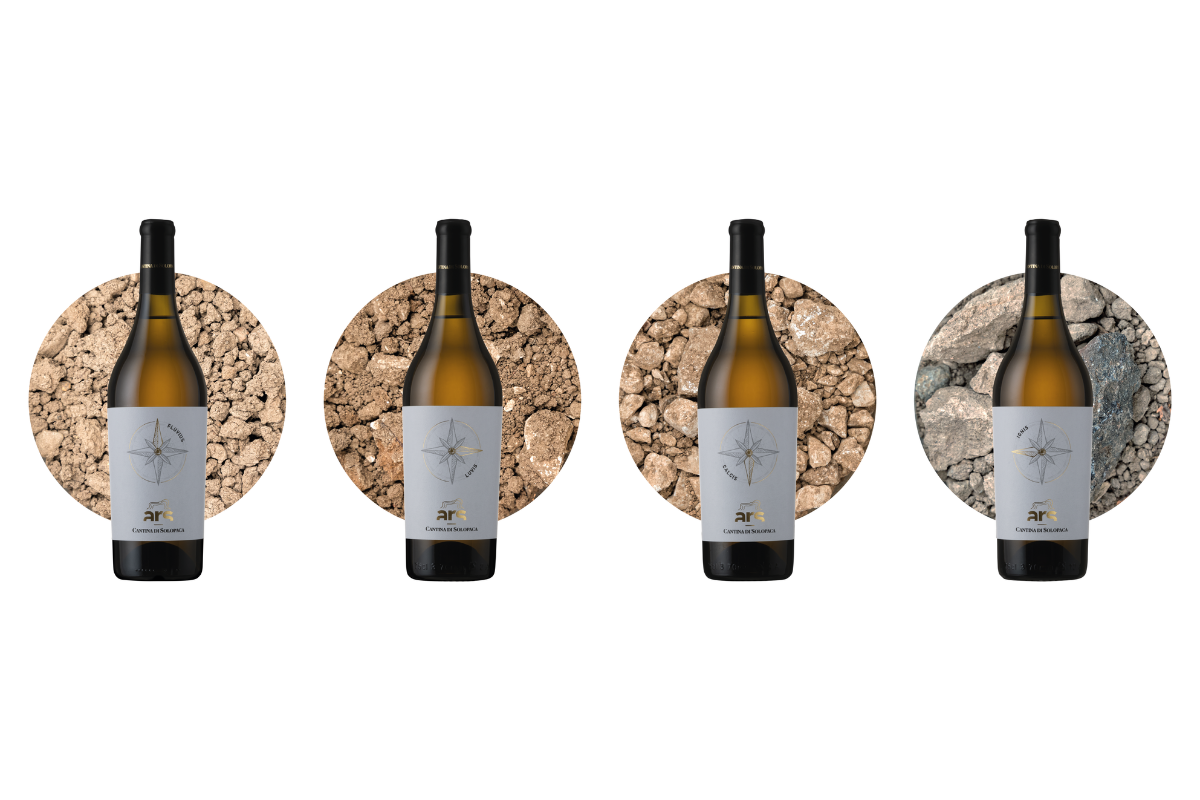
In 2021, a study was conducted specifically in the Solopaca area, which led to the creation of four Falanghina wines, each representing a specific macro-area. The grapes were harvested simultaneously to highlight the differences in ripening capabilities across the various areas and were vinified with skin maceration throughout the fermentation process—a vinification method technically known as “in red”.
The resulting wines are distinguished by their amber color, golden reflections, and pronounced orange hues, which allows them to be classified as “Orange Wine“.
The technical-scientific team of Le Ali di Mercurio Srl, in close collaboration with the winery’s technicians and expert sommeliers, including Rosa Falluto, identified the main gustatory and olfactory differences between the four wines through several tasting sessions.
The data showed that the territory offers a wealth of highly diverse, original, and intriguing aromatic nuances.
Ignis, Calcis, Fluvius, and Luvis: these are the imaginative names given to the wines, with a clear reference to the nature of their respective soils:
Soil characteristics
The exploration of the territory began with the fluvial environment, in the lower area of the Solopaca municipality, specifically in the Padulo locality, 50 meters above sea level (FLUVIUS). This area is characterized by the presence of alluvial sediments, primarily silty-sandy and, to a lesser extent, gravelly. The terrain is flat and of fluvial origin, preserving traces of ancient watercourses and their natural levees.
Another area studied is characterized by the strong influence of Campanian ignimbrite, volcanic material that arrived from the Phlegraean Fields 39,000 years ago. In the locality of Bagno, 72 meters above sea level, the second wine (IGNIS) was produced. Here, the geological formation consists of pyroclastic deposits alternating with alluvial layers.
The third area examined groups together several neighboring localities (LUVIS), composed of terraced land and gentle slopes formed by a geological structure of sandy-gravelly carbonate detrital deposits, with widespread pyroclastic coverings.
The final area investigated (CALCIS) features soils with steeper slopes, heavily influenced by the limestone rock of Camposauro, characterized by dolomites and Mesozoic limestones. These rocks formed during this period constitute the backbone of the Campanian Apennines.
The aromatic profile of the wines
The wines produced from the aforementioned areas were analyzed based on their olfactory descriptors to identify intrinsic patterns between their aromatic profiles and their areas of origin.
Although all the wines are produced using the same grape variety and the same vinification technique, the distinctive impact of the soil of origin on each wine clearly emerged.
The IGNIS wine is characterized by an aromatic profile with notes of broom, apricot, and peach, accompanied by sulfuric hints of brimstone and flint. In FLUVIUS wine, an intense scent of broom is accompanied by delicate hints of apricot, pineapple, apple, and lemon, creating a harmonious olfactory composition. LUVIS wine stands out for its intense apricot aroma, enriched with nuances of pineapple, peach, banana, mimosa, sandalwood, and vanilla, with a light note of flint and river stone in the background. Finally, CALCIS wine offers distinct notes of broom, apricot, and vanilla, followed by light nuances of river stone and flint, creating a balanced and refined aromatic profile.
The strong distinctiveness of the organoleptic characteristics of the four Falanghina wines examined is truly fascinating. It challenges the standard conception of Falanghina’s characteristics and opens new and intriguing perspectives on consumption occasions, serving temperature, and the choice of optimal food pairings.
Furthermore, the advanced analysis of complex aromatic profiles highlights how, through the use of advanced tools, winemaking can support the creation of a product that is increasingly in line with consumer expectations.
In a context where wine must increasingly reflect the dietary habits of the market and accompany the food choices of its audience, it seems to us that scientific studies of this magnitude can have great practical relevance and prove to be extremely valuable management tools for producers.