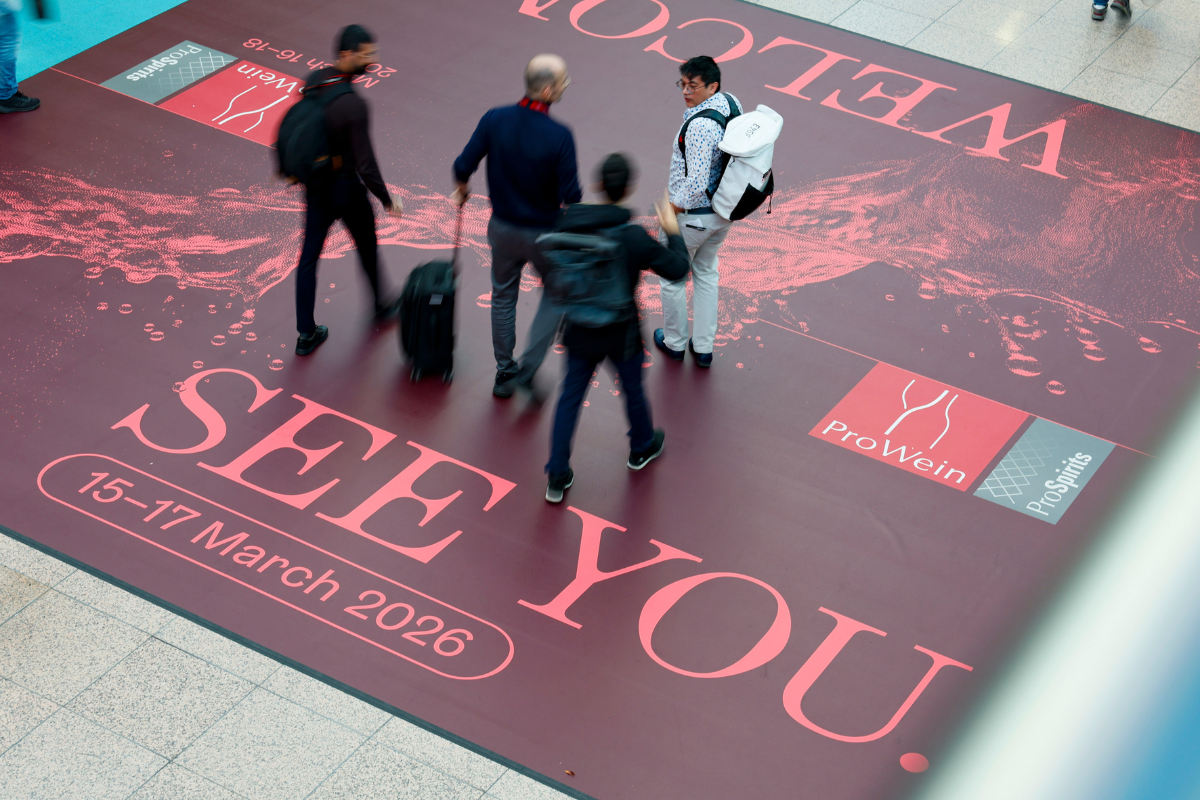
Prowein 2025 captured the current uncertainty in the global wine market, highlighting both challenges and opportunities. With declining consumer interest and a changing trade landscape, many producers are rethinking strategies. The event underlined the urgency of building international alliances, sharing market intelligence, and developing joint commercial approaches to reconnect with evolving consumer needs.
We have already written a lot about this Prowein 2025, which closed its doors last Tuesday with 4,200 exhibitors and 42,000 visitors from 128 different countries. Italian exhibitors, as previously highlighted, were about 800 – almost half compared to last year – but still the most represented country at the Düsseldorf fair.
The expectations for this 2025 edition were quite gloomy, to the point that many exhibitors, even after confirming their participation, had announced it would be their last time at the famous German fair.
I believe many of them changed their mind in the end and, if not all, certainly some will be back next year.
That’s because, although Prowein 2025 is no longer what it used to be in past editions – the de facto leading global wine event – it still showed a noteworthy presence of buyers, especially from European countries.
Most importantly, this Prowein painted an accurate picture of the current health of the wine sector globally. Never before has the international wine industry experienced such a reflective, transitional moment – hard to interpret – marked by confusion and a sort of disorientation.
After hearing many voices at Prowein, I strongly sensed the widespread difficulty in understanding where the sector is headed.
It’s not just market uncertainty, but a broader uncertainty that affects the entire chain, from production to trade. A state largely driven by consumers’ changing attitudes, as they seem, for the first time, much less interested in our beloved beverage.
This was a feeling shared not only by Italian producers but also by many international ones.
I was particularly struck by the appeal of Joel Petersen, executive director of Paso Robles Wine Alliance, one of the world’s largest wine groups, with over 200 wineries in the United States.
During a compelling seminar, Petersen stressed that synergies among wineries from the same country are no longer enough. It is now essential to find agreements at an international level, because today’s challenges affect all players, and appropriate solutions must come through unity.
In essence, Petersen is advocating for an alliance of global wine systems – on the one hand, to better understand current consumption dynamics, and on the other, to identify coherent solutions that meet the needs of today’s consumers, especially younger generations.
I completely agree with Petersen’s perspective, because in the face of such complex issues, we need equally complex and broad solutions, able to go beyond outdated promotional strategies.
In this regard, I was pleased to hear from a major Italian producer in Düsseldorf who told me about meeting Argentine, Chilean, and Australian producers at the fair to build a potential production, promotional, and commercial network.
Likewise, I met a key manager from a well-known company in northeast Italy who told me he was not worried about Trump’s potential new tariffs: “Two years ago, we established our own winery in the U.S., so we’re protected from import taxes.”
So, even amid a decidedly difficult situation, never more than at this Prowein have I perceived that many companies are reorganizing to revamp their strategies. And many of these strategies share a common denominator: teaming up, building networks. It’s no coincidence, for example, that the majority of stands at this last Prowein were “collective”: from consortia, business networks, German importers.
Sure, these collective areas are also driven by economic choices, but I’m convinced they also reflect an awareness that, more than ever, standing together is the best option.
The next step, in my opinion, is to also define common commercial strategies – not just teaming up to gain economies of scale, but to share projects, human resources, and most importantly, market relationships.
Those who still think they can survive on their own are delusional, and this Prowein made that message loud and clear.
Key points
- Prowein 2025 reflects deep uncertainty across the global wine industry.
- Consumer interest in wine is declining, especially among younger generations.
- Joel Petersen calls for global cooperation among wine producers.
- Many companies are shifting to collaborative promotional and commercial strategies.
- Shared market strategies are emerging as the best way forward.