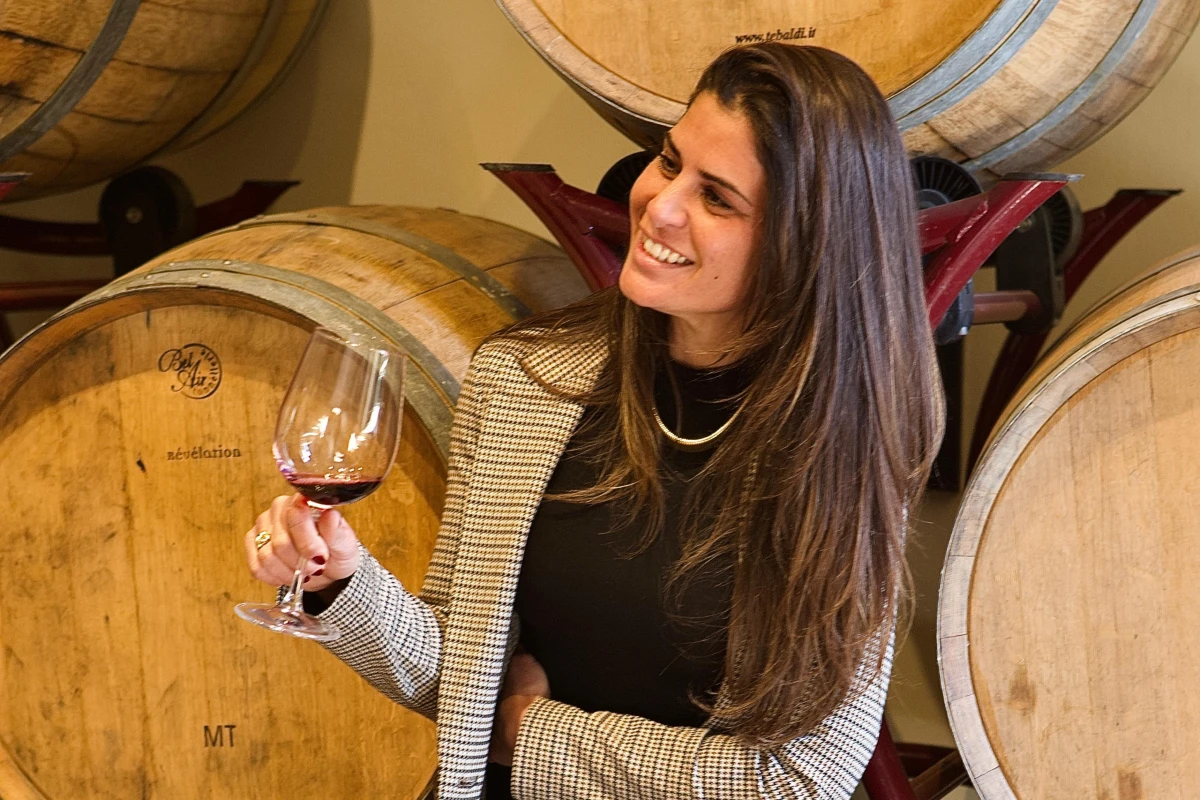
Giulia Giannotti of Diadema winery introduces “Adopt your Barrique,” a project challenging mass-production. Through a tailor-made journey in Tuscany, clients co-create their own wine, from designing deeply personal labels to choosing their own blend. It’s an initiative transforming a bottle of wine into a unique, emotional, and unrepeatable story.
There is a place, among the Tuscan hills, where barrels are not just bought, but adopted. A place where labels are not mass-printed, but hand-drawn, born from a memory, a symbol, a shared moment. This is the world of Giulia Giannotti, co-owner of Diadema and creator of “Adopt your Barrique,” a project that blends wine, emotion, creativity, and experience into a unique, personal, and unrepeatable mosaic. In this passionate and sincere interview, Giulia takes us behind the scenes of an initiative that goes beyond marketing and product. She speaks of memory, of relationships, of that ancestral desire to leave a mark. Because, after all, every bottle can become a voice. And every sip, an indelible memory.
How was the “Adopt your Barrique” project born? What insight sparked the idea?
It’s a project that mentally began about fifteen years ago. Then, for various reasons, it was never implemented due to some changes in the company and also my temporary departure to become a mother to my first son. In short, there was no one left who could oversee it or had the desire to do so, and so it was shelved for a period. Three years ago, by chance, while talking to a friend on the beach, he expressed a desire to involve some of his clients with Diadema, but in a different way than usual. At that point, I brought up the idea of adopting a barrique again, and from there, everything took shape. A project I have always believed in, because it gives you the chance to create something of your own in a world—the world of wine—that doesn’t necessarily have to “belong” to you. I believe that today, in a context where everything is standardized, the ability to personalize a bottle and make it truly tailor-made is almost essential. From an idea born as a game with a group of friends, it is now a concrete project that I am carrying forward with several groups.
Here, wine is not “just” wine; it becomes a voice, a memory, an identity. How important is it for you today to create experiences that go beyond a simple tasting?
For us, it is essential to differentiate ourselves. We have also tried to standardize some processes, but every time a new idea emerges to make each bottle even more unique. I firmly believe that wine has never been just a product on a shelf. And today, in an era dominated by consumerism and standardization, wine must represent a moment: pleasant, shared, authentic. It must be able to take your mind back to the instant you experienced it. This is why it cannot be standardized, just as our tastings or agriturismo experiences are not. Even if we have less than an hour to talk about our wines and show the winery, every meeting is unique. Sometimes, months later, we still write to clients: “How was your daughter’s graduation?” That kind of human connection is fundamental because, for us, wine is this: sharing, emotion, memory.
The heart of the journey is the creative label workshop: how does this phase unfold? How do you support people even if they have no graphic or artistic skills?
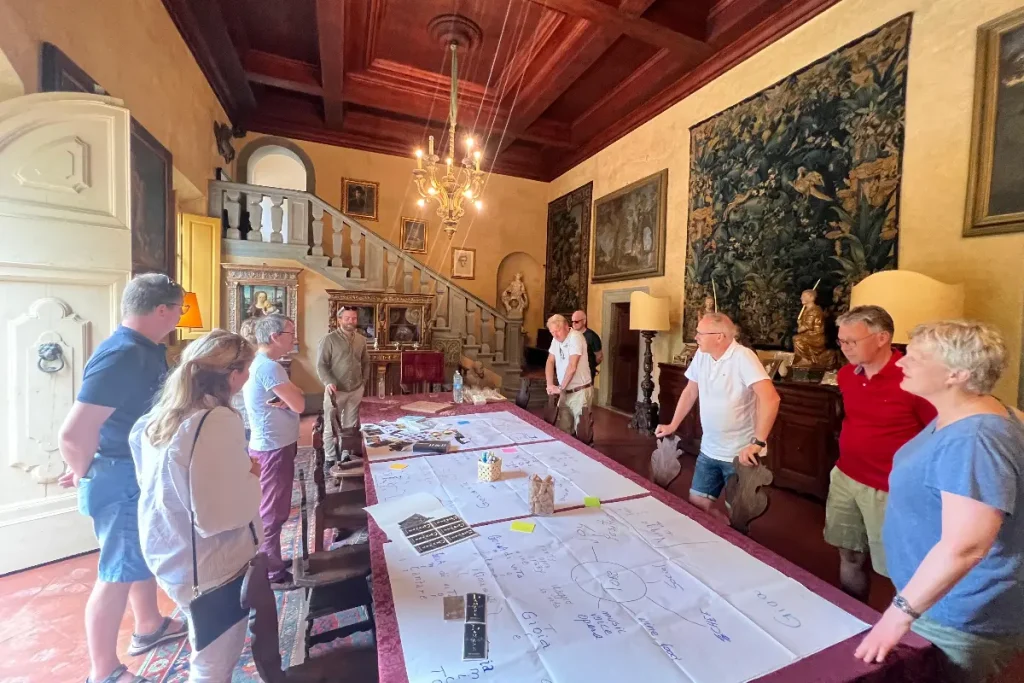
In the label workshop, what I do is give an initial input to kick-start the creative process. Often, these are managers, executives, professionals who have great mental capacity but not always a creative background. And yet, creativity also serves to free the mind from Excel sheets and numbers. Every journey is personalized. After an initial brainstorming session, we give them blank sheets, markers, colored post-it notes… and they start drawing! Sometimes, truly unique projects emerge, to the point where I ask myself: “And now how do I render this graphically?” This is why I ask to record videos where they explain the meaning of the label, and then I handle the graphic design, sometimes with the help of professionals for printing and special finishes. In some cases, however, professional graphics are not needed: as in the most recent project, where we deliberately left the original drawing made by the participants. Behind that drawing of a childlike bird, there was a deep meaning, just as there was behind another image depicting a clock: time passing, but also remaining a child in some way. Every label has its reason.
What are the operational steps of the experience, from the moment the barrique is adopted to the receipt of the personalized bottles? Once you purchase the barrique, you are not just buying wine: you are buying an experience.
It can even last for two years if you choose the long journey. You buy the wine as it ages, and your barrique will then be used to create a blend, which you can choose from our suggestions or create as a custom blend. With the long project, you can participate in the harvest, receive personalized videos of the work being done on your barrique, and visit the winery… The barrique bears your name or your company’s logo. And you can stay at our agriturismo with special rates. You can also involve friends, form a group, come to the winery for a full week of experiences: dinner in the vineyard, a Vespa or quad tour, or a Defender tour through the vineyards, a terracotta workshop with a master artisan from Impruneta… Every day I add a piece to a custom-designed puzzle to make the experience truly unforgettable.
In an era dominated by mass-produced and standardized products, “Adopt your Barrique” focuses on 360-degree personalization: materials, colors, reliefs, engravings… but are there any rules or suggestions to avoid getting lost in the choices? How do you guide clients in creating something truly authentic?
We find it hard to set limits. Sometimes they tell me: “Giulia, stop!” Because I am a volcano of ideas and every project takes a different shape. Let me give you an example: in our latest project, the participants created five labels so beautiful that we couldn’t choose just one. So we produced wooden cases of five bottles, each with one of the labels. That’s 300 bottles hand-labeled one by one, which can be shipped anywhere in the world to the chosen recipient in personalized wooden cases. When the client is involved and asks for customizations, you get so deep into the project that saying “no” becomes impossible. Because, in the end, this is what we want: to make every experience unique.
Who chooses to adopt a barrique? Is it mostly an international audience, wine enthusiasts, companies, couples? Or does this project have the power to unite very different worlds?
Every project is different. I can’t standardize them, which is why, for the moment, I find it difficult to make it an online-purchasable product. There’s the lady who comes with her husband but prefers to go shopping with a friend while he works on the label with his friends. There are elementary school children who visit our olive mill and create their own oil label. In that case, they don’t adopt a barrique, but they still have a personalized experience. The project is truly cross-cutting: it ranges from managers to children. Anyone who wants to feel part of a world—the world of wine—can do it their own way, with something of their own, not defined by others.
The project has also involved young people and schools. What did you learn from that first experience? Was there anything that surprised you in their drawings or in the way they experienced the initiative?
Let me mention three experiences that struck me deeply. The first: elementary school children who arrive enthusiastically at the olive mill, stand in awe before the machinery, go back to school, and send me drawings with a sentence on the back. Those sentences, even though I’m 39, always touch me. Another experience: a group created a label in memory of a loved one, with the son present. An incredibly emotional label was born, about the transition from father to son. Then there’s another project we developed with some young people divided into five groups; each created its own interpretation of the logo. This shows how important it is for every individual—even within the same team—to pursue their own vision. In the end, however, everyone comes together around a common product. In this case, wine.
Another important customization option is the client’s ability to choose the blend that will go into their bottles. I imagine there are knowledgeable people who have a clear goal in mind and others who are less so. From an oenological perspective, how do you manage this phase? How do you intervene or advise the client?
We start with a tasting of our wines. It’s a sort of mini-course that explains what blends are, how they are constructed, and what our proposals are. We recommend our classic blend—Sangiovese, Cabernet Sauvignon, and Syrah—because it has received high scores and performs well in the bottle. But if the client has a different taste, for example, a preference for Petit Verdot, we work together to build their blend using the grape varieties we have available. We also have them taste the single-varietal wines, so they can combine them consciously and create a truly tailor-made product.
This approach of personalization and customization demands an energy, creativity, and personal and professional investment that transcends winemaking, which is already very demanding on its own. How do you personally manage this extra commitment?
Diadema is not just wine and doesn’t want to be. I manage this project with great commitment, and yes, with effort, because let’s be honest, it would be much simpler to sell a “finished,” ready-made bottle. But from us, you also buy emotion, and every label has a purpose, a meaning. If they ask me, “Let’s make a new label?” and I’m in the right moment, I’ll go for it and do it. But if I don’t have the inspiration, I wait. Creativity cannot be activated on command. Then, of course, when it starts… it really starts. But you need that initial moment, that spark. And then, yes, new projects are born, always different, always unique.
Key points
- Challenging standardization by offering a deeply personal, tailor-made wine creation experience.
- The experience includes a creative workshop for label design and choosing a custom wine blend.
- Human connection and emotional memory are fundamental, making each bottle a unique story.
- The project is transversal, appealing to everyone from corporate managers to children.