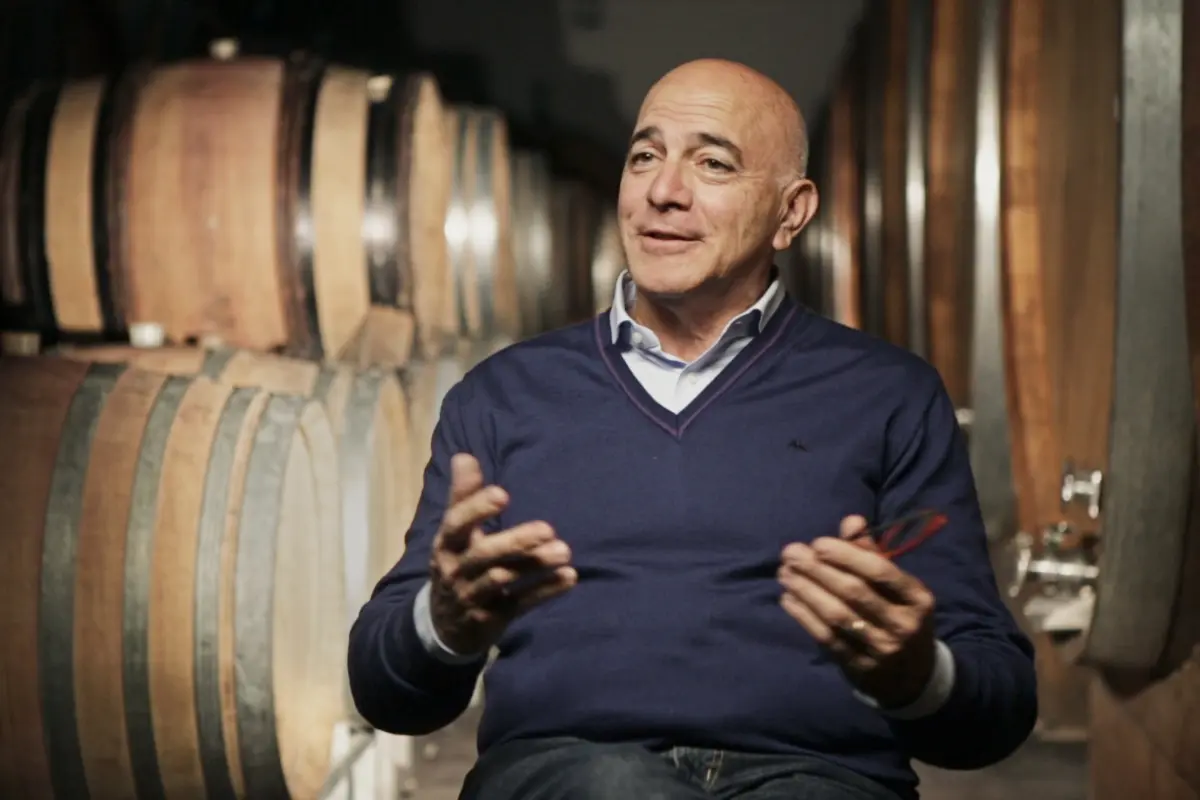
Aldo Vaira, owner of G.D. Vajra, shares his vision of wine tourism as an act of friendship and mutual respect, not just a business transaction. He discusses facing global challenges like U.S. tariffs by strengthening human relationships and prioritizing quality. Vaira advocates for an authentic hospitality model that preserves the soul of the winery.
Opening a winery doesn’t just mean welcoming visitors: it means opening your home, your story, your soul. In this interview, Aldo Vaira, owner of the G.D. Vajra winery, guides us on a journey that goes beyond wine. He speaks of hospitality as an act of trust, of exports as a pact of friendship, and of wine tourism that must be preserved in its authenticity. Faced with global challenges like potential U.S. tariffs and the changing landscape of European trade fairs, Vaira strongly defends the importance of real relationships, of quality before quantity, and of loyalty to principles that withstand market storms. A lucid and passionate vision that gives wine back its deepest value: that of a human bond that crosses borders.
The idea of opening wineries to attract more consumers is shared by many, especially to appeal to young people. However, “it’s easier said than done,” and few wineries are open on weekends or consistently offer aperitifs or events. Is it a concrete difficulty for wineries, especially small to medium-sized ones, to manage weekend hospitality, or are the real problems different? What are your thoughts?
First of all, opening the winery is like opening the door to your home: you let friends into your home. Those who wish to visit us must be friends of wine, not someone who lacks respect or approaches it superficially. It’s a matter of fundamental education for us. We are fortunate that our winery is isolated from the town: we are in a hamlet, about three kilometers from Barolo. This acts as an excellent natural filter, because those who reach us do so with a genuine desire to get to know our reality. Furthermore, we have introduced mandatory reservations and a small fee: this is to guarantee visitors a quality welcome, with air conditioning in summer, heating in winter, and washed and sterilized glasses. But above all, the reservation is another important filter. It pains me when, for example, a table is reserved at a restaurant and the customers don’t show up: it’s a lack of respect that we want to avoid.x
Trump has frozen tariffs on EU goods for now, but the problem will reappear starting next July 9th. How much does exporting to the USA weigh on your company in terms of value and volume, and what strategies do you intend to adopt in this situation?
The customer is always at the center of all our work. Every activity in the vineyard, in the cellar, every choice we make has the ultimate goal of giving the customer the opportunity to consume our wine. We have always tried to maintain fair prices to allow a wide audience to access our wines. When the issue of U.S. tariffs emerged, our first thought went to our customers and the friends who support us. It was a very hectic time: we personally contacted our 17 American importers. Some anticipated us by blocking orders. In the United States, between importation and final consumption, wine goes through at least three commercial steps, and each step amplifies the cost: a 20% tariff easily translates into a 30-50% increase for the final consumer. We chose to take the risk of the tariffs ourselves: we did not stop shipments, we sent a couple of containers anyway. Fortunately, the feared 200% tariffs were reduced to 20% and then frozen. For us, the United States remains a country of friends: our relationship goes beyond commerce, based on friendship and trust.
Looking at the glass half full, is it possible that these potential tariffs might force us to get closer to the BRICS countries and accelerate the entry into force of the free trade agreement between the EU and Mercosur, breaking some of the certainties the sector has relied on for many years?
We have always sought diversification, even when it was not a pressing need. We export all over the world, and for some time we have been looking with interest at markets like Brazil and India. We also have a history of small exports to symbolic countries: thirty years ago we sent a few cases to Lebanon, and today, for example, we are missing Turkey, which has made trade too complicated due to taxation. I hope that we will not be forced to shift our commercial efforts solely for reasons of necessity, such as a possible closure of the American market. Our U.S. customers are part of our history, a relationship built over more than 40 years, so much so that when our children travel, they don’t just visit America, they go to visit family friends. Originally, we focused on exports because the Italian market was too fragmented and lacked a suitable national distribution for us. So being close to our customers has always been our priority.
In your opinion, could these possible Trump tariffs, which might reappear from next July 9th, also have an impact on wine tourism, or will they not affect it?
They could have an impact, certainly. I hope, however, that wine tourism does not become a fallback. Our hills are beautiful when they are frequented by people of different cultures, when different languages are spoken. I return to the initial concept: civic education is necessary. We cannot accept situations where a group books a visit for 6:30-7:00 PM just to find a place to stay warm or cool while waiting for the restaurant across the street to open. This is not wine tourism; it is a lack of respect.
What do you think about the future of the European trade fair system and also about this succession of events (ProWein, Wine Paris, and Vinitaly) which are quite demanding from a logistical and economic point of view and in such a short period of time?
This year we were present at all three major European fairs: Wine Paris, ProWein, and Vinitaly. Once, Düsseldorf was the perfect logistical alternative to Verona: convenient parking, wide highways, a nearby airport. Now Paris has inserted itself forcefully but intelligently, offering a different and interesting proposal. Düsseldorf has lost its appeal, although it remains more convenient for some countries. It is clear that we are in a transitional phase: probably, we will go from three fairs to two. Despite everything, as long as we can, we will continue to participate in Vinitaly. We are grateful to Veronafiere for what it has done over the years. The fair retains its charm: it is an opportunity for authentic human encounters, like that recent company dinner where we shared a table with Koreans, Chinese, Indians, Russians, Americans, and Canadians. Moments of true unity: this is the spirit that wine must continue to convey.
Key points
- Winery hospitality must be based on respect and genuine interest.
- True customer relationships are a buffer against market volatility.
- Market diversification should be a proactive, not reactive, strategy.
- Authentic wine tourism thrives on cultural exchange and education.
- The human connection remains the most valuable asset in the wine world.