Following a debate on the “dinosaurs of wine media,” a young professional, Niki Jooyani, highlights successful specialized foreign models. The author agrees but argues these serve an expert audience. The real challenge is hybridizing these models to create an inclusive language capable of attracting new, younger consumers.
My recent speech at the Alta Scuola Sanguis Jovis and the subsequent editorial on the “dinosaurs of wine media” have ignited a debate that I consider not only useful, but vital. The reflection aimed to highlight the stagnation of an often self-referential information system, incapable of speaking to the present and, above all, to the future. The response from Nikan (Niki) Jooyani – maître/sommelier at NOI Osteria Contemporanea in Modena and training with the Court of Master Sommeliers – a young and brilliant professional who attended that lecture, was not a simple comment, but a precious contribution that enriches and, in some ways, complicates the picture, forcing us to ask even deeper questions.
Niki is right. Her calm yet sharp intervention hits a nerve: while we in Italy discuss the crisis, alternative models already exist, and they work. She cites examples like GuildSomm, a reference for those who, like her, are studying for the Court of Master Sommeliers, or figures like Jasper Morris MW and Jane Anson, who have transformed wine communication into a vertical, specialized, and authoritative narrative. These “authors” do not offer general overviews, but deep dives into specific territories, building a trust that rankings and scores, often perceived as opaque, have partly eroded.
Her analysis is impeccable when she points out that passion today is driven by areas and by authors, no longer by publications. And she hits the mark when highlighting the communicative effectiveness of professionals like Konstantin Baum MW or Stefan Neumann MS, who are capable of acting as a true cultural bridge between producer and consumer. They are, today, the new storytellers who combine depth and accessibility, often through channels like YouTube, considered “new media” only by those stuck in a twentieth-century vision.
However, while I agree with every word she says, her analysis opens up a subsequent challenge, perhaps the most complex one. The models Niki cites, however excellent, are aimed at an already motivated audience, a community of enthusiasts, students, and professionals who have already begun a journey of in-depth study. We have numerous examples of this in Italy too, which I won’t name so as not to wrong anyone. They are also the perfect answer for those who are “hungry for knowledge.” But what about those who don’t even know they are hungry? How do we build a format and a language capable of speaking to a broader target, to those new and young consumers who are currently marginalized by a communication that doesn’t concern them?
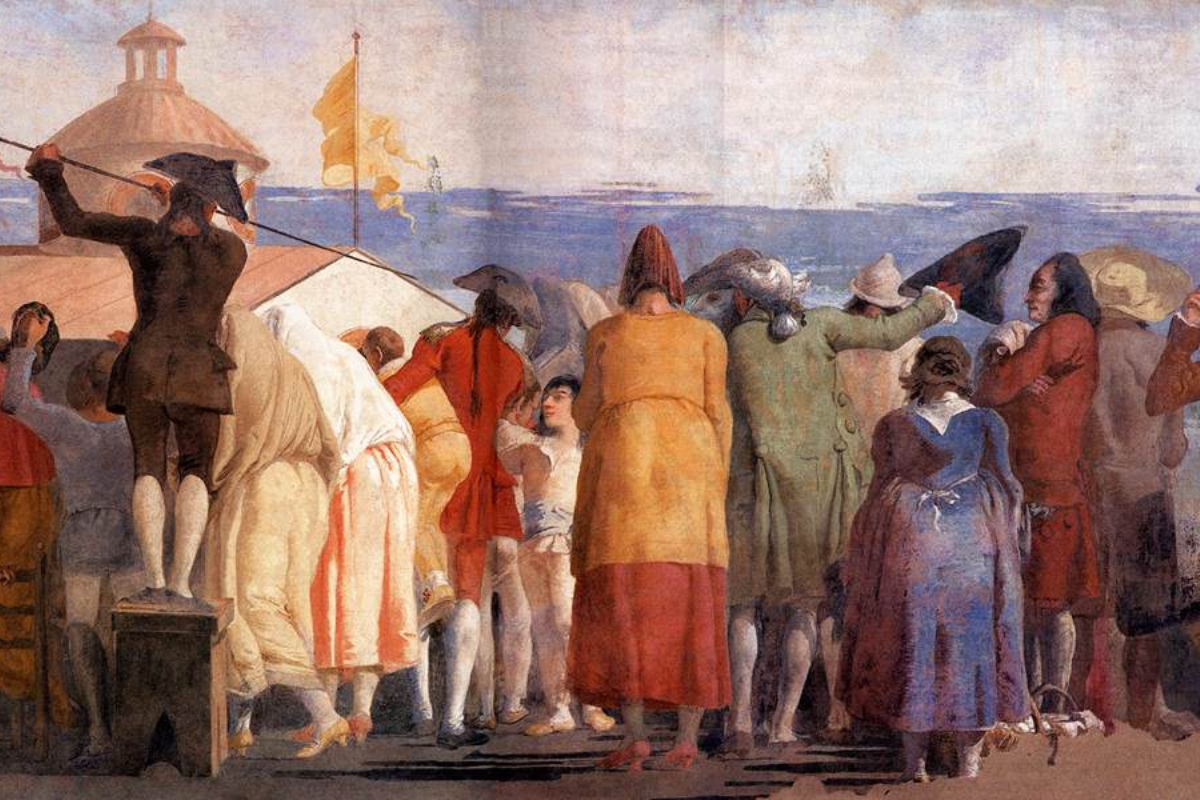
The metaphor from Professor Attilio Scienza, cited by Niki, is illuminating: the new generation experiences reality “through a window,” in a state of distance, but little immersion.
In this regard, the brilliant Prof. Scienza, also during a lesson at Sanguis Jovis, used the image of Il Mondo Novo (The New World) by Giandomenico Tiepolo. Looking at that work today opens up a truly profound reflection: the distant observation, the group that watches but does not participate, the scene that remains off-camera… it all speaks to our relationship with wine and communication as well.
Specialized models are perfect for those who have already gotten out of the car and started exploring on foot. Our true mission, today, is to create something that entices people to pull over, turn off the engine, and get out.
The solution, perhaps, lies not in simply adopting foreign models, but in hybridizing them. We must learn from their depth and independence, but at the same time find a linguistic and emotional code that can be inclusive. Wine must once again become a pretext for talking about other things: travel, landscapes, sustainability, history, and the future.
Niki raises another crucial theme: the disconnect between technical training and communication culture. How many young oenologists, after years of studying soils and vine diseases, feel ready to talk about and sell the wine they will produce? Her provocation is a heavy one: “if I had shared my experiences, would it have been useful for them? Or would they have been bored?”. I fear I know the answer. This is where the system must intervene, integrating modules dedicated not just to marketing, but to storytelling, empathy, and listening to the consumer into training programs, from universities to sommelier schools (whose isolation from figures like Master Sommeliers is a serious cultural gap).
Making wine is one of the most beautiful things in the world, as Niki says. But today, perhaps more than ever, the challenge is not just producing it, but knowing how to enhance its value. The answers, as she suggests, partly already exist. Our responsibility, as communication operators, is to know how to welcome them, adapt them, and, above all, translate them into a language that is not for a select few, but for everyone who, in front of a glass of wine, is simply looking for a good story.
Key points
- The Italian wine media system is often stagnant and self-referential.
- Successful foreign models (e.g., GuildSomm) focus on specialized, author-driven content.
- These specialized models fail to reach the disengaged younger generation.
- The solution requires hybridizing depth with an inclusive, emotional language.
- Technical wine education must integrate modern storytelling and communication skills.