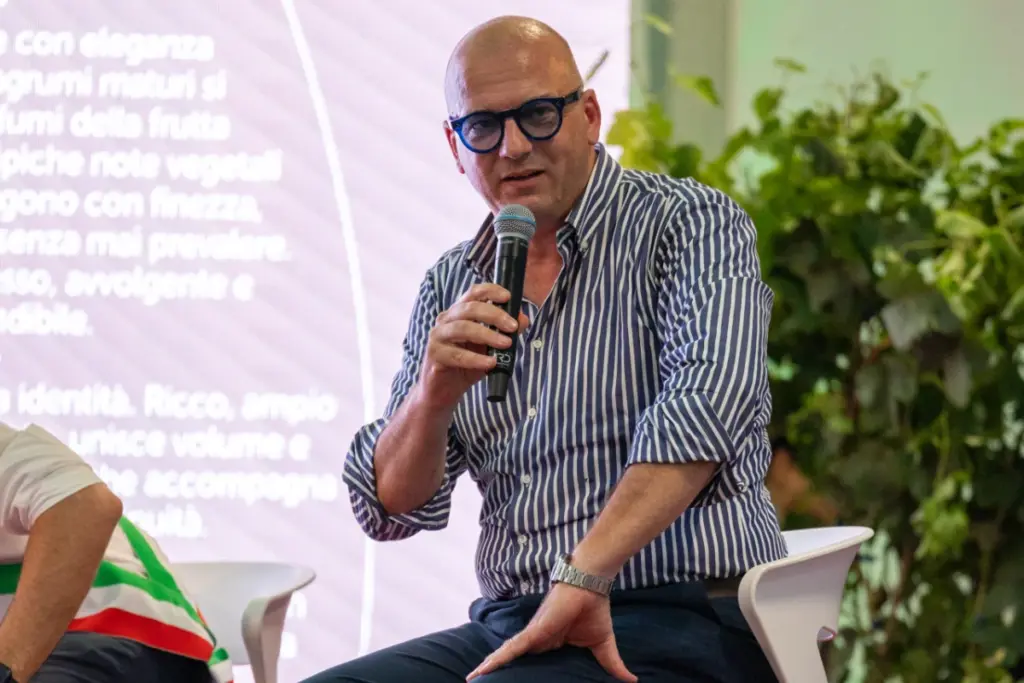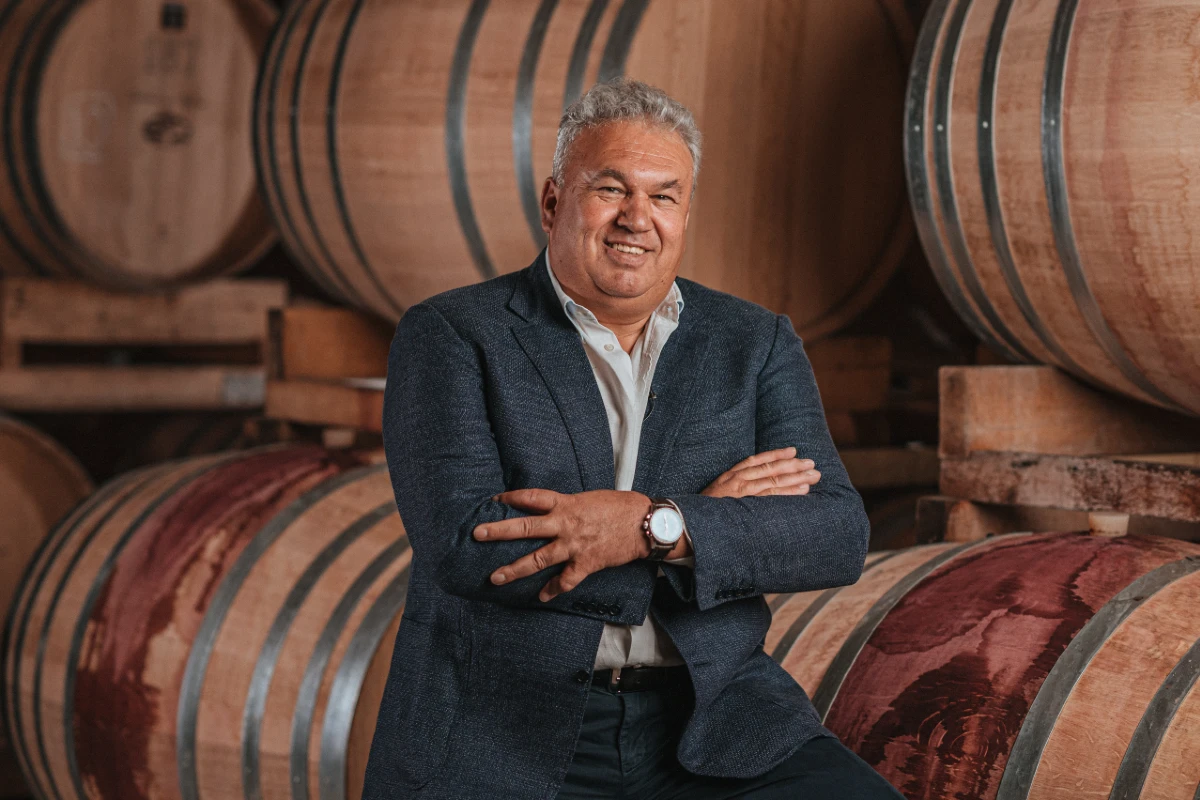
Armando Castagnedi discusses how SCAIA emerged as Tenuta Sant’Antonio’s innovative response to market demands, utilizing IGT freedom to create accessible, contemporary wines. The project showcases risky packaging choices like glass stoppers, unexpected grape blends, and a clear strategy targeting international consumers while allowing the main estate line to focus on traditional territorial expression.
How can a winery with a historic name, deeply tied to the sacred traditions of the Soave and Valpolicella denominations, give life to a project that skillfully and intelligently challenges their conventions? The answer lies in the story of SCAIA and in the words of Armando Castagnedi, co-owner of Tenuta Sant’Antonio, who in this conversation reveals himself not only as a man of wine, but as a lucid strategist with a clear vision of the global market.
The interview reveals how SCAIA was not simply born as a “young” line to chase a trend, but from a precise enological need and an acute reading of the modern consumer. Castagnedi takes us behind the scenes of a stylistic gamble, explaining how the freedom of an IGT became the winery’s creative laboratory, fertile ground for experimenting and engaging with an international audience. The dual and synergistic soul of the winery emerges strongly: on one side SCAIA, with its immediate language, freshness, and iconic glass stopper, exploring new horizons of taste; on the other Tenuta Sant’Antonio, which, thanks to the freedom granted by this parallel project, can dedicate itself with even more rigor and passion to the extreme enhancement of terroir, the rediscovery of roots, and the purest expression of its vineyards.
What follows is therefore not just the chronicle of a commercial success, but a profound reflection on identity, on the courage to innovate without betraying one’s origins, and on the ability to create two distinct but complementary paths, in perfect balance between territorial recognition and universal appeal.
SCAIA was born as a stylistic break from the classic production of Tenuta Sant’Antonio. Beyond the commercial objective of reaching a younger audience, what was the creative spark or “enological” necessity that prompted you to say: “Now we must create something completely different?”
The decision to create SCAIA, whose first vintage dates back to 2006, initially arose from the need to enhance our white grapes. Being deeply connected to the Soave territory, where we were born and raised, we have always believed in this denomination. However, the market and our own collaborators were pushing us to create something different, a wine that could capture the tastes of those who were not regular Soave drinkers. They told us: “You’re good at making wine, why don’t you think about a different blend?”
At that time, the market didn’t offer many alternatives. Certainly, there was the example of Anselmi, who had left the Soave DOC creating an autonomous path, and this had generated debate among producers. However, we never thought about abandoning Soave; it’s part of our history and our territory. In fact, today more than ever, we are investing in the enhancement of sub-zones, the Additional Geographic Units (UGA), like Monte di Colognola. We are convinced that the future lies in territorial specificity.
However, we were aware that not all markets are the same. In Japan, for example, a market culturally closer to wine for longer, historic denominations are sold: Soave, Valpolicella, Chianti. In other markets, like China or Europe itself, the consumer is more open: they taste a wine, if they like it and the price is right, they buy it, regardless of the DOC. We had intercepted the need for a product that could appeal to a broader and more dynamic clientele, including those who, twenty years ago, still harbored prejudices toward Soave or Valpolicella, remembering past experiences of low quality.
This is how the SCAIA project was born, a wine with a different image. We discovered this bottle with the glass stopper, then an absolute novelty, and we decided to experiment. The impact was surprising, both for the packaging and for the wine itself. Working outside a DOC, as IGT, gave us greater expressive freedom. A production regulation imposes precise rules on residual sugar, acidity, extracts. With an IGT, while maintaining high quality standards, we have freer hands to create a wine that comes closer to the taste of a less expert consumer, who is simply looking for a pleasant glass of wine.
The name SCAIA derives from the limestone “scaglia” typical of our soils, especially in Valpolicella. It’s a short name, easy to pronounce and remember. And so, year after year, the line has grown. The Rosato was born at customers’ request. My brother Paolo Castagnedi, the winemaker, made separate trials with Corvina, Corvinone, and Rondinella. The Corvinone was more rustic, the Corvina expressed notes of cherry and small fruits, approaching Bardolino Chiaretto. The Rondinella, however, surprised us with its floral notes of rose and violet. We therefore decided to create a rosé mainly from Rondinella, an unusual choice, to which we then added Corvina, the prince grape of Valpolicella. SCAIA is therefore a line born from our grapes, the same ones we use for DOCs, but interpreted differently.
You chose to include a Blanc de Blancs Brut sparkling wine in the SCAIA line. Not a Metodo Classico, often associated with grand celebrations, but a Metodo Martinotti. This choice reaffirms SCAIA’s accessible and modern soul. How did you work to give this sparkling wine a complexity and identity that would distinguish it in the vast landscape of Charmat, using a pairing of grapes like Garganega and Chardonnay?
They had been asking us for a long time, already six or seven years ago, when the sparkling wine market was in full expansion. To be honest, we never considered ourselves “spumantisti” (sparkling wine makers), it’s a world we’re approaching gradually, after years of trials and small experiments. Today the market is dominated by Prosecco, therefore by Glera, a grape with a predominantly floral expression. We have two varieties that, in my opinion, lend themselves very well: Garganega, which in some ways is not so distant from Glera and which on volcanic soils develops interesting mineral notes, and Chardonnay, which brings a fruity component.
A “serious” Prosecco producer would turn up their nose at notes of ripe fruit, because they could weigh down the bubble. We, on the other hand, believe that this blend creates an interesting and different result. A 100% Garganega sparkling wine would be more austere and mineral. Chardonnay, if harvested at the right time to preserve its acidity, manages to create a pleasant contrast with the citrus and green apple notes of Garganega.
We don’t have the ambition to become great sparkling wine producers; our heart remains with still wine. The sparkling wine was an addition, a response to market demand. We could have chosen Metodo Classico, but we have deep respect for those who produce it with mastery and didn’t feel we had the necessary experience. The Metodo Martinotti, or Charmat, is much more in line with SCAIA’s philosophy: a fresh, immediate, accessible product. A SCAIA Metodo Classico, in my opinion, would have been contradictory.
Can we consider SCAIA your innovation laboratory? Is this where you experiment with varieties, techniques, and styles that one day might also influence the main Tenuta Sant’Antonio line, or are the two brands destined to follow parallel paths forever?
They are destined to follow parallel paths, increasingly defined and distinct. The more time passes, and perhaps age plays a role, the more we feel the need to have products in the Tenuta Sant’Antonio line that are the maximum expression of the territory. For example, we have three Valpolicellas: a young one, a Ripasso, and a Superiore. Until a few years ago, we didn’t produce the young Valpolicella. Then, thanks also to my experience in foreign markets, I came to the conviction that it’s essential to have wines that clearly identify our origin.
SCAIA targets a category of consumers, perhaps very broad, who seek a pleasant wine without too many complications. But it’s often from there that the curiosity to discover more is born, to understand the differences. And then one appreciates the minerality of a Soave, which we try to enhance with meticulous work in the vineyard and cellar. The same goes for Valpolicellas. We deliberately “downgraded” our previous Superiore to base Valpolicella, completely transforming its style to recreate the origins of this wine.
I remember that forty years ago Valpolicella was a light wine. Then, driven by market demands, we all started producing more structured wines. Today, especially among young people and in markets accustomed to wines like French Pinot Noir or Beaujolais, there’s a rediscovery of fresh and easy-drinking wines. And we have varieties like Corvina and Rondinella that are perfect for this style. SCAIA has allowed us to dedicate ourselves with even more attention to this research on the territorial identity of our wines.
The market today no longer knows the low-quality Valpolicella of the past. It’s an open prairie, a fantastic opportunity to present a new conception of Valpolicella, which is actually a rediscovery of its roots. A wine that can elegantly compete with other great international light red wines.
You also mentioned your activity in foreign markets, SCAIA has recorded significant export growth. What are the foreign markets where the brand has surprised most with its success? And where would you like to expand your presence most?
It may seem strange, but we’ve had the greatest success here in Europe, especially in Germany and Northern Europe. These are markets very attentive to quality-price ratio, which in the past may have approached wines of mediocre quality. The European consumer travels a lot, knows Italy, has learned to drink better and recognize quality. Even though Germany is historically considered a market that doesn’t want to spend, if the consumer recognizes the value of a product, they’re willing to pay for it. And this has been a pleasant surprise.
We struggle more in other markets, like Asia, where the importer may be more reluctant to invest in an IGT wine, preferring the security of a known DOC like Soave. Asia, however, represents a market with enormous potential for SCAIA. The Asian consumer, not having a long history of wine consumption, could be approached more easily by a fresh, aromatic, and fruity product like ours. SCAIA could be a perfect “gateway” to the world of wine. We must overcome the initial hurdle, supporting our partners to break the ice.
Even in the United States and Canada we’ve had success beyond expectations. The North American consumer is now evolved, the United States has become a major producing country and where there’s production, there’s wine culture. Moreover, unlike Italy where predominantly Italian wine is consumed, abroad there’s a vast offer of wines from all over the world, and this helps form a more curious and open consumer. We’re also observing with great interest the growth of Eastern Europe: markets like Poland, Romania, and the former Yugoslav countries show a great desire to know and appreciate new products.
The SCAIA line’s image is iconic: the clean label, strong visual communication, the glass stopper. Was there ever fear that such a modern image could diminish the perception of wine quality inside?
Yes, there was fear, indeed. At the beginning, we presented SCAIA to our customers as an experiment, telling them we were ready to change if the impact wasn’t positive. The alternatives to cork were the screw-cap, which twenty years ago in Italy and Germany was still viewed with suspicion, or the silicone stopper, which however gave a very “cheap” image. The glass stopper was different, special, gave a touch of class.
The market reaction was incredible. We had customers telling us: “This wine sells just for the glass stopper!” We received photos from customers who reused the stoppers to create designs, hearts, to tell us how much they loved the wine. So, the risk we had taken turned into a strength.
We had a difficult moment during the inflationary crisis of 2020-21, when the cost of glass skyrocketed. A screw cap would have cost half as much, but we held firm. SCAIA’s image was now too tied to that stopper to be able to go back. And the choice paid off, so much so that customers started asking us for the glass stopper even for the young wines of the Sant’Antonio line, like Valpolicella and Soave Monte Ceriani. It’s practical, convenient, and now recognized as a seal of quality and modernity.
Do you have a precise profile of the typical SCAIA consumer? Has it changed over time?
We started with the idea of targeting a younger, international consumer, open to new experiences. In reality, over time we discovered that SCAIA appeals to a much more heterogeneous audience. I happen to meet professionals, lawyers, doctors, who tell me: “At home we drink little, but we like to drink well,” and then they buy a case of SCAIA. This demonstrates that the perception of quality is subjective, it’s linked to what one likes.
One of our importers in Holland told me he brought SCAIA to an event at his golf club, thinking it was a wine more suitable for a female audience. Instead, he received compliments from everyone. He told me: “SCAIA is a wine for everybody.” I believe it only doesn’t appeal to those who don’t like aromatic and fruity wines, because that’s its stylistic signature.
SCAIA doesn’t want to be an “important” wine, but it positions itself with personality in a very broad consumption range. They are versatile wines, suitable for drinking at any time. Unlike us Italians, who tend to pair wine with food, abroad people drink a glass of wine even at eleven in the morning or three in the afternoon. For these occasions you need a round, pleasant, fragrant product, but not banal. A simple wine, but with character.
SCAIA speaks an international language but is a full expression of a specific terroir. What is the biggest challenge in positioning this line of IGT wines (which don’t benefit from the recognition of a DOC), in an increasingly crowded and competitive global market?
Our winning card is the quality-price ratio. When we compare ourselves with a Sauvignon from the Loire or New Zealand, wines with a similar aromatic profile, we are competitive. The consumer who tries a bottle of SCAIA appreciates it and, without needing great explanations, comes back to buy it because they understand that the quality is comparable to that of other more prestigious wines, but at a lower cost.
We haven’t discovered hot water. Producing a DOC has higher costs, related to lower yields per hectare and more stringent production rules. With IGTs we have more freedom and this allows us to be more competitive. Certainly, today the market is crowded, but we’ve been working on this project for almost twenty years, refining and improving it constantly. We’ve developed over time the idea of Corvina, the rosato, the Paradiso (obtained from slightly dried grapes), but always maintaining freshness, elegance, and drinkability as the common thread. This is the essence of SCAIA.
Key points
- SCAIA launched in 2006 as an IGT line to reach consumers beyond traditional Soave and Valpolicella drinkers
- The iconic glass stopper and modern packaging became SCAIA’s distinctive signature, driving consumer recognition
- IGT classification provides creative freedom to produce approachable, fruity wines without DOC restrictions
- Europe, especially Germany, emerged as SCAIA’s strongest market due to quality-price ratio appreciation
- The two brands follow parallel paths: SCAIA for accessibility, Tenuta Sant’Antonio for terroir expression