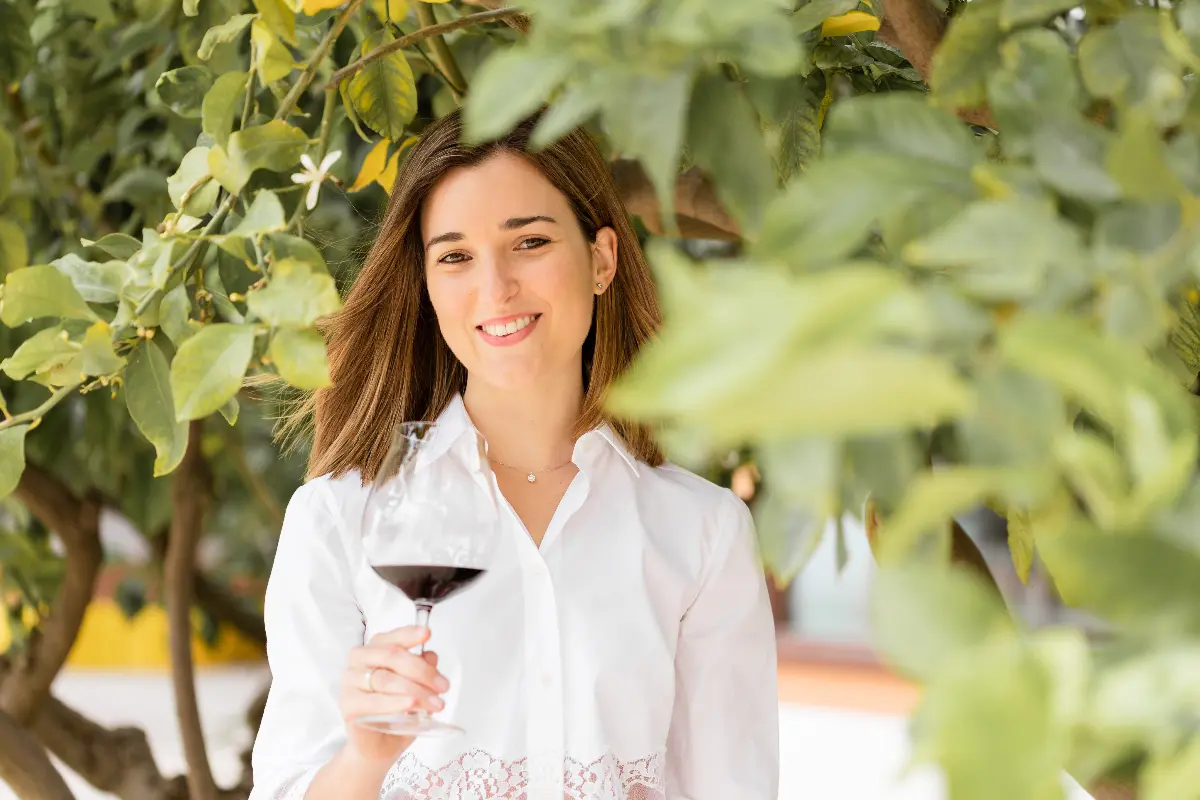
Gabriella Favara, representing Donnafugata’s sixth generation, outlines a strategic vision balancing heritage with disruptive innovation. She discusses the “The Leopard” Netflix partnership, expansion into emerging markets, and shifting wine narration from luxury to authenticity. Her approach prioritizes human capital and dialogue to connect with the next generation of consumers while maintaining the brand’s core identity.
Picking up a legacy like Donnafugata’s is not a finish line, but a starting point laden with responsibility and vision. It means guarding a global success story while having the courage to write its next chapter. This is the challenge that Gabriella Favara, Export Marketing Manager and representative of the family business’s new generation, faces every day.
In this exclusive interview for Amorim Wine Vision, the thought network acting as a catalyst for ideas in the wine sector, we explore with her one of the most strategic and delicate themes for the future of Italian wine: generational turnover. Through her words, a portrait emerges of a new leadership that manages the legacy of an iconic brand not with the fear of making mistakes, but with the awareness of being able to bring unique added value, speaking the same language as the consumers of today and tomorrow.
Gabriella Favara’s analysis is a lucid exercise in balance: between respect for “untouchable dogmas” like quality and human capital, and the push towards “disruptive but coherent” innovation, such as the pioneering collaboration with Netflix. From betting on new emerging markets to the need to shift the narrative of wine from luxury to authenticity, up to the challenge of communicating the “heroic slowness” of Pantelleria to a generation used to the immediacy of social media, her reflections offer a genuine and profound perspective on what it means to lead a wine business in the twenty-first century. A dialogue that perfectly embodies the mission of Amorim Wine Vision: sharing experiences and know-how to illuminate the path awaiting the entire sector.
Often we speak of “innovating with respect for tradition.” But was there a proposal of rupture, perhaps in marketing or strategy, that you brought to the table to overcome a more consolidated approach of the previous generation?
I represent the sixth generation of Donnafugata, a company founded by my grandparents, Giacomo and Gabriella, and today led by my mother José and my uncle Antonio. I followed a path designed to enrich me professionally before making my entry into the company three years ago. After studying Economics in Milan and a Master’s in England, I worked in two large family businesses in the food industry. I believe strongly in cross-pollination between sectors, and I wanted to learn from other contexts to bring something new and of my own.
When I “knocked on Donnafugata’s door” three years ago, I was welcomed with great enthusiasm. My first assignment was in wine tourism, an area that allowed me to immediately get in touch with our territories and the wine lovers who visit us. I found a family and corporate context based on listening and discussion, which greatly facilitated my integration.
My previous experiences in larger companies helped me to bring innovation to processes and working methods. I pushed for greater structuring, introducing periodic meetings to foster dialogue and collaboration between different corporate areas and within individual teams. The goal is to evolve Donnafugata into a company where, while maintaining our family soul, all areas constantly talk to each other.
This approach to dialogue is reflected in the projects we carry out. A special example from this year is the collaboration with the Netflix series “The Leopard” (Il Gattopardo). Donnafugata is, by nature, outside the box: it was so in the choice of name, different from the family name, and in entrusting our labels to an art illustrator. This partnership with Netflix marks a further step in this direction. Despite an initial fear, because it was an unprecedented initiative in the world of wine, my mother and uncle grasped the great opportunity to dialogue with a younger target audience not necessarily expert in wine. We thus dedicated a special edition of our “Mille e una Notte” to the series. This is an innovative project where I feel I played a part, demonstrating how my generation, through language and habits, can provide added value in approaching new consumers.
Your predecessors were pioneers, taking significant risks to create Donnafugata. Today, what is the biggest “calculated risk” that your generation must take?
I would identify two main areas on which to take risks. The first concerns geographic expansion. Handling export marketing, I see that today our main investments are rightly focused on mature and consolidated markets like the United States, Germany, Switzerland, and Japan. The calculated risk we must take is to bet decisively on new emerging consumption areas, such as Southeast Asia, South America, and, one day, Africa. It is not just about keeping them in consideration, but about allocating targeted marketing investments to enter these markets in a structured way. It is a risk because the return is not as certain as in traditional markets, but it is a strategic opportunity for the future.
The second risk is linked to storytelling. For too long, wine has been narrated almost exclusively as a luxury product, a positioning that risks alienating new generations. The challenge is to change this narrative, focusing on values like identity, authenticity, and sustainability, which are much closer to the sensibilities of young people. We must succeed in communicating the great quality of wine through the values it represents, making it an aspirational product but accessible in the principles it embodies.
In this process of evolution, is there a unique value, a teaching, or an operational principle of the founders’ generation that you consider an “untouchable dogma,” a pillar you would never question even in the face of the most tempting market opportunities?
There are three pillars that I consider untouchable: quality, human capital, and identity coherence. Quality was the turning point impressed by my grandparents on Sicilian viticulture: reducing yields per hectare to prioritize excellence over quantity. This is a non-negotiable principle. Quality is never sacrificed, even in the face of great commercial opportunities, because it is what guarantees consumer trust and loyalty over time.
Human capital is fundamental. Respect for people and the territory is a direct legacy of my grandfather Giacomo, who had a deep bond with every collaborator. In a sector where human labor is still essential, the passion and involvement of the people who make up the Donnafugata family make the difference. This has enormous value that cannot be called into question.
Finally, identity coherence. Being innovative and “disruptive” is part of our DNA, but every action must remain faithful to who we are. The collaborations we have undertaken, like the one with Netflix for “The Leopard” or the one with Dolce & Gabbana, might seem bold, but they are profoundly coherent. The former links to the literary origins of our name and our main estate; the latter celebrates the love for “Made in Sicily,” for our traditions and our colors. In both cases, the common thread is the link with art, a cornerstone of our philosophy. We have been disruptive, but always true to ourselves.
Donnafugata is also the heroism of Pantelleria. How do you translate and communicate such a profound value, made of fatigue and slowness, to a generation of consumers like Gen Z, accustomed to instant, visual, and often ephemeral communication like that of social media?
Pantelleria is a place I love deeply because it projects you into another dimension. It is an island that, with its volcanic energy and wild nature, reconnects you to ancient values: care for the land, slowness, respect for nature’s rhythms. It is a regenerating experience. Our mission, through wines like Ben Ryé, is to transfer these values, which in today’s frenetic life we tend to forget.
To do this, we follow two main paths. The first is hospitality in the cellar. Living the experience in Pantelleria is the most powerful way to understand heroic viticulture. When we take our visitors into the vineyard and show them the Pantelleria head-trained bush vines, which do not exceed 60 centimeters in height, they immediately realize the incredible human effort behind every cluster.
For those who cannot reach us, the second path is storytelling on social media. We must translate those same emotions through visual and authentic communication. We show the behind-the-scenes: the faces, the hands, the landscapes, the work of man. Through images and videos, we try to convey the fatigue, the beauty, and the uniqueness of this extreme viticulture, to bring the essence of Pantelleria to life, even from a distance.
You interface with collaborators who have worked at Donnafugata for decades and who have seen the company grow. What is your strategy to involve them and make them an active part of the new vision, transforming their immense experience from a potential brake into an accelerator of change?
It is true, we have collaborators in the company who have been with us since before I was born, and this is an immense value. The combination of historical memory and new energy is one of our strengths. Historic collaborators are our living archive, bearers of a philosophy they have seen evolve and know in depth.
My strategy is based on creating a constant and respectful dialogue between generations. It is not just about respect, but about the awareness of being able to learn enormously from their experience. One way to valorize them is to actively involve them as mentors for the younger ones, placing them side by side in training paths. During phases of change, it is crucial to demonstrate that their presence is an indispensable resource and that evolution includes them.
The goal is to create an environment of maximum collaboration and active listening, where experience merges with innovation. It is the same model I live in my relationship with my mother and my uncle: different generations who, through moments of both formal and informal discussion, share points of view and grow together. This is how we innovate while keeping firm that tradition and philosophy of which our historic collaborators are the most authoritative spokespeople.
There is much talk of AI, big data, and blockchain in the wine world. Beyond trends, is there a technological innovation that you believe will have a real and profound impact on the way Donnafugata approaches foreign markets in the next five years?
At Donnafugata, we have already been using advanced technologies, assimilating artificial intelligence, in the vineyard for years. New generation tools allow us to cross-reference meteorological data and parameters to support agronomic decisions, where human work remains essential nonetheless.
Regarding foreign markets, AI, Big Data, and blockchain represent tools with enormous potential, which we are still exploring. I see a real impact mainly in two areas. The first is market research: these technologies can help us conduct analyses in a leaner and faster way, allowing us to understand consumer tastes in different geographical areas, especially in emerging markets. This will give us precious data to orient our strategies, both to meet local preferences and to “educate” on the consumption of our wines.
The second area of impact will be product traceability, a theme increasingly felt by consumers. There is still much to explore and learn, but I am convinced that these technologies, if used intelligently, can be a strategic support for studying new markets and communicating with greater transparency.
What is the biggest unstated challenge, almost an “unsaid,” for a young leader taking the reins of a family wine company today? The pressure to live up to the past, the fear of failure, or the difficulty of being heard?
I believe the biggest challenge for us young people is overcoming the fear of being “too young to change things.” I am lucky to work side by side with a generation that has a great propensity for listening and innovation, but it is up to us to be aware of our value. Certainly, we lack experience, which we will gain over time, but we have a unique advantage: we speak the same language as the consumers of today and tomorrow.
We must be courageous, step forward, and have a broad vision that looks to the future with optimism. This is a challenge that, in my opinion, must be faced in chorus, not with single voices. This is the philosophy that pushed me to accept the presidency of “Generazione Next,” the group of young producers under 40 of Assovini Sicilia. We want to team up, uniting young Sicilian producers who share the love for this land and the desire to bring it to the world. Putting together our different experiences and the common challenge of reaching younger consumers, we can grow, train, and look to the future together.
The previous generation could measure success in terms of bottles sold, critic scores, or markets conquered. For you, what is the most important metric to define the success of your generation leading Donnafugata?
The parameters you cited, like sales or scores, remain important and we continue to monitor them. However, I believe that today success is measured increasingly through different metrics, linked to a return to values, emotions, and brand perception. The most important metric for my generation will be the ability to cultivate relationships and grasp the signals reaching us from consumers, the trade, and partners on how Donnafugata is perceived in the world.
There is a great return to emotions. Our task is to transmit everything that lies behind a glass of wine: the work, the history, the values. Preference for a wine is subjective, but the value of the human work it contains is objective and must be communicated. We must therefore accompany analytical parameters with more qualitative metrics, linked to “sentiment” and the emotional connection with our audience.
Wine tourism is the most evident demonstration of this. The fact that nearly 30,000 visitors come every year to live an experience in our estates tells us there is a profound desire to go beyond the product, to discover the territories and stories of local realities. The true success will be succeeding in transmitting the energy and values of Donnafugata, both to those who come to visit us in Sicily, and when we are the ones traveling the world.
Key points
- Generational strategy: combining historical expertise with process innovation and structured dialogue between departments.
- Disruptive partnerships: reaching new audiences through bold collaborations like the Netflix “The Leopard”special edition.
- Future markets: taking calculated risks by investing in emerging regions like Southeast Asia and South America.
- Authentic storytelling: shifting the narrative from exclusivity to authenticity to engage younger, value-driven consumers.
- Success metrics: prioritizing emotional connection and brand perception over purely quantitative sales data.