At just 27, Federica Boffa Pio leads the historic Pio Cesare winery, balancing a 145-year legacy with necessary innovation. This interview explores her unexpected succession, the banishment of the “it’s always been done this way” mindset, and her strategies for tackling climate change and modernizing communication without losing the brand’s soul.
At the helm of Pio Cesare, the 5th generation balances the guardianship of history with the breaking of conventions, banning the “it has always been done this way” mindset to address climate and markets.
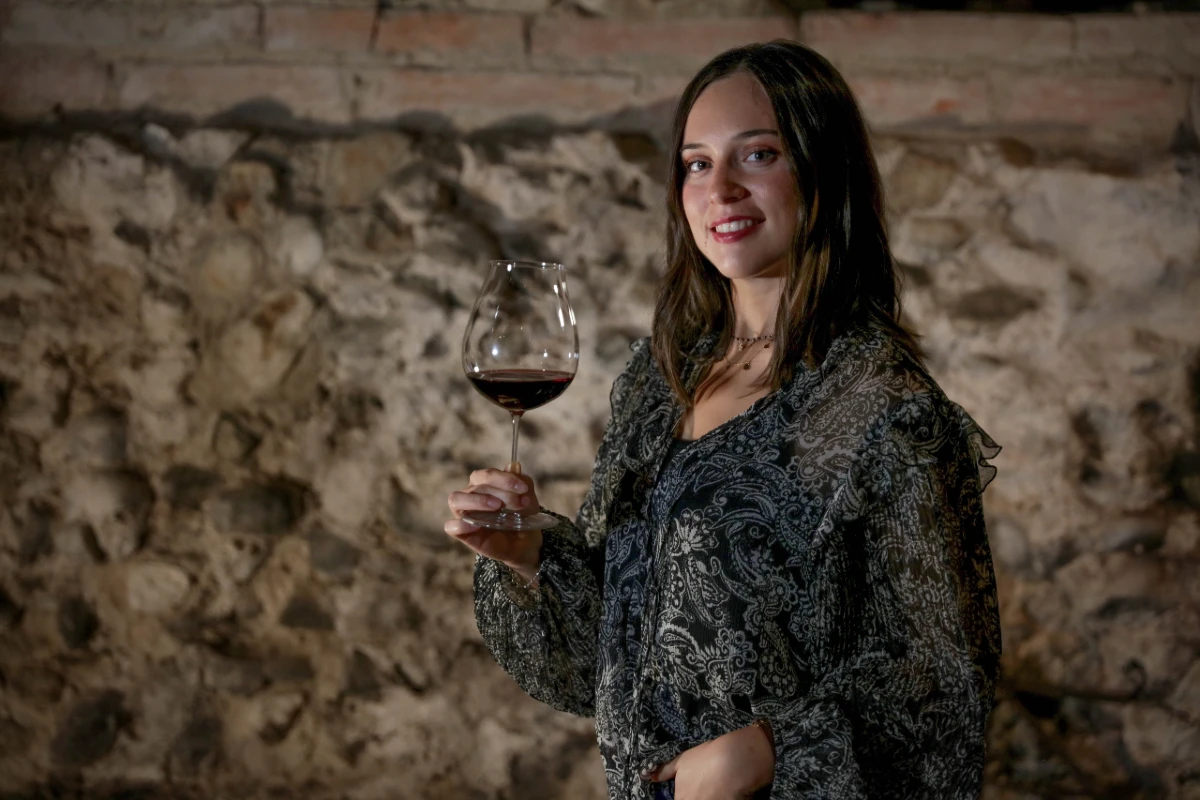
The generational turnover in great family wine estates is perhaps the most delicate and decisive moment: a passing of the baton that defines the future of a legacy. It is the crucial challenge that Federica Boffa Pio, at only 27 years old, found herself facing in a “non-ordinary” and “very premature” way at the helm of the historic Pio Cesare winery, an institution with almost 145 years of history. A challenge that Federica has faced successfully, thanks also to the presence and fundamental support of her cousin Cesare Benvenuto, co-owner with 25 years of experience in the company.
This interview, focused precisely on the dynamics of this transition and the vision of a new leadership, is part of the “Amorim Wine Vision” philanthropic editorial project. The initiative is a thought network that values the perspectives of entrepreneurs and managers capable of sharing know-how, experiences, and concrete ideas. Federica Boffa Pio’s testimony is a perfect case study offering readers anticipatory perceptions and brilliant perspectives.
With impressive lucidity, the interview explores the pivotal themes of her mandate. It starts from the dualism between “custodian” and “innovator,” where tradition is not a “straitjacket” but a “starting point” for the future (as demonstrated by the bet on Timorasso). It continues with the need to “remove the dust” from a monumental brand through communication and wine tourism, and analyzes the relationship with the historical memory of collaborators, a balance found by banning “it has always been done this way.” Finally, Federica’s vision on collective challenges emerges, from climate to digital, with a powerful reflection on wine: not content for “ten seconds,” but a precious occasion to “slow down.”
Many young leaders in family businesses find themselves navigating the dualism between being “custodians” of tradition and “innovators” who want to leave a mark. How do you experience this tension? Do you feel more at ease in one of the two roles, or have you found your own personal equilibrium?
I must premise that mine was not an ordinary path. I arrived at the head of the company very prematurely, following a tragic and unexpected event like the death of my father. Unlike a normal generational transition, where the new generation works alongside the previous one, I found myself immediately alone in command. Today, therefore, I must cover both roles. On one hand, I am the custodian and protector of a company with almost 145 years of history. On the other, I am a 27-year-old girl, and I must interpret the younger and more innovative side. I live constantly moving between these two souls, which, however, have always characterized Pio Cesare in the last 50-60 years. Even my father always tried to respect tradition while projecting himself towards innovation. This is testified by milestones achieved in an almost “disruptive” manner compared to historicity: the arrival of a Chardonnay (a white wine in a land of reds) or the will to make single-vineyard wines, when the Piedmontese tradition has always been that of blending. This dualism has always been characteristic of our company. Today, perhaps, it is even more so. We must respect tradition because our territory consists of great appellations like Barolo and Barbaresco, which are based on historicity and precise rules. At the same time, I try to view tradition not as a straightjacket, but as a starting point. It is a foundation never to be forgotten, from which to start rooting Pio Cesare in the present, but above all in the future. We want to convey dynamism, to make it understood that we are not a company stuck in its convictions, but that we try to seize future opportunities without ever distorting ourselves. The work in the vineyard, the cellar expansion, and the introduction of a new white wine, Timorasso, testify to this will.
Pio Cesare is synonymous with a classic and almost monumental style. Concretely, where do you see space for innovation? Is it innovation expressed more in the vineyard, facing climate challenges, in the cellar with new respectful technologies, or in the way wine is communicated to a new generation of consumers?
We have certainly worked a lot on the communication side. I have tried to dust off a historic brand that, precisely because of its long market presence, can have a downside: being associated with an “old” company. And it is absolutely not old. We started collaborating with a public relations agency, an area in which we had never invested. It helped us expose ourselves to a new audience, telling who we are and what we want to do. My father was a typical Piedmontese, reserved and not fond of being in the spotlight; I believe instead that this part is very important today. We have also invested much more in wine tourism, expanding our proposal. Our historic cellar, built on Roman walls, can be visited with routes that combine the visit with tasting. These two moments are inseparable for me: it is fundamental to see the cellar before tasting the wines; it is a 360° journey into our philosophy. We have also included tastings of historic vintages to explain the evolution of Barolo and Barbaresco to new generations. Today, thanks also to the positive side of climate change, young wines are more easily enjoyable. But it is right to make people understand what we mean when we speak of aging capacity. Regarding production, we are carrying forward and expanding a project started by my father: the cellar expansion. Our main problem has always been space, working in the historic center of Alba, on four floors underground. To continue working efficiently with new technologies, we have started major works. There will also be a new section dedicated to white wines, which I personally love very much and which represent an innovative side for our area. We continue the almost fifty-year experience on Chardonnay and Sauvignon Blanc (by now almost native for us) and complete the picture with a 100% Piedmontese vine, Timorasso. It allows us to close the circle in the search for white wines with structure, body, and great aging capacity. I use the plural because I work closely with my cousin Cesare, who represents the fifth generation with me.
Leading a historic company also means leading people who possess its memory, collaborators who have worked for decades with your family. How do you manage to balance the invaluable value of their experience with the need to introduce new ideas and, sometimes, to challenge the classic “it has always been done this way”?
That phrase – “it has always been done this way” – has been banned here. If someone says it to me, they can turn on their heels and walk out the door. We have a hard core of our team represented by people who have worked with us for very many years and who are by now part of our family. Our winemaker has been with us since 1981 and has only been a winemaker here; our agronomist has been with us since 2003; the foreman in the countryside has worked here for more than twenty years. We have people in the warehouse since they were sixteen and now they are almost sixty. Ours is truly a big family. We are organized into departments, but the family has always been the glue of everything, the one that concretely directs the company and makes the most important decisions. I think this was the fortune when I arrived: our collaborators have always had great trust in our family and in the person who was in charge. They took a great bath of humility when I arrived, opening up to a new push. In reality, it wasn’t such a “new” push: I am my father’s daughter and we are very similar people, even if the vision may be slightly different given the age. At the same time, we have also tried to insert new people, both to replace those who retired and to integrate new figures. We hired young guys in the office, administration, and cellar, who will help me build the team, exactly as my father did.
The world of wine addresses an increasingly global and digital audience. How do you communicate the essence of a brand like Pio Cesare, so tied to the land and patience, to a generation that lives on immediacy on platforms like Instagram or TikTok, without distorting its soul?
This is somewhat the million-dollar question; I don’t have a pre-packaged answer. I believe, however, that the world of wine, particularly that of Barolo and Barbaresco, is an extraordinary opportunity to give young people the chance to slow down. It is an opportunity to make them understand that there is an alternative to frenzy and an attention span that does not go beyond ten seconds. Barolo and Barbaresco rely on patience. In fact, we do not have TikTok or Facebook. We only have Instagram, which I manage, probably even poorly, in the moments when I have time. I think it is a winning strategy to try to make people understand that wine is a reason to sit at the table, take a breath after a hectic day, and enjoy a moment with friends. Today young people are very interested in wine; they want to understand what they are drinking, where it comes from, how it is made. One can certainly improve the way of communicating it, but the metaphor of patience and calm works. We do this a lot through contact with the final customer. When I travel to markets, I always ask our importers to organize dinners with a young audience, possibly under 35 or 40. Making real contact between the producer and the young person is fundamental. There, one no longer talks about grafts, clones, and yields. They are interested in family history, philosophy, and food pairings, in which new generations are much more interested compared to the past.
Looking beyond the gates of your company, what do you think is the biggest challenge that your generation of winemakers must face? Is it climate change, sustainability not only environmental but also economic, or perhaps the difficulty of making people understand the value of an artisanal wine in a global market?
I believe it is a combination of all these things. The challenge is how wine will be understood in the future and how it can be sold. Will traditional distribution logic still exist? We will need to reflect on how to shorten the space between the producer and the consumer. Surely climate change is a concrete and true problem. Our area is among the wine zones in the world most impacted by climate change. If we consider that our grandfathers harvested Barolo in November and we finished on October 4th, we are talking about almost a month’s difference. We witness early harvests, high temperatures, drought, or torrential rains. Today we try to tackle it individually, with strategies in the vineyard and cellar (shorter macerations, more delicate extractions), but I believe these are themes to be addressed as a group, as a “system.” Just think that irrigation cannot be done here: it is a legacy of a regulation built 50 years ago when the climate was the opposite of the current one. Then there is social sustainability, the care of the work environment. We have always done this: we have almost fifteen people working in the vineyard all year round, we do not use seasonal workers, and many live in our country houses. Consortia exist to face these challenges cohesively. Finally, markets and competition are very high. We are more than 600 producers in our area and, in my opinion, a part of these has lost the compass a bit in understanding what it means to make quality wine. They focus on making “natural” wine or using screw caps because it’s “cool,” but wine to be good must follow correct oenological steps, otherwise it is bad for you. The consumer is sometimes distracted. We must focus on quality and, probably, do less to do better.
The world of wine, especially at the top of historic companies, has long been male-dominated. Do you believe that female leadership brings with it a different sensitivity or approach, perhaps in the way of conceiving the company, the product, or the human relationships within it?
I think women can bring so many positive things if they demonstrate they can do it, exactly like a man. Being a woman is not enough for everything to be fine. And in my small way, I think I demonstrated it. Surely a woman manages to lead a company a bit like a family, trying to get everyone to get along and to nurture a healthy climate in work-life management. At the production level, women probably have a sensitivity regarding palate and smell perhaps a bit more developed, and this is a plus today when more elegant and delicate wines are sought. Perhaps we are also better at crisis management, because it is in our DNA to get used to managing family and work pressures. That said, I think the world of wine is one of the few worlds where female emancipation has achieved success. There are so many women in command, even in our area, both of my generation and previous ones. Personally, except in very few cases, I have never felt diminished as a woman. Perhaps it happened to me as a young apical figure, but I can understand that. I think our sector can be an example for others.
Your father consolidated Pio Cesare in the pantheon of great world wines. For you, today, what does “success” mean? Is it still tied to critic scores and sales volumes, or is it also defined by other parameters, like team well-being, impact on the territory, or coherence with your personal values?
Obviously, we cannot neglect the numbers: at the end of the year, we have to draw a line, pay salaries, and support families. That said, success is a combination of the things you mentioned. It is evaluated above all on the well-being of one’s employees and on the work environment that is promoted. Fortunately, I notice a bit of an abandonment of following scores and rankings. It is important to have media coverage – that’s why we have the PR agency – so that the company is talked about and consumers are given advice. But the race for scores fueled an unhealthy competition among producers, which we do not need. Now we need to act as a group. Success, then, is evaluated on the quality of one’s wines. One must never sit back, never stop, but be convinced of high quality and, at the same time, always leave a small crack to do better. We, at least once a week, sit down and taste everything we have in the cellar to understand where we are going wrong and where we can improve. Success is the will to improve oneself, the will to open up to what happens outside – we often visit other wine zones – and the capacity for comparison. I do not have technical training, so for me, it is fundamental to constantly compare myself with my team, in a continuous exchange.
One day, many years from now, when your leadership at Pio Cesare is discussed, what do you hope will be the chapter you added to the long history of this winery? What imprint, what distinctive mark, would you like to be associated with your name?
I hope to be recognized for having done at least half of what previous generations managed to do, particularly my father. I say this not out of a spirit of competition, but because he did incredible things for the company and contributed enormously to the success of our appellations in the world. I would like to contribute to keeping our zones flourishing, not only economically, but also in terms of global recognition and environmental and social sustainability. I hope, in my small way, to represent a prominent figure in the world of wine, not only for our wines but also for the community.
Key points
- Tradition acts as a starting point, not a straitjacket, driving innovation like the new Timorasso white wine.
- Banning the phrase “it has always been done this way” is crucial for evolving alongside long-term staff.
- Wine tourism and communication are revamped to remove the “dust” from the brand and engage younger generations.
- Climate change requires collective action and adaptation, evidenced by harvests occurring nearly a month earlier.
- True success moves beyond scores, prioritizing employee well-being, collaboration among producers, and territorial sustainability.