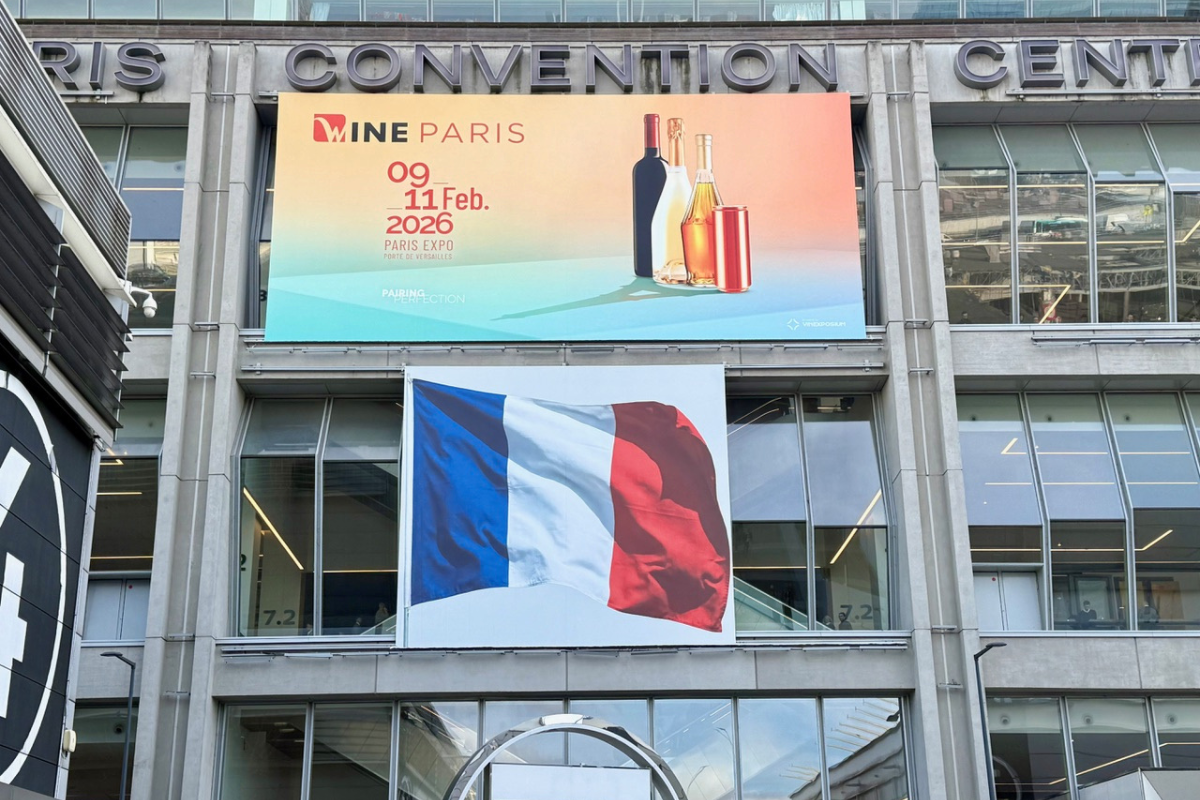
Wine Paris 2026 opened its doors with a striking revelation: Italy is the single most present nation at the world’s leading wine trade fair, fielding over 1,350 exhibitors. Yet the opening day raised more questions than it answered, about the real value of such scale, the balance with buyers, and whether the investment will bear fruit.
Italy’s wine sector dominated the opening day of Wine Paris 2026, with over 1,350 Italian exhibitors out of approximately 6,500 total — raising immediate questions about whether the massive presence will translate into concrete business results or remain a show of force.
The first evidence emerging from this edition of Wine Paris — and which represents the common thread of these initial impressions gathered at the end of the opening day — is clear: Italy is today the wine-producing nation that has believed most, and continues to believe, in the French trade show, contributing concretely to its recognition as the leading international wine exhibition event.
Who would have ever imagined that it would be precisely our country to support the growth of a trade show held in the main competitor country of Italian wine? Yet the numbers speak clearly. The Italian presence was truly massive: over 1,350 exhibitors out of approximately 6,500 in total, distributed mainly in pavilions 5 and 2, with a solid representation also in international pavilion number 4.
If someone was therefore expecting the classic French grandeur, we can say that the “muscles,” if we want to call them that, were shown above all by Italy. It remains to be understood, however, whether we did so to give ourselves courage or to intimidate our competitors.
The first question to ask is therefore: why does Italian wine believe so strongly in Wine Paris? On this first day we were unable to fully understand it. As expected, beyond pre-arranged appointments, companies hoping for casual contacts or chance encounters often had to keep their bottles closed. More complete judgments will come on Wednesday.
We can already observe, however, that as the number of exhibitors inevitably grows, it becomes increasingly difficult to maintain a high level of satisfaction, given that buyers cannot multiply like loaves and fishes without divine intervention.
Interesting, even if perhaps slightly illusory, is the reflection of the director of a major Italian wine protection consortium, according to whom a B2B trade show should have the courage to establish a fixed maximum number of exhibitors consistent with a realistic presence of buyers and operators. A reasonable line of thinking, but difficult to apply as long as trade shows live off the sale of exhibition space and producers struggle to make less emotional choices, avoiding following the herd wherever the majority concentrates.
Despite this, the mood on the first day was overall positive. Large international trade shows push producers toward a more optimistic outlook: seeing themselves alongside so many colleagues helps to share fears but also, fortunately, the many hopes still present in the sector.
Hopes that, in the expansive French area, were reinforced by the intervention of Prime Minister Macron, who dispensed optimism to domestic producers and in particular to those in Champagne. 2025 was in fact a true annus horribilis for them, with losses well into double digits and the decision by the interprofession to uniformly reduce yields to 90 quintals per hectare — a choice that is probably sustainable for the major maisons, but decidedly heavier for smaller operations.
Returning to Italy, it should be noted that pavilion 2 appeared the most disadvantaged in terms of location and foot traffic, at least on this first day. And this despite the presence of some of our country’s most prestigious brands and a strong representation of Franciacorta, with numerous protagonists of our high-end sparkling wines. One cannot help but wonder whether the French organizers have not reserved for us, though decently, a sort of “back room,” placing us nonetheless near the Be No area, dedicated to dealcoholized wines and considered one of the trendiest areas at the moment.
On the subject of trends, the area that in our visits proved most crowded was without doubt the Be Spirits section, dedicated to spirits. A sector that seems to know no crisis and which today in fact appears in great shape, despite the numerous analyses describing a consumer increasingly oriented toward health-consciousness — health-consciousness that seems to concern wine above all, while gin, tequila, whisky, and vodka continue to enjoy excellent health.
This first day, rather than providing definitive answers, has opened numerous questions about the future of major international wine trade shows and the role Italy intends to play in this scenario. The sense is that of a sector which, despite going through a complex phase at a global level, continues to invest in visibility, international presence, and commercial relationships, perhaps also to react to a market environment more uncertain than in the past.
Wine Paris, from this point of view, increasingly represents a barometer of international wine balances: not just a commercial platform, but also a space where the political, economic, and identity weight of the various producing countries is measured. And in this picture Italy appears today among the absolute protagonists.
It remains to be seen — and we will discover this in the coming days — whether this massive presence will translate into concrete results in terms of business, positioning, and new commercial opportunities. For now we can say that the Italian wine sector continues to demonstrate a great capacity for reaction, a strong desire to participate, and above all the awareness that in times of change, not taking part means risking being left out of the game.
The coming days will tell us whether this choice will have been merely a show of strength or also a genuinely productive investment for the future of Italian wine. In the meantime, Wine Paris 2026 is already establishing itself as one of the most important crossroads for understanding where world wine is headed — and what place Italy intends to continue occupying in this ever-evolving geography.
Key points
- Italy leads Wine Paris 2026 with over 1,350 exhibitors out of 6,500 total
- The buyer-to-exhibitor ratio raises doubts about the effectiveness of such massive participation
- Champagne producers faced a difficult 2025, with double-digit losses and reduced yields
- The Be Spirits area was the most crowded, reflecting shifting consumer trends away from wine
- Italy’s pavilion 2 suffered from poor foot traffic and a less favorable location