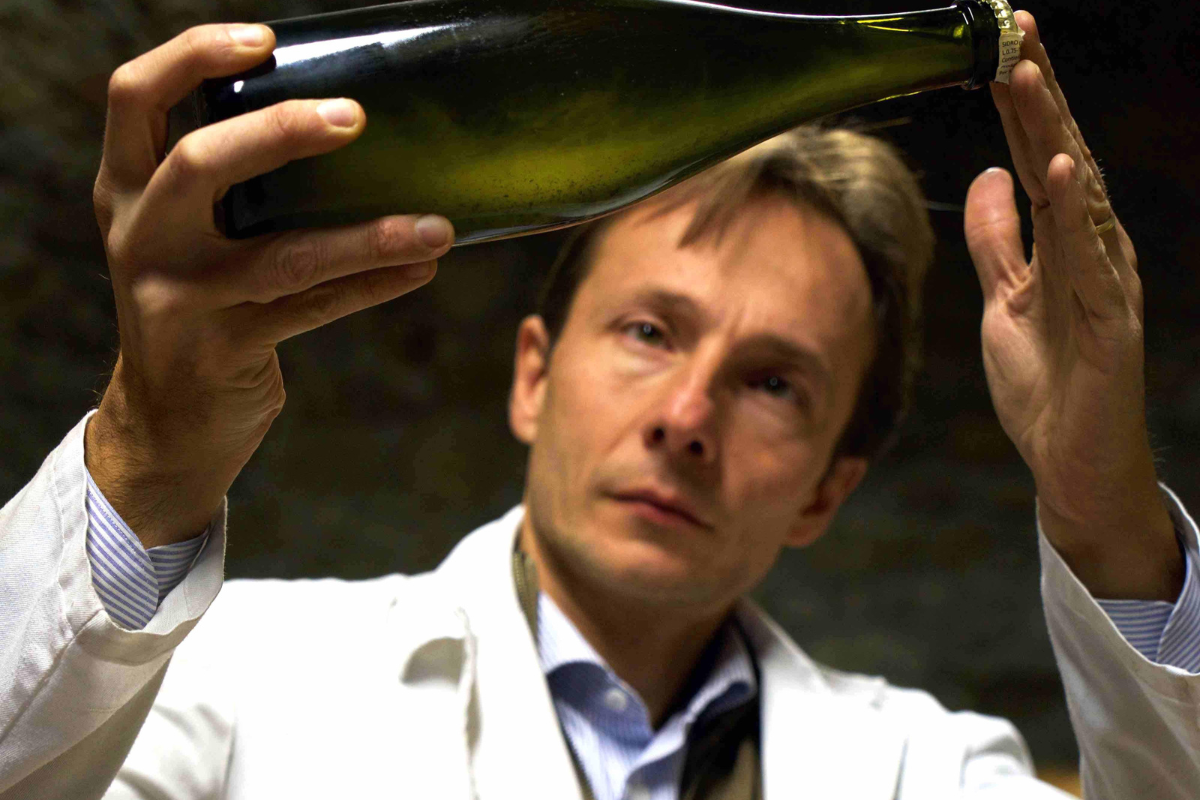
Gianluca Telloli, head of Research and Selection at Proposta Vini, explains Maley, a high-altitude cider born from centuries-old apple varieties between the Aosta Valley and French Savoy. In this interview, he challenges the marketing noise around “low alcohol,” argues for drinkability over labels, and makes the case for authenticity as the only truly unclonable asset.
There is a lot of talk about low alcohol, perhaps too much, and with the same ease with which, a few years ago, people talked about natural and sustainable wines: right words used at the wrong time, or used well by a few and badly by many. Gianluca Telloli, head of Research and Selection at Proposta Vini, has been working with low-alcohol products for years, with the patience of someone who knows that certain topics need time to settle.
His project is called Maley: a high-altitude cider born from the recovery of ancient and rare apple varieties grown at up to 1,500 metres above sea level between the Aosta Valley and the French Savoy. It was not born from a market trend. It was born from an agronomic, botanical, and ultimately cultural conviction.
We spoke with him.
The market is full of dealcoholized or artificially lightened products. What distinguishes a naturally low-alcohol product like cider from these industrial operations? Is it a technical matter or also a cultural one?
Talking about naturally dealcoholized wines is a contradiction in terms. There are beverages that, by the nature of the source fruit, produce less alcohol: fewer sugars means less work for the yeasts and therefore less alcohol in the final result. That is the starting point.
But to truly understand it, you need to go back in time, to the years between the 1960s and 1980s, when European viticulture was rewritten with a post-war logic: reconstruction was the goal, and varieties were sought that were productive, full of energy and alcohol. Meanwhile, the climate changed significantly, and some choices made fifty years ago no longer hold up today.
This has brought renewed attention to forgotten varieties with naturally low alcohol levels. I think of the Blauer Portugieser in Trentino, which developed ten degrees and had been sidelined in the 1970s. Today it is relevant again. I think of the Fortana in Emilia.
On the opposite front, there is industrial dealcoholization technology: equipment that removes alcohol from an already-finished wine, often with results that can work technically. Taking a bottle and shipping it to a distillery in Germany to have the alcohol removed for use elsewhere: how truly sustainable is that? These are paths that exist and that we acknowledge. But when we look for something, we always start from the fruit.
Is there a risk that “low alcohol” becomes a hollow marketing label, as happened with “natural” or “sustainable” in wine?
It already has. We are talking about it, and that means it has already taken that turn. The problem is that we probably still lack the communicative power to express the right concepts with the necessary clarity.
A wine at eleven degrees has always existed: nobody used to call it low alcohol. Now that we call it that, is the consumer truly ready to choose consciously between a partially dealcoholized Chardonnay processed through an industrial plant and a Blauer Portugieser that has eleven and a half degrees because it was born that way?
I don’t have that certainty yet. Perhaps the word to put front and centre, more than “low alcohol”, is drinkability, a concept that carries with it harmony, pleasantness, and accessibility.
How do you convince a wine consumer to approach cider with the same open mind they would bring to a Champagne?
It is a question I have genuinely worked on for years. I come from an alpine territory: in the Aosta Valley, above certain villages, the vine simply did not reach. Apples were grown, cider was made, people survived. It was not philosophy, it was necessity. A ripe apple either gets eaten or fermented; otherwise you lose energy. Cider comes from that place, from that essential logic.
The problem is historical. In Normandy and Brittany the tradition of cider is very strong, yet producers never truly aimed for excellence, because their ultimate goal was Calvados, the spirit, absolute concentration, capable of lasting three hundred years. Cider was the halfway stage, the everyday drink. Across all of Europe, wine culture prevailed for economic, historical, and cultural reasons. As if an “alternative” beverage could ever have claimed a prestigious place.
Today the landscape is different. There is a desire to explore new paths, even from an aromatic and gustatory point of view. The wine world itself opened that door: when people started moving away from the four classic models, when the pursuit of the same prototypes stopped, it became possible to say “let’s try this too.” But there is one element that counts more than any communication strategy: being authentic. A beautiful image of the perfect orchard is not enough; the consumer must touch it firsthand, walk among monumental plants, understand what is truly behind it. When you are authentic, you are unrepeatable. And no one can clone that.
Real cider must be made with cider apples, not table apples. How many people – even among insiders – truly know how to tell the difference in the glass?
Very few. And that is the main work to be done today. There is no widespread awareness, and sometimes it is missing even among cider producers themselves. The shortcut of using table apples is tempting: it does not impose the long timescales of planting cider varieties, does not require waiting ten years for the trees to come into production.
Talking about cider today is like talking about wine with the awareness of 1920. Everything still needs to be codified, written, built. Add to that the fact that some of the old cider varieties have natural resistance to fungal attacks, making them relevant in a modern agronomic context as well. But orchards need to be redesigned, belief in the project is required, and a distribution vision that accompanies the production one must exist. Without balance between production and commercialisation, the rest falls apart. It is a blank canvas, with everything that implies: freedom and responsibility.
How difficult is it today to source ancient varieties in sufficient quantities without compromising quality? Is there an uncrossable production ceiling for Maley?
For Maley, yes: a ceiling exists. We work with varieties from the Mont Blanc massif and the Savoy territory, and production cannot exceed sixty thousand bottles, at least within the current time horizon. Production timelines are long, but on the Savoyard side we recover century-old plants that each produce four to five hundred kilos of apples.
The real problem is that those trees exist in a state of constant abandonment because there is not enough profitability to justify their care. On the southern side of the Alps the loss has already been enormous, and recovery will take decades. The other variable, however, is climate. In the analytical data from the last fifteen years that I monitor, the fruit is increasingly fragile. Research will be needed, new varieties descended from the ancient ones, a long journey. It is necessary, but it is a journey that still needs to be written.
In a difficult vintage, with hail or drought at 1,500 metres, does cider tell the story of the year’s hardships the way wine does?
Yes, and it does so very clearly: first in the aromatic profile, then in the acid balance. But there is an element that distinguishes cider from modern wine, at least in the model we pursue. Old orchards were not planted all at once in the same year: one tree was put in per year, of different varieties, exactly as used to happen in old vineyards, where monovariety was the exception.
The result is an orchard with trees of different varieties and different ages, which responds to pathological attacks and climatic conditions in a diversified way. This always guarantees a production base, even in difficult years. The aromatic profile changes from year to year, certainly, but production is protected by that planting logic. It is a model that is complicated to manage and to replicate, but it is fundamental.
Is there an ideal consumer for Maley? Who is it, concretely
Someone who has eyes to see beauty and understands that modernity, in the end, passes through harmony. I have Michelin-starred clients and I have mountain trattorias you reach after a hike. From the rifugio keeper at altitude to the restaurant in the centre of Milan. What they share is awareness: understanding that this drink tells a place, a story, a way of doing things.
Key points
- Low alcohol as a marketing label has already lost meaning: drinkability is the more honest and useful concept.
- Real cider requires cider-specific apple varieties, not table apples; awareness of this distinction is still very limited.
- The Maley project is capped at around 60,000 bottles due to the scarcity and fragility of ancient alpine varieties.
- Abandoned century-old orchards in the Savoy region are a critical resource and their recovery will take decades.
- Authenticity, letting consumers experience the orchard and its history firsthand, is what makes a product truly unrepeatable.