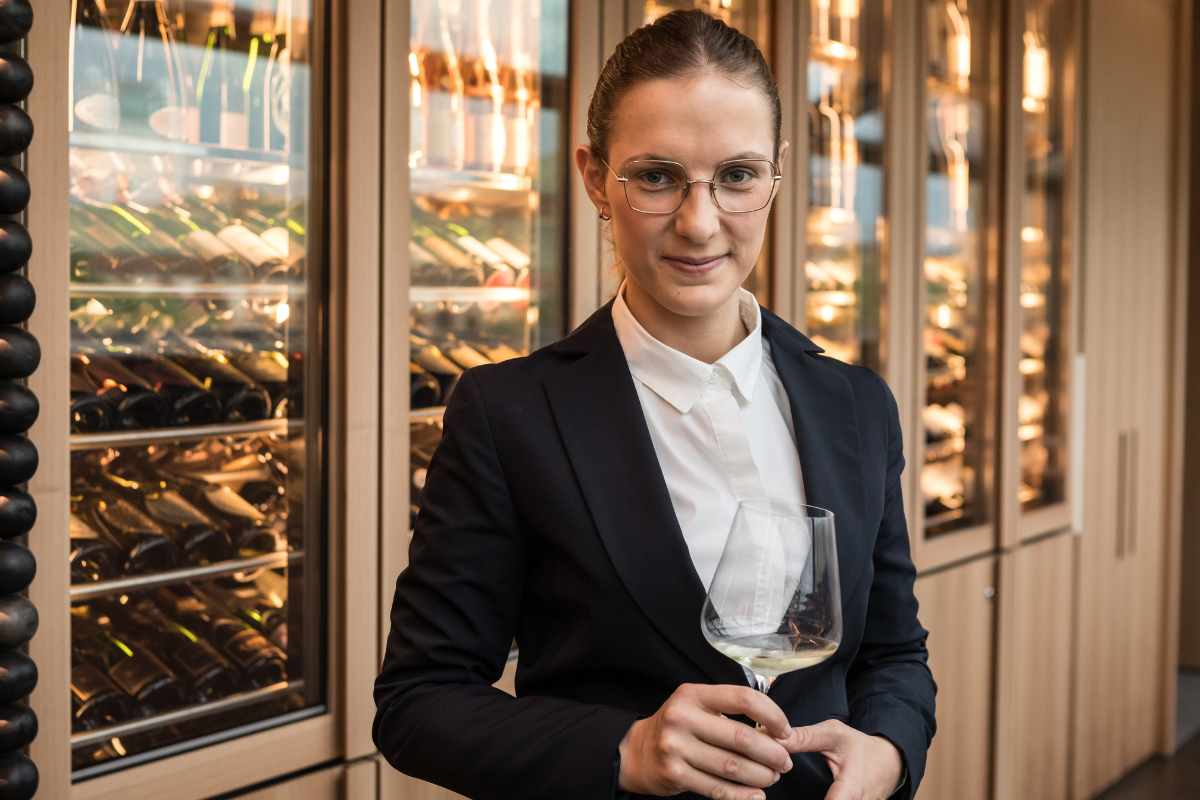
Jessica Rocchi, restaurant manager and sommelier at the two Michelin star restaurant Andrea Aprea in Milan, discusses how fine dining wine culture is changing, why guests now value authenticity over status, how the wine list is built through direct relationships with producers, and why wine today is remembered as an experience rather than a display.
In the world of wine, there is a lot of talk about freshness, drinkability, lower alcohol content, less extracted reds and more vertical whites. But how much of this narrative actually reaches the table of a fine dining restaurant?
We chose to listen to those who sell and talk about wine every day in the dining room. Jessica Rocchi, restaurant manager and sommelier at the two Michelin star restaurant Andrea Aprea in Milan, observes from a privileged position the changes in consumption, requests and guest expectations. Her point of view is clear: the change does not only concern taste, but the very role of wine within the gastronomic experience.
There is a lot of talk about fresher, less alcoholic wines, less marked by wood. Is this a real trend at the table, or is it something insiders are telling themselves?
It is true that there has been a shift in trends, although today they are increasingly varied. Working with guests who come from different countries, the restaurant becomes a daily observatory. During service, in just a few intense hours, you understand a lot about what people are really looking for.
The desire for wines less marked by wood, less built on an international style and more oriented toward fruit or floral notes does exist, but it did not start today. It is a process that began several years ago. I think, for example, of Barolo: some time ago people tended to think it needed at least five or ten years behind it to be ready. Today, younger, more readable, more immediately fruity wines are accepted more easily.
Having said that, in my opinion the real shift is not only about taste. The most interesting change concerns the cultural role of wine within the meal. The guest is not simply looking for a good wine. They are looking for a wine that has a position, an identity, a meaning within the experience they are living.
For a long time, luxury in wine was a vertical concept: the great vintage, the great label, the great name. Choosing an iconic bottle, in certain contexts, was also a way to communicate status. Today I instead see a more horizontal search, linked to engagement. The guest is looking for something authentic, identity driven, recognisable. They want to understand whether a wine is truly sustainable, whether it is credibly artisanal, whether behind that bottle there is a real process and not just an appealing label built to look unconventional.
There is also another aspect: today’s guest is not necessarily more prepared, they are more informed. Preparation requires study, time, practice. Information, on the other hand, is immediate. Just pick up the phone, search online, compare prices, read something about a producer. This has also greatly changed the relationship with the wine list and with the sommelier.
In this context, how much does the guest still rely on the sommelier? And how does your role change in front of a more informed guest?
The key point is that today’s guest does not want to be educated. If I go to a restaurant and find a sommelier who starts giving me a lesson, it annoys me. Even more so in a fine dining context, where those working in the dining room should have the intelligence and empathy to understand who they have in front of them.
We should not educate the guest. At most, we should accompany them. We must have the sensitivity to understand how to guide them in their choice, without imposing ourselves and without turning the service into a lesson.
The sommelier’s role remains crucial, but only if you are able to read the table. If you do not understand the guest, it is the guest who cuts you out. If instead you manage to interpret them, then your figure becomes central. And when trust is created, it is often you who chooses what that person will drink.
Has the possibility of checking prices and labels online changed the way a wine list is built?
Yes, because today the guest can much more easily check the price of a bottle. This makes it even more important to have a wine list with a strong identity. It is essential, but it is also divisive.
Our list has around 900 labels and can generate opposite reactions. Some look at it and say: “There is so much choice that I almost get lost.” Others, faced with the same list, say: “You have practically nothing.” It always depends on who you have in front of you.
For us, the wine list has to be representative of the restaurant and has to stay alive. This is perhaps the aspect I care about most: change. Ours is a job of continuous learning and the list has to evolve together with our skills, our vision, seasonality and also the way consumption moves.
It cannot be a static photograph. If I built a list with 50% reds and 50% whites, I would get a distorted picture of consumption, because in August, for example, we might sell many more whites and in December many more reds. The list has to change, but not necessarily by endlessly increasing the number of labels. At the start we had around 500 references, today we are around 900. We do not want to grow much more in quantity: we want to broaden the horizons of the selection.
How difficult is it to keep a dynamic list amid costs, allocations, direct relationships and the grey market?
It is never simple, especially if the list is also based on certain specific labels. That said, we are a fortunate reality. The restaurant has been open for only a few years, but it has an important name behind it, and I have been working in this field for almost twenty years. This has, in some cases, made access to certain bottles easier.
Thanks to the restaurant’s reputation and my twenty years of experience, we are able to buy some important labels directly from the producers. But the relationship with producers is built over time. In the first year, many guests asked us why we did not have a certain label, or why for a certain wine we only had one specific vintage. The answer is simple: because to reach that bottle you have to find the contact, build a relationship, earn trust, obtain an allocation. And often, at the start, the allocation concerns only the most recent vintage.
The shortest path would be to go to the grey market, buy everything needed and immediately build an important vertical. But then you really do not know where those bottles come from or how they have been stored. Building a direct relationship is harder, but it is also more correct. And it allows us to work in a healthier way economically, including toward our guests: a bottle bought directly can cost much less than the same bottle purchased elsewhere. As a result, the way you can offer it also changes.
In my own small way, I try to accept as few compromises as possible. I think of the so called “packages”: to access an interesting bottle you also have to buy many other bottles that you may not need. We could do it, because we have two outlets and could absorb certain volumes. But that is not how I want to work.
If a producer wants to be part of our reality and recognises its value, then the relationship builds itself. If instead access to certain bottles has to go through compromises I do not share, I prefer to choose another producer I believe in just as much. The list can work that way too.
When a guest chooses a wine, which factors really matter most?
The economic factor always plays a role. It would be naive to say otherwise. Even in a high level restaurant, price matters.
This is why whoever sells wine needs empathy. I am not talking about managing the list, but about the actual sale. You have to understand who you have in front of you, what kind of experience they are looking for, and also what their budget might be.
With experience you learn to read the table. Sometimes two or three key words are enough to understand where to go. When a guest tells you they are looking for a soft red, more fruit forward, certain mental drawers open immediately. Every word, even the least technical one, points you toward part of the selection.
The main factors are therefore three: the sommelier’s ability to understand the guest, the price, and the guest’s own openness. Some want the full experience and choose the wine pairing. Some prefer to stay in their comfort zone. Some always drink the same type of wine but are willing to be guided toward something different.
And this openness does not necessarily depend on age. There are young people who only drink what they know, and older people who are very open to experimenting. The difference lies in mindset. Anyone sitting down in a restaurant like ours has to be willing to live an experience.
Today, what works better: bottles, glasses or wine pairing? And which types of wine are performing best?
In my opinion we are in an interesting moment because two opposite dynamics coexist.
On one hand, the classic codes still work: Champagne, Burgundy, Barolo, Etna. In an unstable world, part of consumers still look for solid references, recognisable names, reassuring categories.
On the other hand, though, the desire for uniqueness is growing a lot. There is increasingly strong demand for micro producers, independent winegrowers, wines with territorial identity, and pairing experiences able to complete the dish.
The real change, in my view, is that prestige no longer necessarily coincides with ostentation. I do not drink Burgundy just to show something. I can choose a wine pairing because I want to give more value to the experience I am living.
If an important bottle can cost 250 euros and two wine pairings reach 340 euros, today’s guest can ask themselves: would I rather spend on a great, recognisable label, or on a journey that lets me taste unusual, perhaps unrepeatable things, told within their context?
For me, true luxury today is not the richness of the bottle. It is the enjoyment tied to the experience.
We offer everything: large formats, bottles, half bottles, by the glass, wine pairing and also non-alcoholic pairing. We have also been criticised for the half bottles, but in my opinion they are a very useful tool. They allow the guest to drink what they want. If at one table one person wants to drink white and the other red, two half bottles can be the best solution.
Our goal is to have a wide range of possibilities and to shape the offer based on what we pick up from the guest. For three tasting menus we have three wine pairings and three non-alcoholic pairings. Here too, though, consistency matters: if a guest asks me for a non-alcoholic pairing made with de-alcoholised wines, in my view that is not the right path. I prefer to work with mocktails, extracts, reductions, fermented drinks with an alcohol content below 0.5%.
We try to offer valid, varied and original alternatives. Then, if the guest is unsure, we help them find their own way.
In summary, what is the role of wine in a fine dining restaurant today?
Wine today no longer has to simply prove something. It has to complete the experience, give it depth, create a relationship between the dish, the territory, the producer and the guest.
The great name still holds value, but it is no longer enough. The guest is also looking for something else: authenticity, storytelling, consistency, uniqueness. And above all, they are looking for someone in the dining room able to read them without lecturing.
Wine remains central, but the way it is perceived is changing. It is no longer just status. It is part of the experience. And when it truly works, it becomes memory.
Key points
- Guests today seek authenticity and identity, not just status or big name labels.
- Fine dining wine lists must stay dynamic, evolving with skills, seasonality and consumption patterns.
- Sommeliers should guide, not lecture, reading each guest instead of imposing knowledge.
- Direct producer relationships matter more than fast access through the grey market.
- Real luxury today lies in the experience, not the price or fame of the bottle.