Pierpaolo Cielo, Vice President of Cielo e Terra, explains how Freschello became one of Italy’s best selling wines over thirty years. Through smart pricing, screw cap innovation and a viral virtual influencer, the brand connects tradition with new generations, defending its market share against private labels while celebrating its 2026 anniversary.
In the Italian wine landscape, often anchored to lofty narratives or elitist technicalities, the Freschello case represents a fascinating anomaly. Born thirty years ago from the intuition of a family from Vicenza who managed to read the crisis of the large format bottle before it even manifested itself, this brand did not simply occupy a shelf: it rewrote the rules of everyday consumption. Pierpaolo Cielo, Vice President and Commercial Director of Cielo e Terra, guides us on a journey spanning three decades of large scale retail history, revealing how a “democratic” wine managed to transform itself from a simple table product into a genuine cultural phenomenon.
Through packaging innovation, the courage to introduce the screw cap and the communicative boldness of a virtual endorser capable of rapping on social media, Freschello shows that modernity does not lie in detachment from one’s origins, but in the ability to engage with new generations without ever losing one’s identity. This interview is, in essence, a masterclass on how consumer loyalty is built not on the lowest price, but on consistency, constant quality and the ability to become a companion, light hearted, ironic and accessible, in the most spontaneous moments of conviviality.
In 1996, the wine market was polarized between the great classics and bulk wine. How did the idea of Freschello come about and what market gap did you identify at the time?
At that time, in large scale retail, the 1.5 liter sparkling wine still dominated the market. My father had the intuition to anticipate the crisis of this format, proposing a lively, fresh and light wine in the 750 ml bottle. The choice of a distinctive name and a divergent packaging allowed us to immediately create a strong identity.
In 1999 we then consolidated the operation with Cantina dei Colli Berici, with which a commercial agreement already existed. The intent was to find an outlet for lowland productions characterized by high yields per hectare, such as lowland Garganega and Merlot with low alcohol content. Freschello fit perfectly into this vision. Having a defined territorial production base allowed us to maintain constant quality on large quantities, avoiding the speculative approach of those who buy tanks on the spot market, destroying consumer loyalty.
Sales data and rankings confirm that for years the Freschello line has been among the best selling brands in Italy. In a retail context where shelf space is increasingly contested and turnover times are fierce, what is the economic formula that has allowed this brand to maintain such a high and constant “cruising speed” for decades?
The formula is based on the rule of the three “P’s”: Product, Price and Place (meaning distribution reach), supported by innovative packaging that guarantees great visibility. While consumption was strongly regional at the time, Freschello presented itself as a wine free from local boundaries, making the purchase immediate.
From the very beginning we focused on a net price logic (“every day low price”), minimizing dependence on aggressive promotions. This built loyalty over the continuous term. While it is not today the product with the absolute lowest price, Freschello has become a brand identity. The results prove us right: in the first 4 months of 2026, our sales figures show a +11%.
Reaching the 30 year milestone in 2026 means having overcome complex economic cycles and strong inflationary pressures, including recent ones. How did you manage to protect price accessibility for the end consumer without sacrificing the company’s financial solidity and product quality?
Today Freschello represents about 12% of our turnover. The solidity comes from having added more premium lines over time, sold mainly abroad, which improve the company’s average margin. In addition, extremely efficient operational management allows us to balance high volumes with financial sustainability.
Freschello was a pioneer of light wine, with a low alcohol content, long before the “low alcohol” trend became global. Was it a lucky intuition or an early reading of new lifestyles and consumption patterns?
Thirty years ago, daily consumption was already declining; families were looking for smaller quantities and lower alcohol content. Freschello intercepted this need, simplifying the choice process and becoming synonymous with a type of consumption. Today, the flagship product remains “Vivo,” our slightly sparkling wine (white, red and rosé) which, according to Circana Group sell out data, consistently remains at the top of the sales rankings.
Being a B Corp implies rigorous standards. How is environmental and social sustainability reconciled with the volumes and competitive prices required by a product like Freschello?
Our quality and sustainability certifications are not a limitation, but a driving force: they help us be more efficient in managing resources and reducing waste. We do not perceive sustainability as a cost in contrast with competitiveness, but as a strategic lever.
From the first bottles to today, Freschello’s image has changed while remaining true to itself. What role does packaging play in the perceived value of this line, which aims to offer everyday wines?
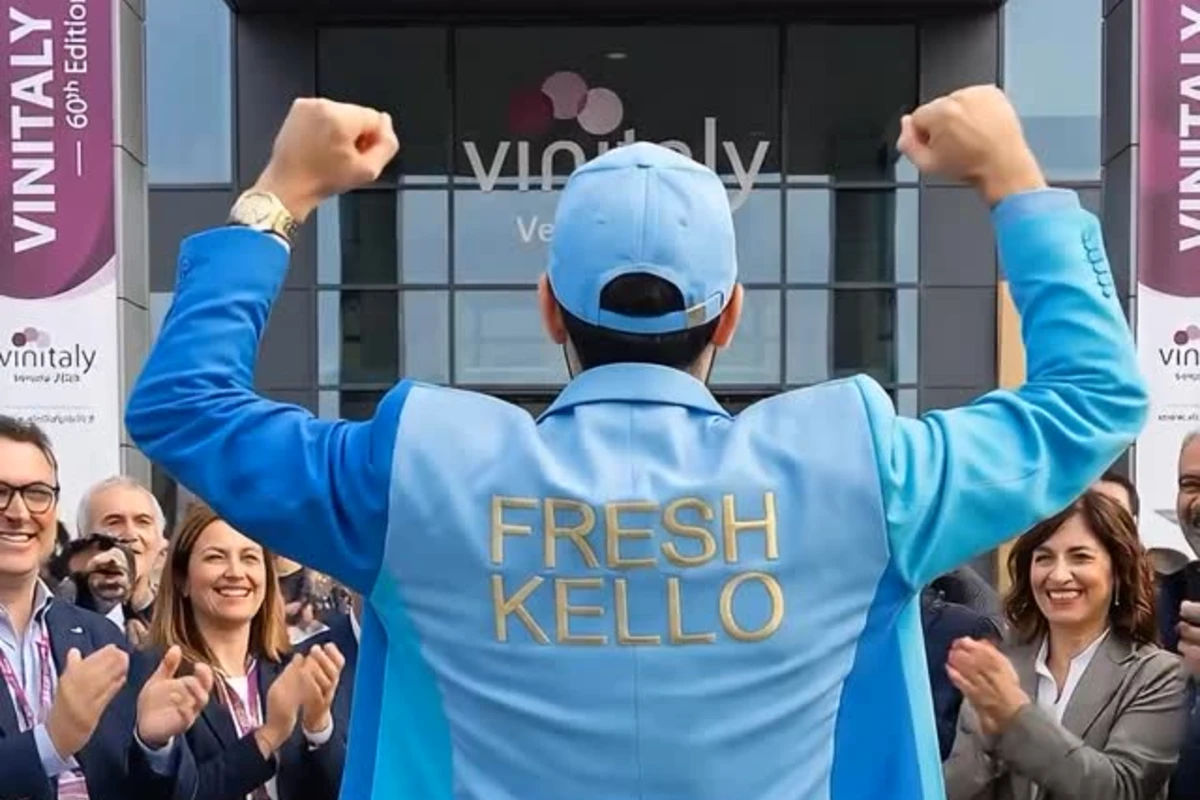
After a phase in which the identity had become more traditional, in recent years we have gone back to focusing on freshness and visibility. The adoption of the screw cap was a winning choice: initially feared by large scale retailers, it was instead rewarded by consumers for its practicality. For the 30th anniversary, we introduced the QR code on the label, a bridge to dialogue directly with the public through multimedia content and our virtual endorser, Fresh Kello.
Ensuring quality consistency across millions of bottles requires millimetric precision. How much does investment in R&D and automation weigh in the success of this project?
Success lies in pre harvest planning with our agricultural partners and in the rigorous control of raw materials. We do not compromise: constant quality comes from planning, not from opportunistic purchasing on the market.
Who is the Freschello customer today compared to 10 or 15 years ago? How are you engaging the new generations (Gen Z and Millennials) who approach wine in a less ritualistic and more experiential way?
We are reaching a world of young university students who experience wine in informal social settings. With the Fresh Kello campaign, which raps and communicates in a disruptive way, we are entering Gen Z’s cultural codes. We believe that an “easy” wine like Freschello can be the ideal entry point for those who are less experienced but seek an authentic and unpretentious experience.
How does Freschello manage to defend its market share against the advance of private label (store brand) wines in large scale retail?
Freschello has become a “banner product,” a synonym for convenience comparable to major consumer brands like Nutella or Barilla. Retailers use it to demonstrate their competitiveness. Despite attempts by some competitors to enter with lower priced products, our brand strength protects us: consumers recognize the brand and remain loyal, making it difficult for private labels to dislodge us from the category.
Are there substantial differences in Freschello’s sales volumes between distribution chains in Northern and Southern Italy? Or are the sales figures homogeneous?
The product performs well everywhere, but our competitiveness is affected by transport costs. The further we move away from Veneto, the more margins contract. For this reason, in some areas we are more cautious with promotional activities: our management is based on real economic sustainability, not on gaining market share at any cost.
Is Freschello also present in large scale retail chains abroad, or is it a product designed almost exclusively for the Italian market?
We have tested various markets, from the initial success in China (later slowed by geopolitical circumstances) to Russia, where current regulations however penalize imported products. We have good performance in Belarus and Ukraine, where the semi sweet version is also appreciated. In more mature markets, such as Germany or England, we were unable to compete due to unsustainable price dynamics. Regarding Freschello, we have found that, when it comes to export, emerging markets are more receptive than classic, established ones.
What is your policy and strategy regarding the discount channel? Is Freschello a brand that also finds space in this sales channel?
We are not interested in price wars. We work with discount stores only if there is respect for the price positioning we have set on the market. The risk of working with discounters is being “squeezed” until the brand’s identity is lost. However, we are observing a change in the sector: if discounters are willing to maintain the correct value of the brand, opportunities for collaboration increase.
How do you collaborate with retail category managers to help them optimize the layout and organization of the entire wine department in supermarkets?
Often, being a high turnover, low price product, Freschello risks being “hidden” on less visible shelves. Our strategy relies on enhancing display units, which become a genuine tool of visual theater at the point of sale. We focus entirely on communicative innovation, such as the integration of the QR code, which allows us to measure consumer interest and start a dialogue that goes beyond the shelf, also pushing toward new uses such as light, low alcohol mixology.
You rightly state that Freschello is considered an everyday wine, a high turnover wine. But in this period this segment is losing market share, and the moment when wine is consumed daily at the table no longer exists. So Freschello’s success appears as a result that clearly goes against the trend. What do you think are the reasons?
Freschello grows because it has managed to reinvent itself, keeping a likeable image and investing in modern packaging. Young people also choose it for alternative uses: spritz, sangria or homemade cocktails. It is a product that connects the tradition of everyday wine with new, more fluid and informal lifestyles. As long as we manage to be perceived as a “friendly” brand, accessible and of quality, we will continue to hold a privileged place on the table of Italians.
In the future, in a world increasingly attentive to health and sustainability, what place will Freschello occupy?
We will need to continue innovating without losing our identity, exploring segments such as 8.5% sparkling wines and 10.5% spumante. We believe less in the “zero alcohol” segment, as it often lacks quality. Our philosophy remains to offer “el vin bon al momento bon” (the good wine at the good moment).
Key points
- Freschello built lasting loyalty through consistent quality, fair pricing and wide distribution rather than discounts.
- The screw cap and QR code packaging innovations modernized the brand while boosting consumer trust.
- Targeting Gen Z through virtual rapper “Fresh Kello” keeps Freschello relevant among younger, informal wine drinkers.
- Strong brand identity helps Freschello resist competition from private label wines in large retail chains.
- Sales grew 11% in early 2026, marking 30 years of steady growth despite shrinking daily wine consumption.