Sandra Ciciriello, founder of Milan’s 142 Restaurant, explains how she rebuilt her wine list from over 900 to around 300 labels, focusing on Italian wines, guest-centered service, and a lighter, fresher style suited to today’s diners.
There is a point in Sandra Ciciriello’s story that comes even before the wine. Before the labels, the bubbles, the old vintages, the Italian territories to be showcased, or the reds to be lightened. It is the theme of hospitality. Wine in a restaurant never exists on its own: it lives inside an experience, at a table, in a dialogue between whoever serves and whoever sits down.
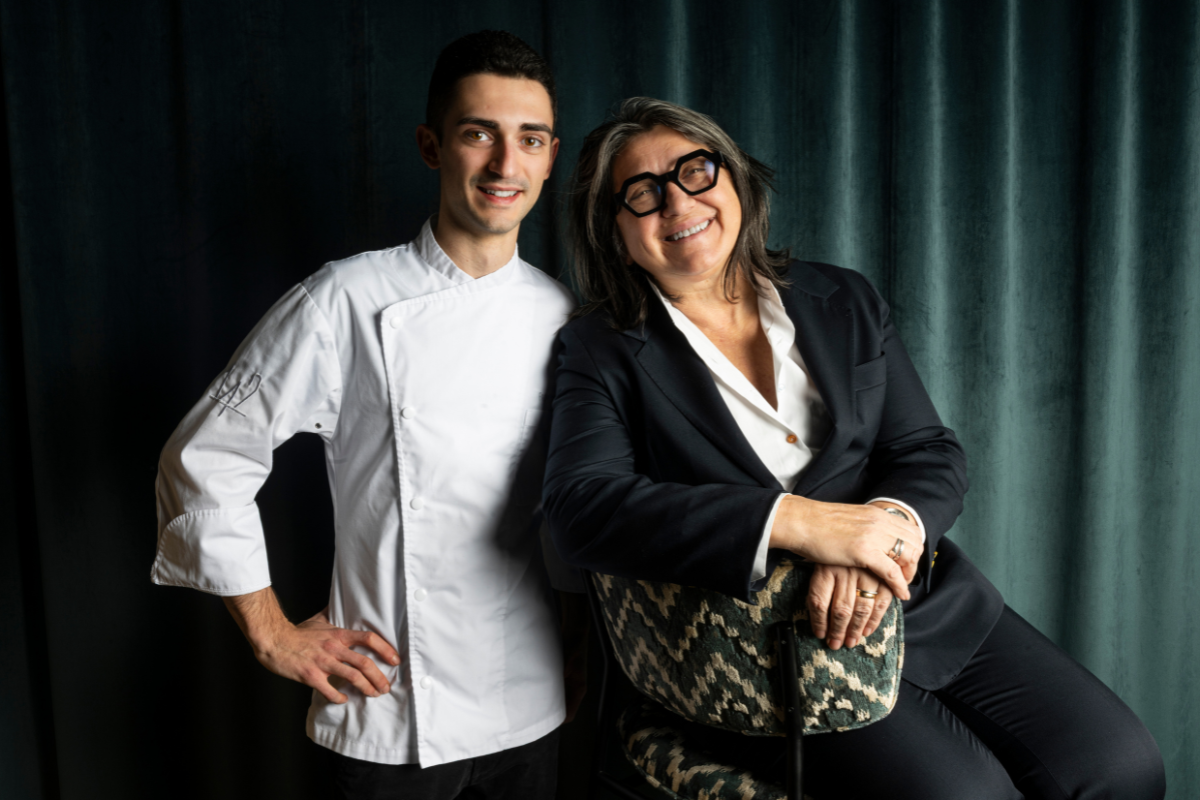
At 142 Restaurant in Milan, Sandra Ciciriello carries forward an idea of hospitality built on dialogue between kitchen and dining room. The project, today structured between Café & Bistrot and fine dining, sees chef Federico Zappalà in the kitchen, who joined the team in 2025, with an offering built on raw ingredients, hospitality and Italian identity.
Before founding 142 Restaurant, Sandra Ciciriello led the restaurant Alice in Milan for years, building one of the most important wine lists in the city. That path allowed her to compare very different models of cellar management, from the more than 900 references of her previous experience to the roughly 300 labels that today make up the list at 142.
Ciciriello carries forward a precise vision of the dining room: less rigidity, fewer unnecessary formalities, more ability to read the guest. It is a vision built over years in hospitality and commerce, through a path that led her to closely observe how the customer has changed, and how much the sommelier’s role needs to shed certain automatisms.
Let’s start with the relationship with the guest. Today there is much talk of fine dining being perceived as distant, sometimes too rigid. How much does the dining room’s ability to make the customer feel at ease matter, even when it comes to wine?
It counts enormously. When a customer walks into a restaurant, they must feel welcomed. It doesn’t mean making everything informal or losing the sense of service, but remembering that the guest is coming into your home. And if they come into your home, you have to put them in a position to feel good.
In recent years I sometimes see a rigidity that doesn’t help the restaurant industry. I understand a chef’s thinking, I understand a menu’s identity, I understand the need to keep a precise line. But when everything turns into a prohibition, when the customer faces only restrictions, something isn’t working.
The same applies to wine. If a person doesn’t want to drink, they shouldn’t be made to feel odd. If they want to understand, they should be guided. If they already have clear ideas, they should be respected. The dining room has to be able to adapt, rather than impose the same script on everyone.
In recent months, several dining room professionals describe a more informed customer, often already oriented in their choices. Is that also the case at 142 Restaurant?
Yes, especially in higher-level restaurants the customer often arrives better prepared. Many already know what they want to drink, or at least know which direction to take. The list still serves a purpose, though. It is there to spark curiosity, to shift attention, to reveal something the customer might not have chosen alone.
I still keep a printed wine list. I don’t use a QR code, because in my view the physical list remains a tool for connection. You pick it up, look at it, comment on it, and it opens a dialogue with the table. I understand that digital can be convenient, also for costs and updates, but in the way I work the printed list still holds value.
Today’s customer has more references, more attention, more information. But precisely for that reason, you can’t treat them as someone to be educated from above. You have to understand what they’re looking for. Maybe they studied the list before arriving, maybe they already know a producer, maybe they simply want to be guided. These are different situations, and the dining room has to be able to read them.
This also changes the sommelier’s role. Today it’s no longer enough to know the labels: you need to understand the customer, the moment, the tone of the table. Has it become a more psychological role?
In my view it always has been. I’ve worked in commerce since I was very young, and I’ve always thought that anyone who sells, welcomes, or serves must first of all listen. You can’t suggest something if you haven’t understood who is in front of you.
In wine this is even stronger, because wine is never just the liquid in the glass. It’s the moment you drink it, the company, the dish, the mood. You can drink a bottle one evening, in a wonderful setting, and fall in love with it. Then you buy it again, drink it at home, and it doesn’t give you the same emotion. Not because the wine changed, but because everything around it changed.
That’s why I say the sommelier has to understand whether the customer wants to talk, wants to be left in peace, needs to trust, or wants to be surprised. And they have to use their knowledge the right way. Knowledge shouldn’t make the customer feel less prepared. It should help explain, build a bridge. If it turns into a lesson, you’ve already lost the table.
Your experience at the Alice restaurant meant working with a list of over 900 labels, while today at 142 Restaurant the selection counts around 300 references. How has your approach to building the wine list changed?
Today at 142 we have 300 labels. It was an important choice, but a necessary one. With the arrival of Covid, I chose to remove foreign wines and focus on Italian products, with the exception of Champagne, which I’m quite fond of. Not because I don’t love foreign wines, quite the opposite. But at that moment I felt the need to work more on Italy, to support Italian wine and build a list more coherent with our restaurant.
There’s also a question of audience. We work with many foreigners, and a foreigner, if you know how to guide them, wants to discover Italy. They don’t necessarily come to drink what they could find anywhere. If you tell the story of a territory, a denomination, a producer well, you can take them places they would never have considered.
Regarding style, there’s a lot of talk about fresher, less alcoholic wines, less marked by oak. Do you see that in customer requests too?
Yes, the trend is clear. Wines that are too heavy, too woody, too constructed struggle more today. I’m not saying they no longer have a place, but they need the right context. A great important red also needs a kitchen that can support it. If the dish lacks structure, if there’s no chewiness, that wine risks becoming tiring.
For us, for example, important reds sell little. That’s why I removed wines like Amarone and Sagrantino di Montefalco. They are great wines, and this isn’t a rejection of the territory or the cellars. Simply, in our offering they weren’t moving. They stayed there, took up storage space, and weren’t functional to the experience we wanted to build.
I myself now look for wines that can be drunk with pleasure, without wanting to stop after two glasses. For me the pleasure of wine is also sharing a bottle calmly, without being challenged by its structure. And I believe many customers are moving in this direction.
In this scenario, what role do bubbles and by the glass service play? Champagne, Franciacorta, Trentodoc, pairing: how does today’s customer move?
Bubbles remain central. On a tasting menu, I often suggest starting right there. A well made sparkling wine accompanies, cleanses, sets the rhythm. Then everyone should drink what they love, of course. But if I have to think of a wine capable of fitting well within a culinary journey, I often think of a bubble.
Franciacorta in the North continues to hold significant strength. It has done great marketing work and the customer recognizes it. Trentodoc, however, is emerging enormously and I’m happy about that, because I consider it a denomination of great quality. It has freshness, identity, mountain character, and it can speak very well to an international audience too.
With foreign guests the conversation is interesting. They don’t only ask for the best known names. Often they want to drink Italian, but they want to be guided. They can be intrigued by a Franciacorta, or by a Trentodoc. If the story is told well, they follow the path.
As for by the glass service, I’ve always been against overly long journeys, with seven courses and seven wines. I prefer three, at most four glasses, well thought out. A wine can accompany more than one dish, can create a transition, can be designed within the menu. We don’t need to prove something by putting a different glass with every course. Wine has to support the kitchen, not steal its space.
Speaking of young people, it’s often said they’re more distant from wine, drawn to cocktails, beer or other languages. Is your perception different?
Very different. I see young people who drink well, who are curious, who know what they want and are also willing to spend. Not necessarily to drink a lot, but to drink better. Today I see a more attentive generation. Then of course, there are also those who follow trends, who drink something because they saw it somewhere, who want the wine of the moment. But that’s fine too, if it becomes an entry point. It’s up to us to understand whether there’s real curiosity behind it, and to nurture it.
Key points
- Ciciriello reduced her wine list from over 900 to around 300 labels, focusing on quality over quantity.
- Hospitality is centered on reading the guest rather than imposing a fixed script.
- Since Covid, the list has focused on Italian wines, with Champagne as the only exception.
- Customers now prefer fresher, lighter wines over heavy, oak-driven reds.
- Young diners show real curiosity and willingness to spend on better wine, not just trends.