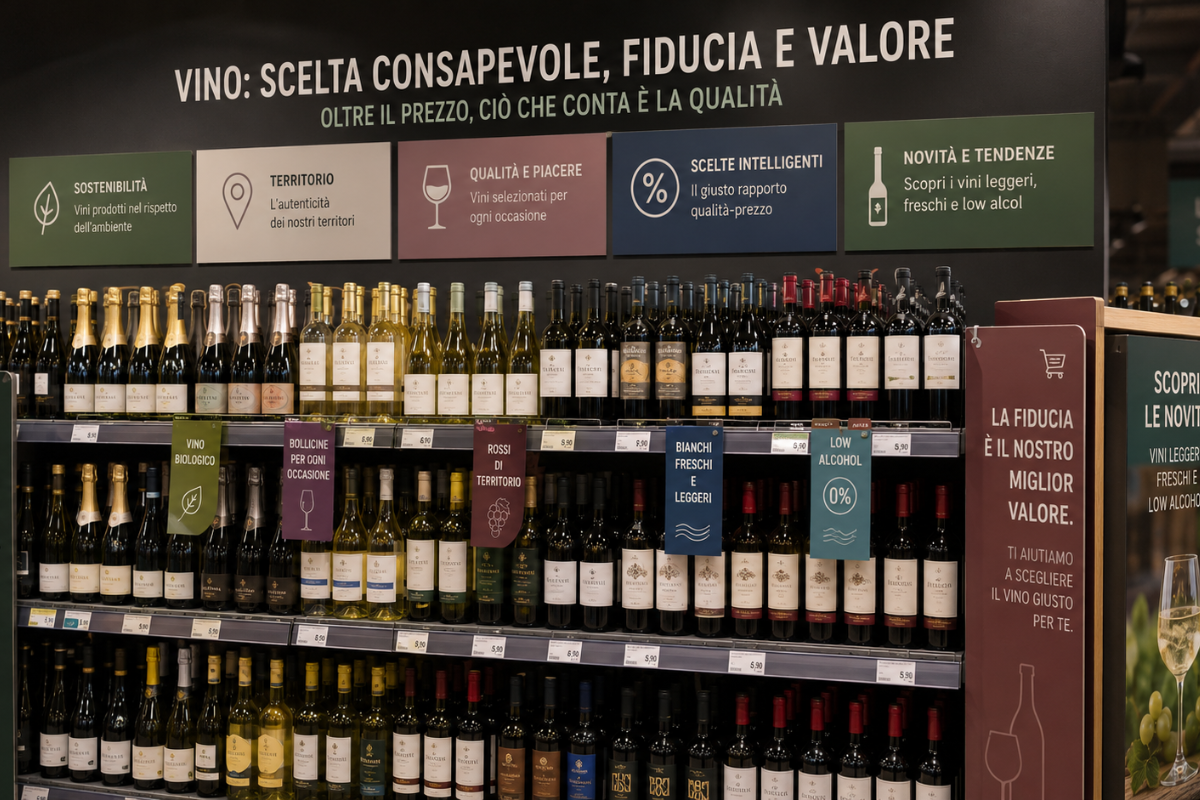
Giuseppe Acella, Beverage Buyer at Maiora, explains how large scale retail is responding to changing wine consumption habits. Consumers are buying less but seeking higher quality, lighter styles and greater trust, while promotions remain important but risk weakening perceived value. Innovation and tradition, he argues, are coexisting rather than replacing one another in today’s wine market.
Over the past twelve months, the wine market has continued to show signs of transformation. It is not just a matter of understanding which categories sell the most, but of reading with greater precision the motivations that guide purchasing decisions: price, brand, territory, occasion of consumption, trust, and the desire to experiment.
We discussed this with Giuseppe Acella, Beverage Buyer at Maiora, to understand how large scale retail is observing these changes and what responses it is building in terms of assortment, communication and shelf enhancement.
Over the past twelve months, how has wine buying behaviour changed? And which drivers weigh most heavily today in the choice?
The most evident change concerns the shift from a more quantitative consumption to a more qualitative one. Consumers tend to buy fewer bottles, but show a greater willingness to spend a little more on products perceived as better or more consistent with their own values.
This phenomenon goes hand in hand with greater awareness. Wine is no longer purchased only out of habit, but increasingly through a reasoned choice. The context of consumption has also changed: wine has partly lost its everyday dimension linked to meals and is shifting towards more specific occasions, often informal or social ones.
As a result, the hierarchy of purchasing drivers is also changing. Price remains important, especially in our supermarkets, but the weight of experience, perceived quality and trust in the brand or denomination is growing. Brand and reputation continue to play a fundamental role, because they simplify a decision that is often perceived as complex. At the same time, territorial origin and denomination carry increasing weight in the medium to high segments, where they become elements of storytelling and authenticity.
In summary, today there is no single dominant driver: consumers choose through a balance between rational and emotional factors.
There is a lot of talk about fresher, leaner, less alcoholic and easier to drink wines. Is this a real trend in sales? And in which categories are you seeing the most dynamism?
This trend finds concrete confirmation in market dynamics. In recent years we have observed growing demand for lighter, fresher wines with a more contained alcohol content, especially among younger generations, who show greater attention to wellbeing and moderation.
At the same time, the no and low alcohol categories are expanding, attracting new consumers and helping to redefine some occasions of consumption. That said, the change is not uniform. A significant part of the public continues to prefer more traditional, recognisable and reassuring wines. The market therefore appears increasingly polarised: on one side a more innovative and experimental segment, on the other a public still strongly tied to continuity.
The most dynamic categories are those linked to freshness, versatility and ease of consumption. Sparkling wines, in particular, continue to grow thanks to their ability to adapt to an ever wider range of moments. They are no longer limited to celebratory occasions, but are also chosen for more everyday and informal consumption.
White and rosé wines also show good dynamism, supported by a more modern positioning and greater ease of pairing. Red wines remain central in terms of volume, but are recording more contained growth and, in some cases, a slight relative contraction.
How have you adapted assortment, communication and wine selection to these changes?
We are progressively adapting our approach to respond to a consumer who is more demanding and less loyal than in the past.
On one hand we have strengthened the premium and identity driven offer, focusing on wines strongly linked to the territory and with a clear value content. On the other, we have expanded the assortment towards more contemporary categories, such as light, fresh or low alcohol wines.
On the communication side, we have shifted attention towards sustainability, transparency and storytelling, elements that have now become decisive in building trust. At the same time, we are seeing greater use of digital channels and direct sales, which allow for a more immediate relationship with the consumer.
What are today the main difficulties for Italian wine in speaking to the end consumer? And how much weight do promotions and discounts still carry?
The main difficulty lies in the complexity of the Italian wine system. The enormous variety of denominations, grape varieties and territories represents an extraordinary richness, but it can be difficult to communicate, especially to less experienced consumers.
Added to this is a fragmented production system that makes it more complex to build strong, recognisable brands, even internationally. Another limit concerns language, which is often still too technical and not very accessible compared to new, more informal and less ritualised consumption habits.
Finally, wine has to compete with new consumption occasions and with more immediate competitors, such as beer and cocktails, which speak a more direct language.
In this scenario, promotions continue to represent an important lever, because they significantly affect sales and product turnover. However, we are trying to reduce the excessive use of this lever. The risk is that consumers become trained to buy only when there is a discount, weakening the perception of the product’s value as a result.
For this reason, we are trying to balance promotional activities with strategies aimed at brand enhancement and building a more stable relationship with the consumer. In this sense, a more accessible reading of the shelf can also help support the choice without reducing it to convenience alone.
Looking ahead to the coming months, which trends do you think will continue to strengthen? And which, instead, seem more talked about than actually confirmed by purchasing behaviour?
Some dynamics already underway are likely to continue strengthening: the reduction in volumes in favour of greater quality, attention towards lighter and more versatile wines, and the growth of sparkling wines.
Sustainability and authenticity will also remain central elements in consumer choice. On the contrary, some trends appear clearly overestimated, such as the idea of a rapid shift towards completely dealcoholised wines or a total abandonment of traditional wines.
Change is real, but it happens gradually. More than a substitution, today we are seeing a strong coexistence between innovation and tradition.
Key points
- Consumers now prioritize quality over quantity, buying fewer bottles but spending more on trusted, values aligned wines.
- Sparkling, white and rosé wines are gaining ground thanks to freshness, versatility and everyday drinking occasions.
- Maiora is expanding its premium, territory driven range alongside lighter, low alcohol options to meet new demand.
- Excessive discounting risks weakening brand value, so promotions are being balanced with trust building strategies.
- Innovation and tradition are coexisting, with full dealcoholisation and abandonment of classic wines still overestimated trends.