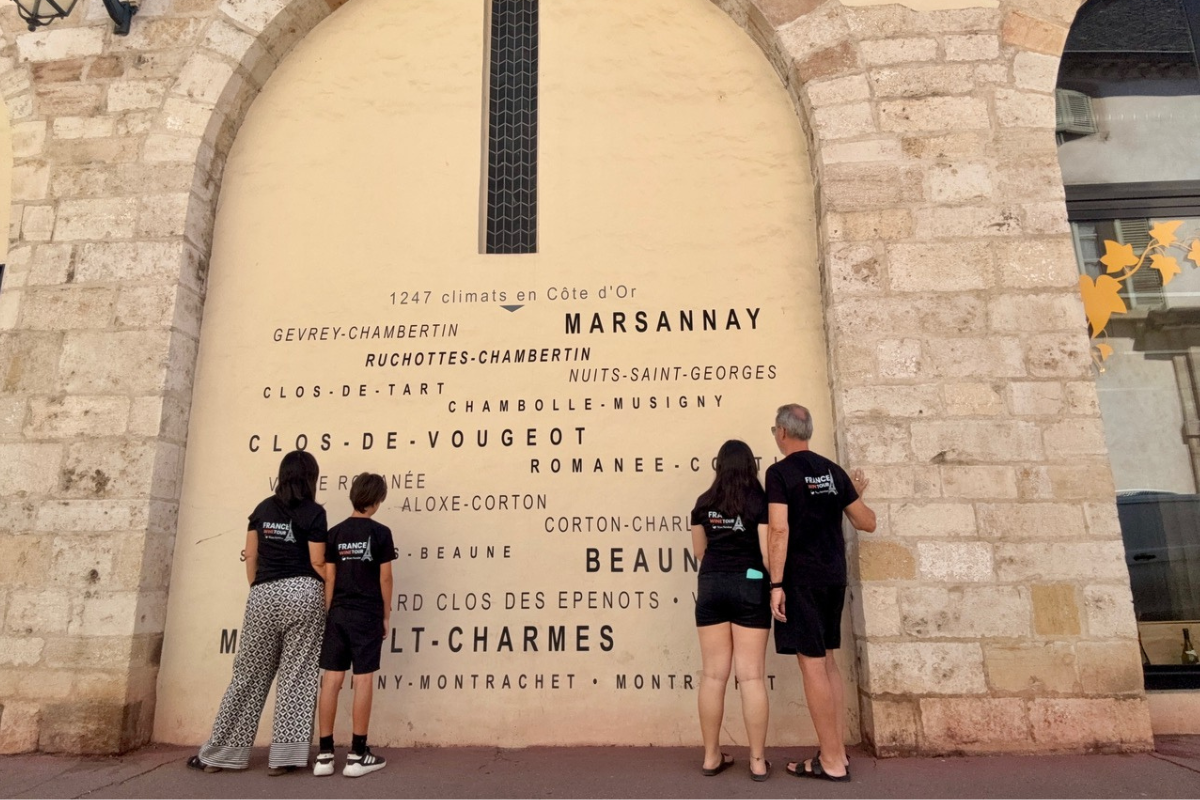
Our Wine Summer Tour’s first stop was Burgundy, where wine tourism thrives alongside centuries of history. Wineries proudly sell and showcase their experiences, making wine the true engine of the territory’s economy. Italy has its own potential “Burgundies,” but struggles to fully develop them. Producers there also fear losing authenticity to outside investors.
There are journeys made to rest and journeys made to understand. Our Wine Summer Tour has belonged, for years now, to the second category. The camper is taking us through France, England and Scotland, in a mix of wine tourism experiences that for the first time places whisky distilleries alongside wine, distilleries which, it must be said immediately, represent perhaps the pinnacle of hospitality at production sites, a model to study rather than to imitate.
But the first stop could only be iconic: Burgundy. A land that, year after year, confirms itself, probably, as the most prestigious wine production place in the world. And what air do we breathe, in Burgundy? This is the question we carry with us, because from such a privileged vantage point one can read, better than elsewhere, the state of health of wine. A health that, seen from here, appears good. And, hear hear, good also thanks to wine tourism.Because here the wineries, even the most renowned ones, are not at all ashamed to sell wine at the cellar, to offer and enhance their own wine tourism experiences. And they succeed not only because of the prestige and quality of their wines, but above all because in this land everything speaks of wine, everything starts from wine. It then becomes natural to ask: how many territories and denominations, in Italy, have made wine their main tourist attraction?There is an objection often heard. In Australia, in California, in South Africa, wine is the main attraction because there is nothing else so important: there is no history made of churches, museums, monuments, villages. Well, this cannot be said of Burgundy. Here the towns, starting with the beautiful capital, Beaune, are steeped in history.And despite this, wine remains the constant evocation, the thread that holds everything else together. From the vineyard landscape to the signage, from tourist offices to every detail of hospitality: everything leads you to understand that here the main attraction is the wineries, and that it is through them that you can know the history of a land and the meaning of an entire economy.All of this, naturally, rests on a quality that has few equals in the world. Pinot Noir and Chardonnay dominate, offering themselves at such a level that it makes you understand something simple: when such excellence is reached, crisis seems further away. And people arrive from every part of the world not only to taste great wines, but above all to experience a great wine land.How many Burgundies do we have in our country? Without wanting to seem presumptuous, I would say more than one. The problem is that we struggle too much to let them express themselves at their best, to fully capitalize on their extraordinary potential.Yet, for those who love wine as we love it, one leaves Burgundy reassured. With that good feeling that wine has not only a great history behind it, but also a great future ahead. Provided one believes in it, and invests in it seriously, without fears and without reservations.And so, if it is not the market, as it almost everywhere is in the world of wine, what is the real concern felt today in Burgundy? We do not have a statistically reliable answer, we say this honestly. But many of the producers and managers we met told us they were worried, some even very much so: that Burgundy might increasingly become the property of funds, or of those who see this land above all as a business.”People from outside,” capable of gradually eroding the authenticity of a place. They say this not out of some form of closure toward the foreign invader, but out of a fear, in my opinion legitimate, that their land might lose that sense of belonging, that truth of the territory which has been a decisive factor in its growth and its credibility. Ultimately, it is a concern that all the great wine lands should have. Including our own.
Key points
- Burgundy proves that wine tourism and rich cultural history can thrive together successfully.
- Wineries there embrace direct sales and tourism, unlike many hesitant Italian producers.
- Italy holds several potential “Burgundies” but struggles to develop their full tourism potential.
- Producers worry that outside funds may erode Burgundy’s authentic sense of territory.
- Investment and belief, not just quality, will determine wine tourism’s future success.