At Envisioning 2035 in Milan, consultant Federico Giotto argued that Italian wine must separate terroir from style, embrace dealcoholization on its own terms, and rethink rigid regulations under climate change. He proposed a future portfolio built on three wine types, the Manifesto, the Essential and the Threshold, to meet contemporary consumers.
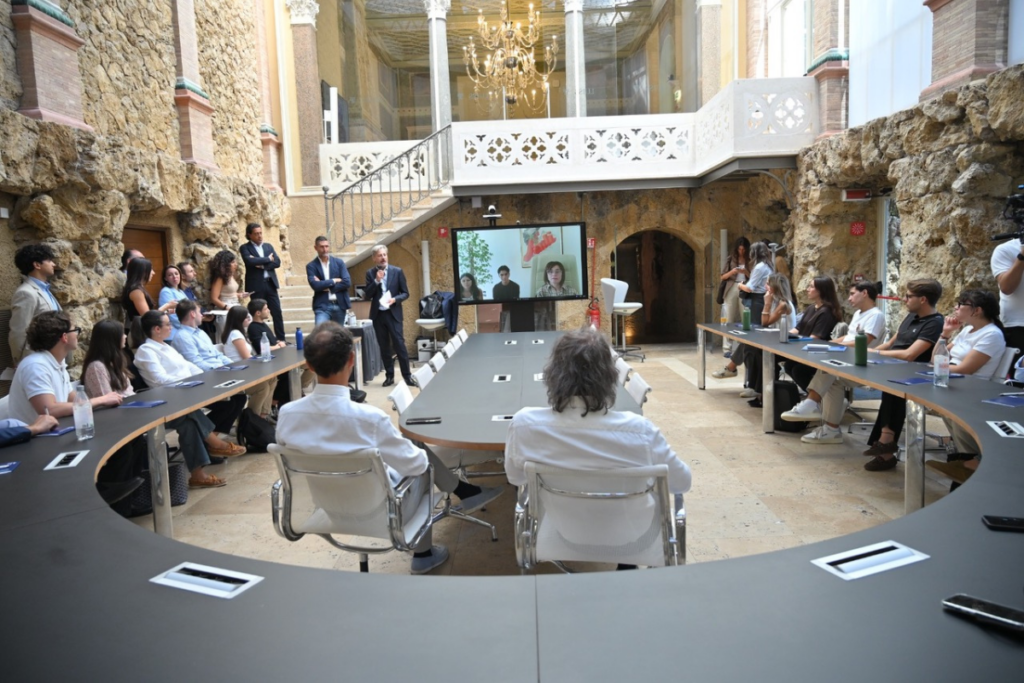
On Thursday, June 4, 2026, at the Terrazza Belvedere of Palazzo Regione Lombardia in Milan, the second edition of Envisioning 2035, Wine [R]evolution, took place, the event organized by Wine Meridian with the support of FreedL Group dedicated to the strategic priorities of Italian wine looking ahead to 2035. The format, built around dialogues guided by director Fabio Piccoli, brought together entrepreneurs, managers and analysts called upon to state frankly what works and what needs to be rethought in the supply chain.
Among the most substantial contributions was that of Federico Giotto, founder of GiottoConsulting, today Giotto Wine Listeners, and among the first voices in Italy to translate contemporary wine into concrete consulting practices.
Terroir and style: two concepts we still confuse
The heart of the speech was a distinction that, according to Giotto himself, the industry still cannot make its own: “Terroir and style are not the same thing. One of the great weights we have carried is thinking that style could defend terroir.”
Terroir is what we are, geology, exposure, microclimate, the culture of the place. It is immutable, or almost. Style is how we open ourselves to the world now, extraction, elegance, use of oak, management of aging. It is changeable, shifting decade by decade. Confusing the two concepts, in his consulting experience, is “the root of most of the positioning errors of Italian wine over the last decade.”
The image he uses is almost pop: “The shoulder pads of the 1980s were pure contemporaneity, they were the way communication happened then, but they did not identify the character of the people who wore them.” The overextracted reds of twenty years ago were the shoulder pads of wine. “Style of a decade, not the identity of a terroir. It is a narrative shortcut that has become a collective habit, and it impoverishes the vocabulary of the industry.”
From this distinction comes his definition of contemporaneity in wine: “Contemporaneity is what has always allowed wine to be truly current.” And he gives two historical examples. The first concerns the methanol crisis at the end of the 1980s: those who listened to demands for more genuine wines managed to make great wines precisely during that difficult period. The second, a decade later, concerns the rediscovery of native grape varieties: “Those who did not listen did not remain more faithful to terroir.”
Well-made lightness is an act of vision, not subtraction
On the subject of lighter, more drinkable, less alcoholic wines, a growing demand among consumers, Giotto is clear: the signal should be taken seriously, but interpreted correctly. “Today’s lightness is a broader cultural phenomenon. Fine dining is retreating in favor of more direct formats. The rhythm of meals is changing, their duration, their context.”
The distinction he proposes is fundamental: “Light does not mean empty. The consumer is not asking for dilution but for a more approachable form of wine, less conceptual, more immediate. And more immediate does not mean simpler: it means a wine that expresses itself with empathy for those who want to explore its substance.” The adjective he proposes is essential: “Well-made lightness is an act of vision, not of subtraction.”
The mistake he sees growing is exactly the opposite: thinking that “lighter” is achieved by increasing yields or irrigating more. “The result is a wine without a center, and a wine without a center builds neither loyalty nor margin.” The correct answer lies elsewhere: calibrated loads in the vineyard, harvesting by aromatic profile, macerations defined by duration and temperature calibrated to the variety, selective extraction.
DOC regulations should not be overturned, but climate has changed the rules of the game
On the regulatory front, Giotto acknowledges an objective limit of the production rules without proposing a radical rewrite. “When the major Italian regulations were defined in the 1970s, there was an assumption: the territory had been like this for 200 years. In the last 15 years we have seen completely different variations. Climate change is completely challenging the rules of the game.”
“Tannins that ten years ago needed four years of aging to round out now arrive already polymerized at harvest, and long aging risks drying them out instead of building them. Alcohol and extracts that we used to call structure are now imbalance. Phenology has advanced, harvest windows have narrowed, the chemistry of the berry is different. Terroir has not changed as geology. It has changed as expression.”
The paradox is that this is happening while the market that used to buy Italian wine has stopped doing so as before: domestic consumption declining, American tariffs weighing on margins, Asian demand stalled. “The cornerstone has cracked inside and outside the vineyard at the same time.” For the first time, the Italian winemaker no longer has a fixed point. He must read two things in motion, not one.
Dealcoholized wine: not a wine without alcohol, but a category with its own rules
On dealcoholized wine, Giotto chooses to move with neutrality, without remaining a slave to an enological culture he nonetheless says he is proud of. Technically, he says, good quality dealcoholized wines are made today, especially with whites and sparkling wines: advanced reverse osmosis, vacuum distillation, spinning cone column. “Each with its own balance between yield, aromatic integrity and investment in the process.”
For reds the challenge is different: “Removing alcohol from a red wine is not a neutral operation on its phenolics: tannins and anthocyanins rely on ethanol as a solvent and carrier, and this changes structure, color, longevity.”
The main problem, however, is not technological. “Italian winemakers scorn dealcoholized wine because they see it as a technique of subtraction. It is a cultural reflex, not yet an analysis.” And he gives the example of sparkling wine: at first it was seen as a forced choice compared to “natural” wine. From that contested technique one of the most appreciated, and expensive, categories in the world was born. “What one generation calls denaturing, the next calls language. The difference never lies in the technique. It lies in the time the category takes to understand what that technique can do uniquely.”
The trajectory Giotto indicates is precise: dealcoholized wine must not be “our wine without alcohol,” a subtractive version of the flagship product. It must find its own suited grape varieties, its own protocols built specifically for dealcoholization. “A product that only lives as a subtractive version of something else will never have its own light. And without its own light, it will not break through.”
The parallel is with Glera and sparkling wine production: without Prosecco, Glera would never have become the best selling sparkling wine in the world. “The technique found its variety, the variety found its technique, and together they built a new identity. Dealcoholized wine is not a wine without alcohol. It is a wine with its own rules, which have not yet been written.”
PIWI and climate change: field data, not just conferences
On the subject of resistant grape varieties, Giotto brings direct field data. At GiottoConsulting they have tested over fifty resistant varieties across multiple sites in recent years, and the picture that emerges is “less triumphant than what circulates at conferences.”
Souvignier Gris and Solaris have shown proven resistance to downy mildew and powdery mildew in the field. “Others present real cultivation problems. And almost all are more susceptible to less discussed diseases, such as black rot, which shows up as leaf loss in summer, bunch mummification and weakening of the wood. This is not an agronomic detail: it affects the vitality of the plant and the lifespan of the vineyard.”
He also distinguishes between two technical paths that are often confused in public debate: on one hand PIWI varieties in the strict sense, obtained through interspecific crossing; on the other cisgenesis, which acts on the existing variety by transferring resistance genes from compatible species. “Cisgenesis does not dismantle Italy’s varietal map: it keeps Nebbiolo, Sangiovese, Glera, Aglianico, and adds resistance.” A path that deserves, he says, open discussion within the regulatory framework the EU is defining.
On the structural block he is direct: “The production rules are the tool through which the past defends itself from the present. We are asking Italian producers to face a changing terroir, and at the same time we are forcing them to use the same protocols established in the 1990s. Both things cannot be done at once.”
The practical proposal is to open small portions, particularly in the replanting of vineyards that are dying, where the interaction between variety and specific territory can be tested in a controlled way, at limited cost.
The winemaker of 2035: a wine listener before being a wine maker
Asked whether the Italian winemaker is today more a brake or an accelerator of innovation, Giotto answers without mincing words: “Today, often, the Italian winemaker is a brake. His profession was defined forty years ago as ‘interpreter of the territory,’ and that profession is no longer enough today.” With a less comfortable addition: the brake is not only the winemaker’s, but also that of whoever stands above him, “the founder patriarch of the winery who thinks in silos and not in ecosystems.”
His thesis on the profession is direct: “To make a good wine only one thing is needed: everything. There is no other productive activity in the world that requires as many converging skills in the same finished product.” Agronomy, viticulture, chemistry, microbiology, process engineering, design, marketing, finance, governance, communication, distribution. The winemaker’s profession in the two thousands was one of these things, perhaps the noblest. Today it is not enough.
The term he uses to describe the new figure is precise: “Wine Listener before Wine Maker. The order matters. Whoever makes wine before listening makes the wine of the twentieth century.” A choice he says he made empirically when he decided that GiottoConsulting would not be a consultancy with a head winemaker, “but a multidisciplinary team of people with converging skills.”
Vermentino as a testing ground for business aggregation
Returning to the example of Vermentino, mentioned during the day, Giotto points to business networks as the most immediate tool for giving critical mass to a variety grown across different territories: “In certain territories, a union between companies, including some with very strong brands that can act as leaders, can in my view be an effective and powerful tool.”
But he recognizes a limit that is “purely cultural, entirely Italian: individualism, skepticism, distrust, egocentrism. The problem with networks or business aggregation lies entirely here, and it is mainly a cultural matter. The business network, in my view, is the first tool to consider for developing a project of this kind.”
Three grammars of the same terroir: Manifesto, Essential, Threshold
Piccoli’s last question was operational: which three wines should an Italian company have in its portfolio to be relevant by 2030, and probably does not yet have. Giotto’s answer turned out to be a thesis: “The Italian company of 2030 is no longer a winery that produces a range, but three grammars of the same terroir.”
The Manifesto is the wine of identity: it states who you are as a vision of terroir, as style, as a company across the time in which it lives. “It is the wine that differentiates itself and will never be a commodity.”
The Essential is the wine of empathy: it embraces a precise moment of consumption, even one that until yesterday did not exist. “It moves closer to the consumer instead of asking the consumer to move closer.” It does not replace the Manifesto: “On certain occasions the duty to draw closer rightly remains with the consumer, and it is the Manifesto that governs those occasions. The Essential reverses the vector for the rest of the occasions, it does not cancel the others.”
The Threshold is the wine of inclusion: it includes those who were outside the ritual by choice, by faith, by occasion. But it also includes those who were outside for geographic reasons, the new markets that did not grow up inside the ritual of Italian wine. “I have worked as a consultant on several continents, and one thing I have learned in the field: a wine of inclusion is designed well only if you have drunk, eaten and sold within those cultures. It is a form of language, a bridge that often opens the way for Manifesto wines.”
The conclusion is not a forecast but a diagnosis: “By 2030 there will not be companies that make contemporary wine and companies that do not. There will be companies that have built these three languages, and companies that will have only one, which will always need a constant Wine Translator to be understood and communicated.”
Key points
- Terroir and style are distinct concepts, and confusing them has caused years of positioning mistakes.
- Well-made lightness requires vineyard precision, not simply higher yields or more irrigation.
- Dealcoholized wine needs its own grape varieties and protocols, not treatment as subtracted wine.
- Winemakers must become listeners first, combining agronomy, design, finance and communication skills.
- Three wine styles, Manifesto, Essential and Threshold, will define competitive Italian wineries by 2030.