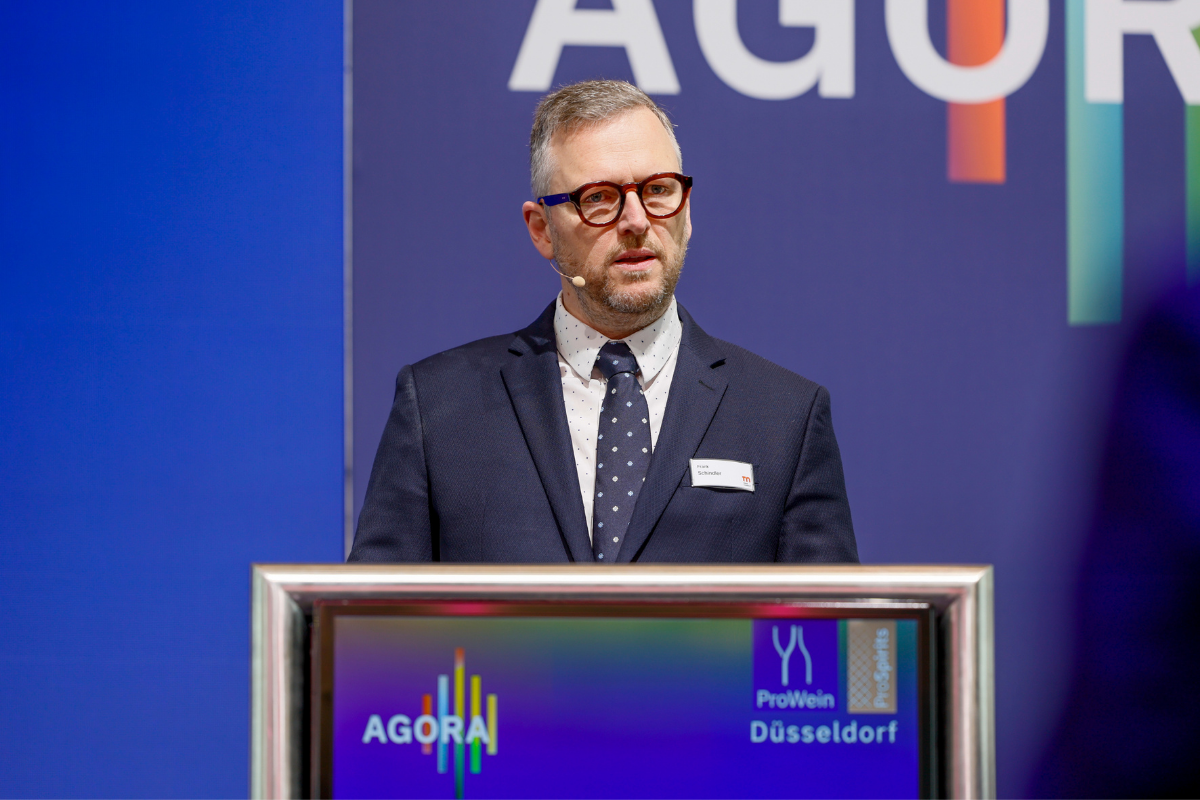
ProWein is redefining its strategic role in the international wine market by prioritizing quality over quantity. Under Director Frank Schindler, the 2027 edition introduces an exhibitor cap and freezes prices. The focus shifts towards targeted buyer matchmaking, long-term stability, and continuous year-round industry support, reinforcing Düsseldorf’s position as a central European trade hub.
The landscape of wine fairs is changing rapidly. Rising costs, increasing competition among events, and a highly selective approach by exhibitors are forcing organizers to rethink their role. ProWein responds with a strategy built on three pillars: More Focus, More Proximity, and More Industry. We discussed this with Frank Schindler, Director of ProWein Düsseldorf from October 2025, exploring the reasons for this change, the decision to limit the number of exhibitors, and the role Düsseldorf intends to play in the future of the international wine business.
ProWein deliberately chose to limit the number of exhibitors and maintain a more compact format. In a sector where many fairs continue to associate growth with size, why did you decide to go in the opposite direction, and what did the 2026 edition teach you about the effectiveness of this approach?
ProWein has grown enormously in recent decades, but we are witnessing profound changes in the wine market, and consequently, the fair must evolve as well. We must become a partner for our exhibitors and visitors, creating the conditions for fertile and successful business, moving beyond merely providing exhibition spaces.
For me, it was particularly important to guarantee long-term stability for both visitors and exhibitors. This is also why ProWein introduced a cap of approximately 4,000 exhibitors for 2027 and the coming years. The goal is to avoid overloading the infrastructure, maintain shorter routes within the fair, and preserve that efficient and focused format that has always represented one of ProWein’s strengths.
You describe ProWein 2027 as the main European fair dedicated to wines and spirits. Beyond the slogan, what does this positioning mean concretely for exhibitors and buyers, and how does it differ from the role ProWein played just a few years ago?
ProWein is a truly international fair, since only about 20% of the exhibitors are local. At the same time, we represent a natural hub for all emerging wines and producers from Eastern Europe. With the new positioning as the main European fair supported by strong international purchasing power, our geographical location becomes a competitive advantage once again.
Germany remains the largest wine importing market in the world, while North Rhine-Westphalia hosts the highest concentration of wine merchants and importers in the country. The fair is located practically next to the most important European purchasing centers. ProWein also interprets its role as an observer of trends and a facilitator of new opportunities. For this reason, the new Discovery Zone was created, conceived as an economically sustainable access point for young, innovative, and trend-oriented producers interested in connecting with international buyers and developing new commercial relationships.
The wine world increasingly demands quality contacts rather than large numbers of visitors. To what extent has ProWein shifted its priorities from attracting more people to attracting the right people, and what elements from the 2026 edition convinced you that this is the correct direction?
With our Hosted Buyers Program, we want to ensure that producers get in touch with the exact target they are looking for. While in the past we merely opened the doors of the fair, today we define very precisely who we consider truly important to bring to ProWein. The main source markets for buyers, besides Germany, are Benelux, Scandinavia, the United Kingdom, Eastern Europe, Asia, Africa, and the United States.
This strategy reflects a broader shift in ProWein’s priorities. Rather than focusing on the overall number of visitors, the fair aims to attract buyers with real purchasing power and a concrete commercial interest. The objective is to create the best business opportunities for exhibitors, generating new orders and new revenue streams.
Wine fairs have always been great meeting points for the sector, opportunities for discussion and sharing. In a phase of profound change, however, a fair must offer much more than meeting historical clients and good friends, translating concretely into new orders and new revenue opportunities.
The international wine market is becoming increasingly selective, and companies carefully evaluate their return on investment when choosing which fairs to attend. How is ProWein adapting to this new reality, and what international audience do you intend to attract in the coming years?
We invite our exhibitors to indicate their markets of interest, and we focus our work exactly on these needs.Germans are known for clarity and efficiency, qualities that the wine market particularly needs today. We will continue to enhance these strengths of ours even further.
This market-oriented approach also explains ProWein’s decision to keep exhibition space prices flat without inflation-linked increases for 2027. The cost per square meter will remain unchanged, keeping the fair accessible even to small and medium-sized producers and helping to maximize the return on investment for exhibitors.
Besides matchmaking activities, ProWein is expanding its role as a reference platform for the sector throughout the year through initiatives gathered under the ProWein Academy brand. These include the Agora congress format, the Visionary Talks, and the Masterclass Forum, designed to offer market information, strategic insights, and professional training well beyond the three days of the event.
Germany remains one of the main wine importing markets in the world. How does this context strengthen the strategic role of ProWein, and why do you believe that Düsseldorf is becoming an even more relevant hub for the international wine trade?
Being an importing market, we understand buyer needs even better, enabling us to offer German and international operators the most suitable exhibitors and program. This is our strongest Unique Selling Proposition, as we are perfectly capable of reasoning with the mindset of international buyers.
This ability to understand purchasing behaviors is at the center of ProWein’s future strategy. The fair is increasingly shaping itself as a platform built around demand rather than supply, leveraging Germany’s role as the world’s largest wine importing market as a competitive advantage.
In parallel, investments in accessibility and networking are further strengthening Düsseldorf’s attractiveness. From September 2026, the new U81 subway line will directly connect Düsseldorf airport to the exhibition center, while a dedicated agreement with Düsseldorf Tourism will make 400 hotel rooms available at a fixed rate during the event.
We have listened very carefully to the sector in recent months and we have understood what the most urgent needs of businesses are today. These are demanding times for the wine world, but I am convinced that ProWein represents a solid long-term partner for all participants, continuing its support throughout the entire year.
Key Points
- Strategic exhibitor capping ensures efficient routes and long-term infrastructure stability for all participants.
- Targeted buyer matchmaking prioritizes high-quality commercial contacts and concrete purchasing power over general visitor volume.
- Price freeze initiatives keep the fair highly accessible for small and medium-sized innovative wine producers.
- Year-round platform expansion provides continuous strategic insights and professional training through the new ProWein Academy.