When Giuliano Bortolomiol passed on his winery, he left no son to inherit it, only four daughters. Maria Elena, Elvira, Giuliana and Luisa built their own governance model instead, running the estate on quality, sustainability and instinct. Their vision extends to Parco della Filandetta, a restored silk mill now hosting art, nature and wine.
Italian wine has a favourite succession story: a son inherits the cellar, the family name gets stamped on a new label, and the rest more or less writes itself. Bortolomiol was never going to follow that script, if only because Giuliano Bortolomiol didn’t leave behind a son to follow it with.
What he left, instead, were four daughters, over two centuries of family winemaking behind them, and an open question in front of them: what do you do with an inheritance like that?
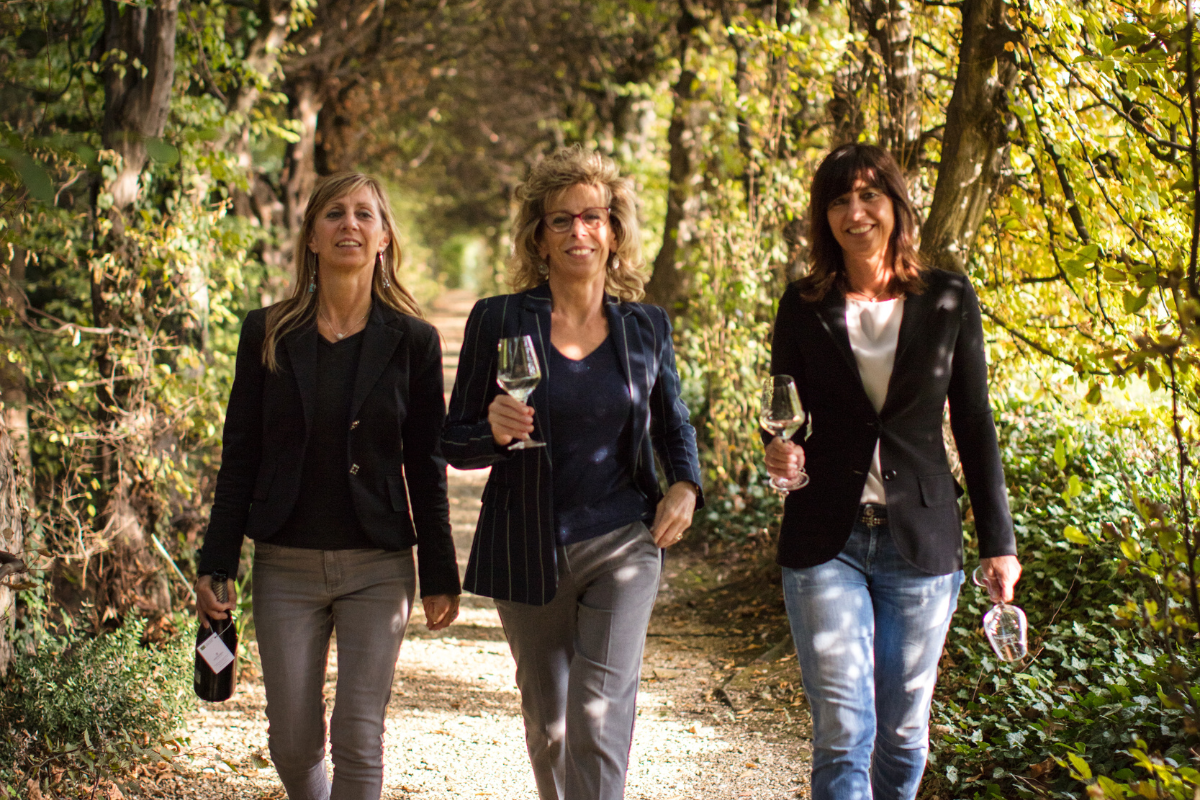
Maria Elena, Elvira, Giuliana and Luisa found their answer not in following instructions but rather in trusting their instinct. Under the imprint left by Giuliano and his wife Ottavia, the four sisters didn’t simply hold the line on what their father had built. They took on new challenges of their own, running the family business through the ordinary, unglamorous pressures every winery faces, quality, efficiency, effectiveness, with a competitive edge that’s entirely theirs. The result is something still fairly rare in Italian wine: a company led, at every level, exclusively by women.
It shows up first as a matter of principle. “We were born and we work in a precious territory,” the family has said. “Preserving this heritage and these hills intact is a responsibility, a daily commitment that guides every decision we make.” It’s the kind of line that could read as a slogan anywhere else. Here, it reads more like a job description, the same one Giuliano wrote for himself decades earlier, handed down and rephrased for a new generation.
That principle translates into specifics: energy savings, water use kept in check, waste reduction treated as routine rather than gesture, a broader environmental and social commitment the sisters describe as creativity and renewal applied to the land itself. Which means that the wine world is changing, and, fittingly, this particular revolution comes in rosé.
That range runs wide, from the Rive di Col San Martino and the Grande Cuvée del Fondatore in the Fondatore Collection, through the Couture Millesimati wines, Bandarossa and the Superiore di Cartizze D.O.C.G. among them, to the Tradizionali Millesimati line of Audax, Prior, Senior, Maior and Suavis. It’s a range that keeps circling back to the same hills: Valdobbiadene, Col San Martino, the steep vineyard of Cartizze itself. And it’s no accident that the rosé carrying the Filanda name is the one that shares its roots most directly with the old silk mill turned art space, two projects born from the same instinct to give a familiar place new form.
The clearest expression of that philosophy isn’t in the cellar at all. Parco della Filandetta – Wine & Art Farm occupies a former industrial complex that was, in its own time, a place of female labour and emancipation, a filanda, one of the silk-spinning mills where generations of women earned their own wages before that was a common thing to do. Restored, it’s now a space where nature, contemporary art and wine culture are meant to sit at the same table, which makes it less a side project than a fairly precise metaphor: a building once defined by working women, brought back to life by women running the estate next door.
Giuliano used to say this land held something nobody fully understands yet. His daughters seem intent on finding out anyway, one harvest, one exhibition, one water-saving measure at a time.

Key points
- Succession broke tradition: four daughters, not a son, inherited Bortolomiol’s two-century winemaking legacy.
- Governance at Bortolomiol is now led entirely by women, a rarity in Italian wine.
- Sustainability practices, energy savings, water control, waste reduction, guide daily decisions across the estate.
- Parco della Filandetta repurposes a historic silk mill into a wine, art and nature venue.
- Heritage and renewal coexist, as the sisters reinterpret their father’s principles for a new era.