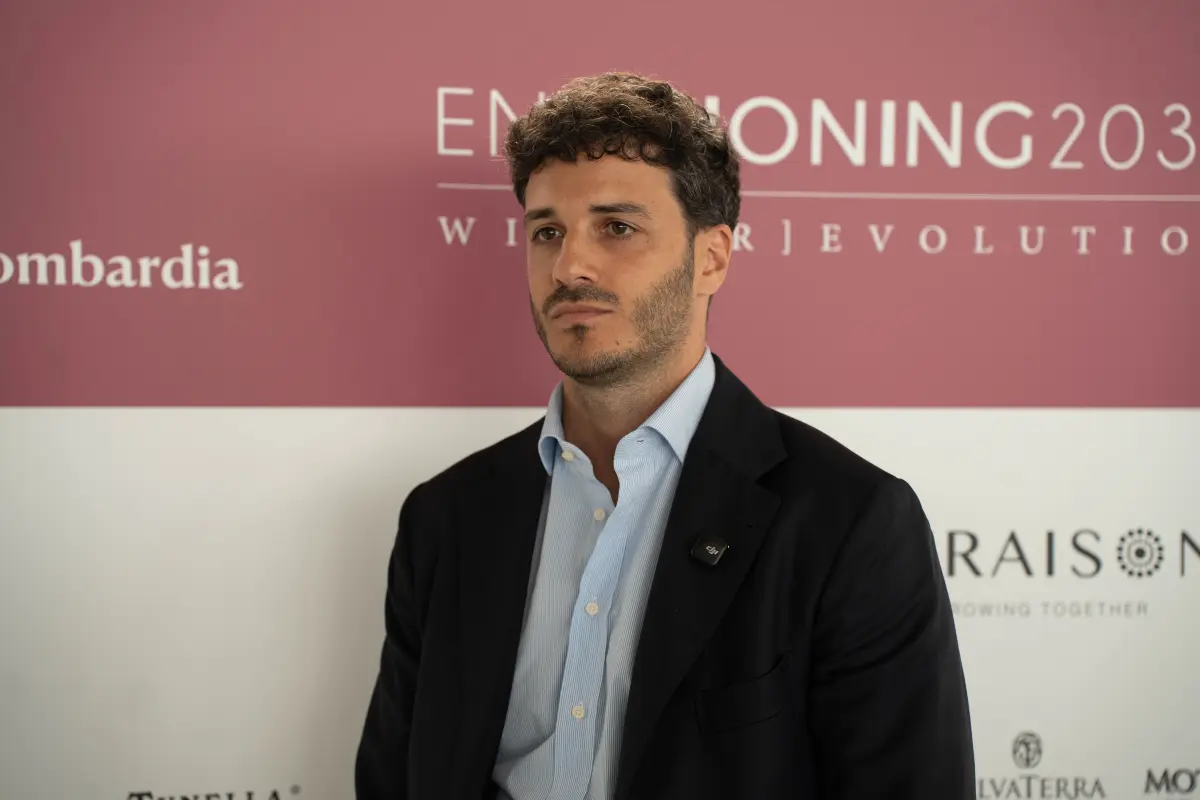
At Envisioning 2035: Wine [R]evolution in Milan, Michael Page head hunter Pierluigi Catello explained why wine companies struggle to attract talent. Small size, unclear growth paths, family structures and vague roles discourage young professionals, while international vocation and territorial identity remain strengths. He urged companies to ask why a talent should choose them.
On the Belvedere Terrace of Palazzo Regione Lombardia in Milan, last mid-June, the second edition of Envisioning 2035: Wine [R]evolution took place, the Wine Meridian initiative supported by FreedL Group that each year brings together entrepreneurs, managers and analysts of Italian wine to build, through direct discussion, concrete strategic priorities looking ahead to 2035.
The moderator Fabio Piccoli guided the whole day, asking the speakers to go beyond analyzing critical issues and to also bring operational solutions and testimonies into the room. Shifting the focus to the sector’s human capital was Pierluigi Catello, Executive Manager Food & Wine Industry and Head Hunter at Michael Page, among the most experienced recruitment figures in the world of wine in Italy.
Company size also weighs on the labor market
For Catello, the sector’s low attractiveness to talents depends largely on the same characteristic already raised in other talks of the day: the average size of companies. “We are talking about small to medium-sized companies in most cases, which are often not organized and structured to attract, welcome and retain talents who today, on the market, are approached by large companies from various sectors and product categories,” he explained.
“Today a wine company must compete not only with other wine companies to attract a talent, but must also compete with realities from other product sectors,” such as luxury, spirits or industrial food and beverage.
Unclear growth paths, absent organizational charts
Catello precisely identified the organizational knots that discourage young professionals: “Clear growth paths are missing, and so when a young person enters the company he or she does not know what path they will be able to follow and what roles they can aspire to.”
The family structure, frequent in the companies of the sector, adds a further limit: “I’ll give an example: perhaps a young guy enters with the role of junior export manager and reports to an export director who is a member of the family. So he already knows from the start that he will not have the chance to grow all that much within the structure.”
To this are added poorly defined organizational charts and uncertain boundaries of responsibility: “I often find myself dealing with candidates who do not even know well what their boundaries of responsibility are, where perhaps the ownership is very influential and also enters fields it should not enter.” And, as a consequence, objectives that can be measured and incentive plans linked to results are often missing.
Small size as a training ground for skills
Catello also paired this picture with a positive aspect that is often underestimated: in less structured companies, roles are more fluid and allow young professionals to get hands-on experience with different functions. “This allows, when the next step comes in other companies, to have a wealth of skills and knowledge that surely has great value and carries a certain weight within the market. It is no coincidence that the more structured companies of the sector then go fishing for their talents or their managers within these companies that are precisely less structured.”
The question every company should ask
Catello ended his speech with a direct synthesis, addressed to all companies in the sector: “The question that more wine companies should ask themselves is: why should a talent choose us today? And not other companies, both in the same sector but also outside the sector.”
The answer, according to Catello, comes through internal organization: welcoming people, making them grow, training them, retaining them, offering credible paths over the medium to long term. Among the strengths on which to build this proposal, Catello cited the sector’s strong international vocation and the territorial and cultural identity of the product, two elements that, by his account, remain a concrete competitive argument toward young people in search of a job with a recognizable meaning.
Key points
- Small company size limits the ability to attract, welcome and retain talent against luxury, spirits and industrial food groups.
- Missing growth paths leave young professionals unsure which roles they can reach.
- Family structures often cap career progression, with senior roles held by relatives.
- Vague organizational charts blur responsibilities and leave objectives and incentives unlinked to results.
- Small companies build skills, and larger companies recruit talents and managers from them.