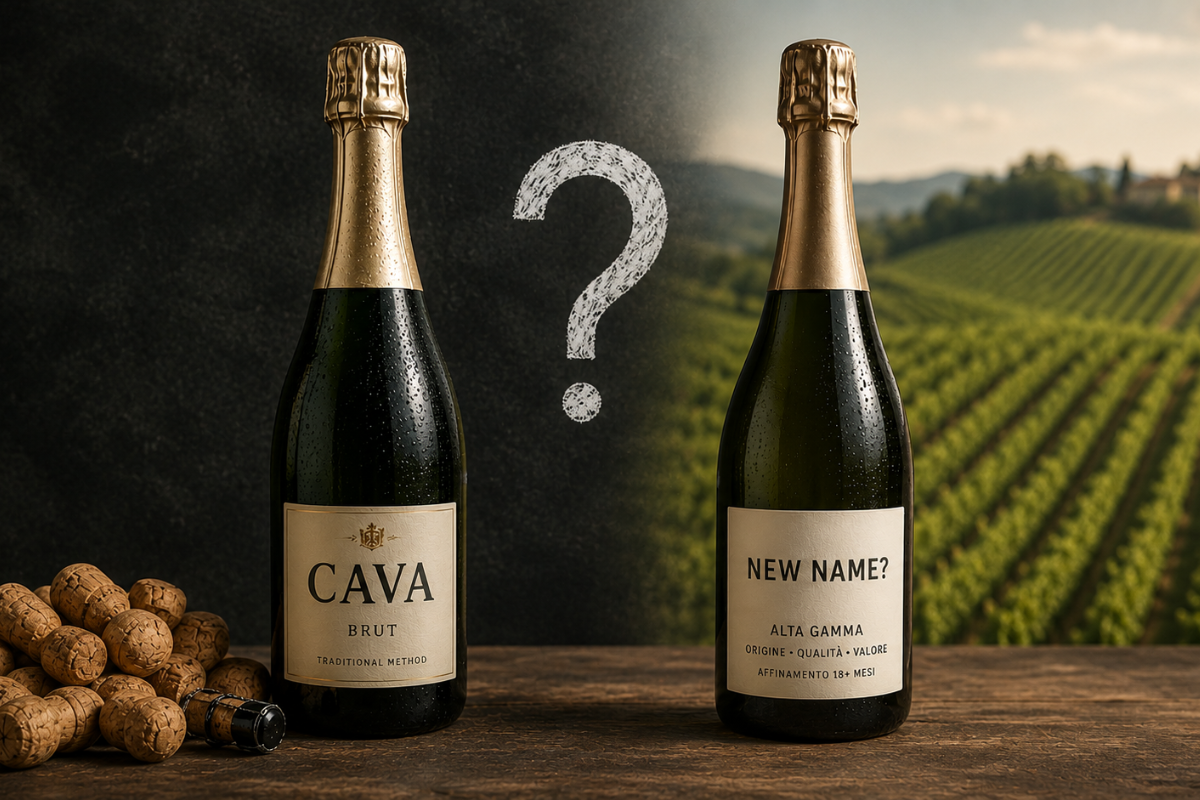
Some experts suggest that Spain’s best sparkling wines should abandon the name Cava to escape a reputation weakened by volumes. The article questions whether a new name alone can raise prices, since distribution, positioning and collective value remain unchanged, and shows how marginal Cava is in Italy. A new name works only as the result of a project.
Faced with a weakened reputation, changing the name is a formidable temptation: it costs less than changing the market. But if tomorrow Spain’s best sparkling wines stopped being called Cava, would consumers really be willing to pay more for them?
Carlos López de la Calle of Artadi argues that the name has been damaged by volumes and that the top end needs a territorial identity. Sarah Jane Evans MW even proposes a threshold: Cava under 18 months of ageing, another name for the superior wines.
The diagnosis contains a truth. In 2025 the DO marketed 190 million bottles and almost 88% belonged to the basic category, Cava de Guarda. If the name appears mainly on affordable products, more months on the lees are not enough to make it a symbol of prestige. Removing the name Cava from the best labels would mean leaving it to the products that weakened its perception. Would it be a cure or a surrender?
In Italy the problem comes even earlier. A survey of the digital catalogues of Carrefour, Vino.com and Callmewine returned at least 18 names between brands and producers. In the three large-scale retail chains checked, only three emerge: Freixenet, Heretat El Padruell and Fantini/Cala Rey. It is a sample, not the national total, but it points to a fragmented presence.
The volumes confirm the marginality: in the Datos Económicos 2023 of the DO Cava, the latest report in which the breakdown for our country is available, Italy ranked twenty-fourth with 765 thousand bottles. In the Global Report 2025, instead, it no longer appears among the denomination’s top twenty foreign markets.
We had already observed in February on Wine Meridian that between 2009 and 2025 Spanish sparkling wines had grown by 22%, against 276% for Italian ones, with an average price of 3.76 dollars per litre. These are problems of positioning, distribution and collective value: no vocabulary can solve them.
The provocation concerns Italy too, where the Qualivita Observatory counts 522 PDOs and PGIs of wine. How many struggling denominations could blame their own name? And how many, after changing it, would discover that consumers continue to ignore them?
Corpinnat or a new territorial identity can work if they make stricter rules, origin and quality visible: the name thus becomes the consequence of a project. If instead it serves to escape low prices and a weak reputation, it is only a new label on the same problem.
Key points
- A new name cannot fix reputation, distribution or prices on its own.
- Cava de Guarda made up almost 88% of the 190 million bottles marketed in 2025.
- Italy is marginal: 765 thousand bottles in 2023, absent from the top twenty foreign markets in 2025.
- Corpinnat or similar identities can work only when they make stricter rules and quality visible.