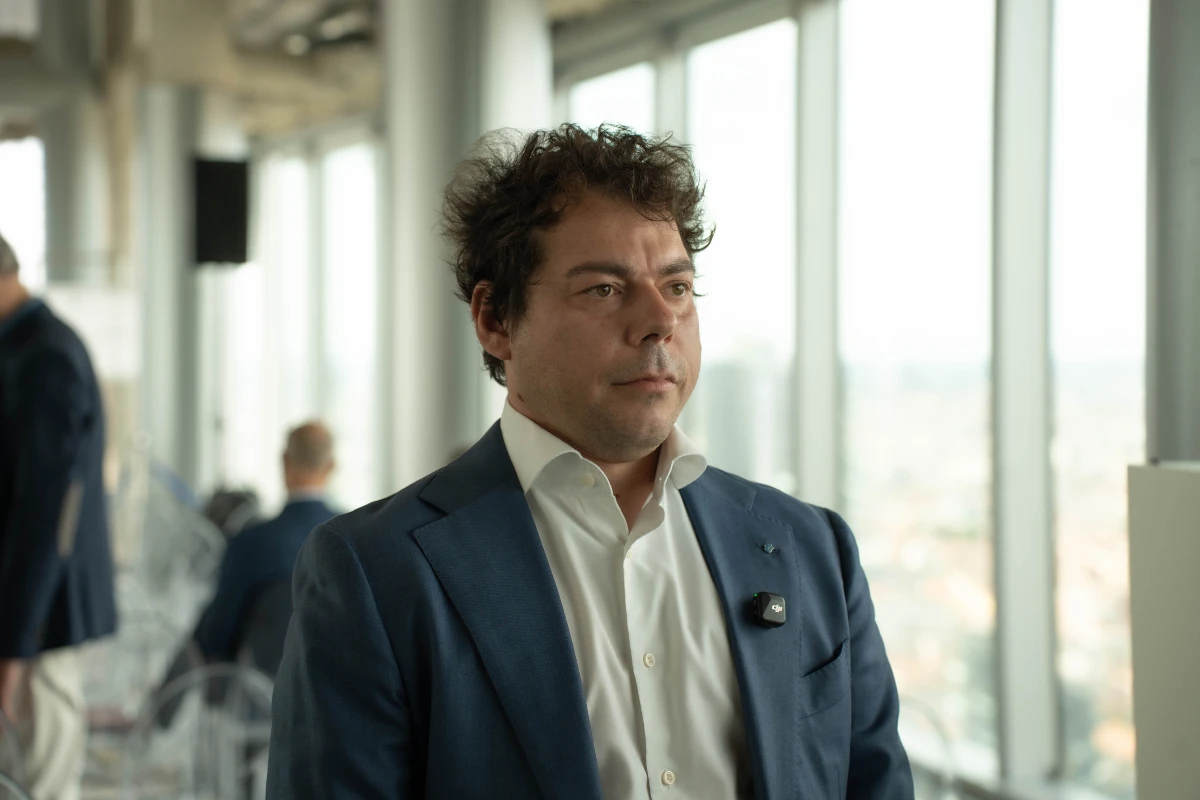
At Envisioning 2035 in Milan, Winelivery CEO Francesco Magro outlined a pragmatic strategy for the wine sector: diversify markets and sales channels, keep financial discipline, and integrate online with physical venues. In his view, digital is evolving rather than declining, because people want social experiences, while online solves convenience and logistics.
The second edition of Envisioning 2035: Wine [R]evolution took place in early June at the Terrazza Belvedere of Palazzo Regione Lombardia, in Milan. The event, organized by Wine Meridian with the support of FreedL Group and hosted by our Director Fabio Piccoli, brought together entrepreneurs, managers and analysts called upon to discuss a precise goal: to turn the analysis of the wine sector’s difficulties into concrete strategic priorities for the next ten years.
One of the protagonists of the day was Francesco Magro, CEO and co-founder of Winelivery, indicated by Piccoli as one of the most original observers for his career, which began in digital and is today increasingly oriented also toward physical spaces.
Diversify markets and channels
Magro adopted an operational approach from the very first words, avoiding general recipes in favor of his direct experience: “Rather than saying what should be done, I will tell you what we do, in a very simple and pragmatic way. We have an important industrial structure, we have to produce and sell those bottles every year in a context that I would call challenging, to use a polite term”.
The first point he insisted on is the need to multiply commercial markets and channels, precisely when internationalization alone is no longer enough to offset the decline in domestic consumption: “The fact that Italian wine has dealt with a drop in domestic consumption through internationalization is no longer enough today, because distant markets are increasingly difficult. For this you need organization and people”.
A reading that, he observed, is also confirmed by Mediobanca reports, where the most structured companies turn out to be those that have best handled the current phase, having more resources to maintain a presence in distant markets.
For Magro the formula comes down to two pillars: “Diversification of markets and commercial channels. We have a direct sales part to the final consumer, e-commerce, on-trade, large-scale retail”. Alongside this he places a second element that he considers non-negotiable: “Financial discipline, which is a fundamental issue in a company. It would not even be necessary to stress it, but the numbers must be in order”.
Digital is not in crisis, it is evolving
Asked about Winelivery’s transition from a company born online to an investor in physical wine shops, Magro offered a reading that overturns the most common narrative on the alleged decline of wine e-commerce: “There is no “crisis” of digital in itself, but there is an evolution. People, post-Covid, have a strong desire for physical experiences, for socializing, for touching things with their own hands. Online solves a problem of convenience and logistical functionality, but it does not solve the experiential aspect”.
His current strategy stems from this observation, which he defines as omnichannel rather than an alternative between physical and digital: “Online and physical are not in competition, but integrate with each other. The physical venue also becomes a hub, a direct point of contact with the consumer, which strengthens the brand and builds loyalty among customers, offering that experience of socializing and conviviality that is fundamental today to sell wine”.
A summary that, during the Envisioning 2035 day, found an echo also in other talks devoted to the growing role of physical experience in the relationship between wineries and new consumers.
Key points:
- Diversify markets and channels: direct sales, e-commerce, on-trade and large-scale retail, since internationalization alone falls short.
- Structured companies cope better: they have more resources to cover distant markets, according to Mediobanca reports.
- Financial discipline is fundamental: the numbers must be in order in every company.
- Digital is evolving: online delivers convenience and logistics, while physical venues deliver experience and socializing.
- Use physical venues as hubs: direct contact with consumers strengthens the brand and builds loyalty.