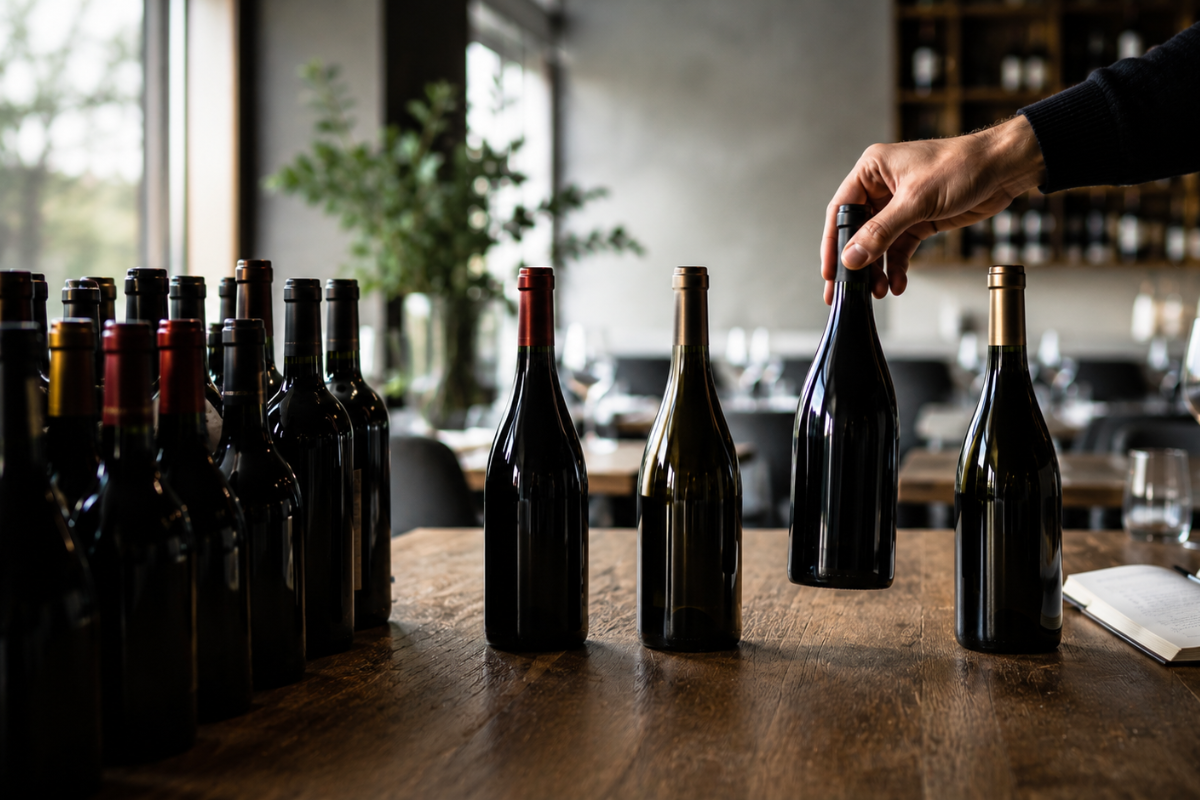
Horeca venues are ordering less, more often and with greater caution, favoring wines that rotate quickly and well known names. Distributors report smaller volumes but rising average prices. Their role is shifting from supplying a wide catalog to guiding restaurateurs toward coherent, sellable lists that respect liquidity, warehouse limits and supplier commitments.
The distributor is one of those trades that everyone criticizes until they are truly needed. When the market is moving, it can seem like just one more step between the winery and the restaurant. When sales slow down and the warehouse starts to weigh, the perspective changes. Because today the problem is not finding wine. The offer has probably never been so wide.
Carlo Alberto Sagna, sales director of Sagna, describes a less expansive market than in the past. Not necessarily stalled, but far more careful about what it buys. “Caution is evident. In general we receive smaller but more frequent orders, with greater attention to liquidity and warehouse management.”
Rotation has become the criterion that decides the survival of a reference. It is not enough for a wine to be good or to represent a prestigious denomination. It must have a recognizable function within the venue’s offer. If it stays still, sooner or later it disappears.
“After the phase following the pandemic, during which many wine lists had expanded, today we are seeing a return to more targeted selections,” Sagna continues. He does not consider it an impoverishment of the offer, but a more conscious construction of the assortment. Depth remains where there is concrete demand; elsewhere stocks are reduced.
The results of Sarzi Amadè show the other side of the same phenomenon. The first half of 2026 closed with a revenue increase of over 12%, despite a slight decrease in bottles sold. “Against a slight decrease in bottles sold, we recorded an increase in the average price per bottle,” says Alessandro Sarzi Amadè, head of the historic Milanese distributor.
The high end holds, but mostly through recognized names. When the market becomes cautious, curiosity is often the first item to be cut. Venues prefer to buy bottles that do not require months of explanation before finding a customer willing to order them.
“Demand is concentrating more and more on the most renowned producers,” observes Sarzi Amadè. Lesser known labels, instead, encounter greater difficulties, even when their price is not particularly high. The perceived risk does not depend only on cost: it depends on the time needed to sell the bottle.
Luca Cuzziol, chief executive officer of Cuzziol Grandi Vini, notes how the average restaurant relies more and more on distribution. “In a moment like this, the wine list of the average restaurant goes more and more toward the distributor, because there is a need to have more offer.”
The advantage does not consist only in the breadth of choice. A distributor allows the venue to avoid dozens of direct relationships and to buy more manageable quantities. It can guarantee that continuity that becomes essential when nobody wants to keep bottles destined to gather dust in the cellar.
Pietro Fasola, wine ambassador of Velier, underlines precisely this aspect: “Distribution offers a new business the opportunity to access a wide portfolio, allowing it to create a wine list quickly. Another advantage is the possibility of managing everything with a single invoice.” It is a concrete service, perhaps not very romantic, but decisive for a business that has to control its warehouse. The risk arises when convenience replaces thought and the list becomes the reduced copy of the supplier’s catalog.
A wide portfolio, in fact, does not automatically coincide with a good selection. The distributor’s work begins precisely where the catalog ends: in understanding which producers are coherent with a venue and which risk remaining only interesting names on the list. Craftsmanship, too, cannot on its own become a sufficient criterion.
There remains the economic tension. Sarzi Amadè describes it as the attempt to reconcile the commitments made with suppliers and the resistance of customers to buying products that are not essential. “The greatest difficulty consists in reconciling the needs of customers with those of suppliers,” he explains. “On one hand there are precise commitments in terms of volumes; on the other we encounter a growing resistance to buying products that are not strictly necessary.”
The distributor must respect the agreements made with the wineries, but cannot offload them onto the lists of restaurants. If it does, it stops selecting and simply starts transferring its own warehouse into someone else’s.
Sagna identifies pressure on prices and credit management as two of the most evident critical issues. For this reason the relationship with Horeca must go beyond supply. “It is not enough to put a reference on the list,” he maintains. The distributor must help the venue build an assortment coherent with its identity and with the actual possibilities of rotation.
It must not choose on behalf of the restaurateur. It must avoid having the restaurateur choose in the dark. Horeca wine does not need yet another bottle proposed only because it is available in the catalog. It needs someone who can explain why it should go on the list and, above all, who has the courage to recognize when it would be better to leave it out.
Key points
- Rotation decides which wines stay on the list, as venues order smaller but more frequent quantities.
- Average prices rise while bottles sold decline slightly, with demand concentrating on renowned producers.
- Distributors offer wide portfolios, fewer supplier relationships and single invoicing to venues managing liquidity.
- A wide catalog is no substitute for a selection coherent with each venue’s identity.
- Distributors must help restaurateurs choose wines that fit their identity and rotation, without passing on their own stock.