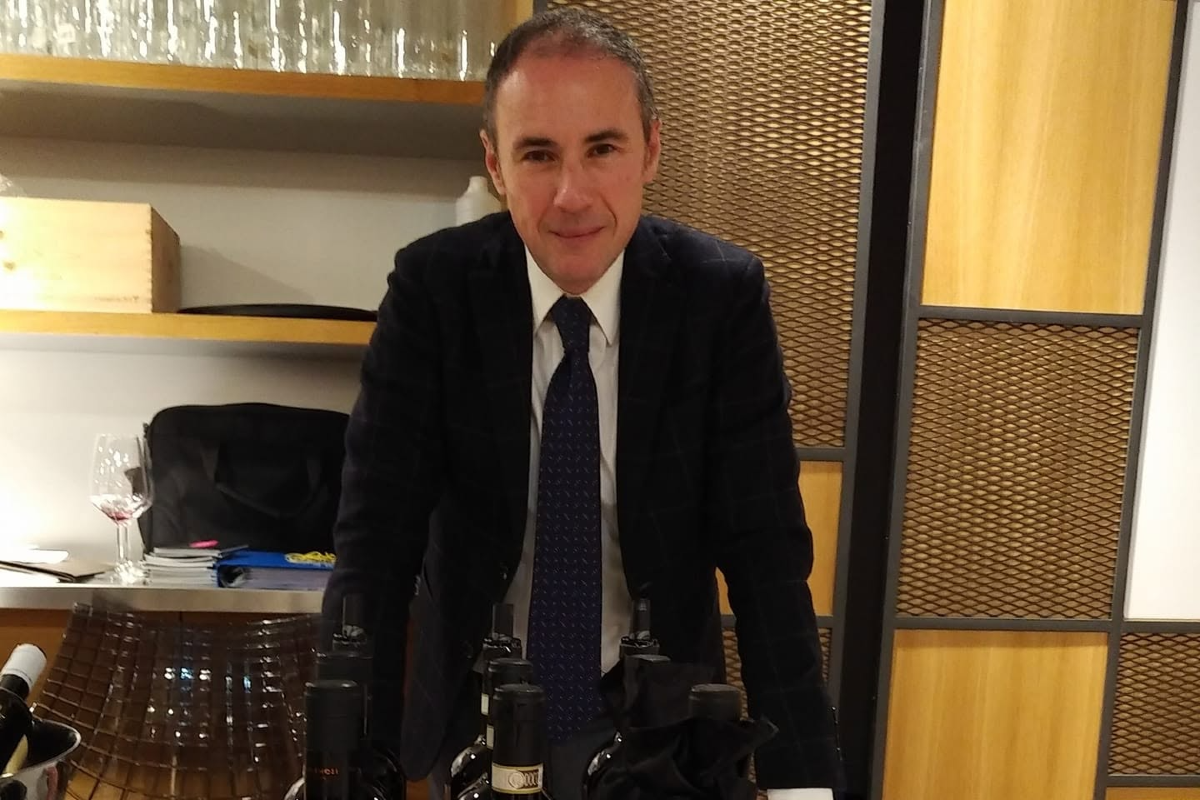
Dario Pennino, a wine professional with 25 years of international experience based in Germany, argues that Italian producers should treat the German market as a domestic one. He links weaker sales to misaligned prices rather than changed tastes, criticizes sporadic commercial efforts, and calls for local presence, continuity and tailored business models before the expected economic rebound.
The German market continues to be a fundamental outlet for Italian wine, but approaching it with the same commercial logic as a few years ago could prove to be a mistake. With consumers increasingly attentive to the ratio of quality to price, premium wines struggling to find space, competition that often plays out among Italian labels themselves and export strategies that are not always sufficiently structured, Germany is asking our companies for a change of perspective.
This is stressed by Dario Pennino, a wine professional with 25 years of international experience, now permanently resident in Germany, where he follows the market for companies such as Velenosi, Firriato, Tenuta di Capezzana and, in the food sector, world leader Urbani Tartufi. His knowledge, built directly in the field through daily dealings with importers, distributors, restaurateurs and sales operators, allows him to observe the dynamics of the German market from a privileged perspective.
His reading starts from a contrarian consideration: it is not necessarily the German consumer who has changed attitude towards wine, but the producers who have progressively misaligned their offer from the consumer’s spending expectations. It is therefore a question of prices, but also of perceived value, positioning and the ability to interpret the characteristics of a market that is anything but homogeneous.
The interview also reveals a rather sharp criticism of the way many Italian companies approach export: ranges that are at times not very effective, commercial channels treated indiscriminately, discontinuous investments and knowledge of the market often entrusted to sporadic visits. For Pennino, Germany should not be considered simply a commercial destination, but a true domestic market, to be covered with specific skills, continuity and a concrete presence on the ground.
A scenario in which opportunities are growing for white wines and sparkling wines, while the premium segment is going through a particularly difficult phase. And in which, above all, waiting for a recovery in consumption will not be enough: companies will need to arrive prepared, with business models capable of intercepting the new market conditions.
You live permanently in Germany and directly follow the market for several Italian wine companies. After these years of on-the-ground observation, what is the most significant change you have noticed in the behavior of German operators and consumers? Is it mainly greater caution in purchases, a different sensitivity to price, or is the role that wine plays in consumption habits changing more deeply?
The attitude of buying smaller quantities stems, in my opinion, from a certain caution towards wines whose prices have risen conspicuously in recent years, especially in restaurants. If so, I would dispel the recurring warning of recent times according to which consumption is shrinking simply because people “want to drink less” or because tastes have changed. I would instead shift the reasoning to another level: the contraction is induced by an offer that has progressively become misaligned with demand.
Let us look at the matter from another perspective: the consumer has not changed, the offer has. Buyers remain faithful to the price categories in which they recognize themselves and which allow them to sustain a certain level of spending. It is a mechanism that applies to all product sectors.
Wine producers have overstepped, when not even ignored, this scheme, applying increases over the years that are now backfiring on them. Some wines, having reached very high prices, cannot even express in the glass a value truly corresponding to what is asked.
In the German market, local wine retains a very strong position, especially in certain categories. How much does competition from German producers weigh today, and on what grounds can Italian wine truly compete?
Frankly, I do not believe that German wine can cause a decline in the quantities sold of Italian wines. It is certainly a competitor by its very nature, but Italian wine has a very strong link with the gastronomic tradition, and this is precisely its ideal ground for competition.
One of the most delicate aspects for Italian wineries is probably building a correct price positioning. In a market where discounters and large-scale retail carry considerable weight, while consumers pay increasing attention to the ratio of quality to price, which price ranges are the most interesting for Italian wines today?
As we mentioned before, the German consumer has a rather precise view of the amount they intend to spend on a bottle of wine, whether in a restaurant, in a supermarket or in a wine shop. The ratio of quality to price is a fundamental element, also because the romantic and impulsive component of the German consumer is much less present than, for example, that of an Italian.
Consequently, if a product does not match their perception of value and what they consider the correct price point, they simply do not buy it. They give up or, at best, postpone the decision. There is also an aspect not to be underestimated: we are generalizing, because Germany is by no means a homogeneous market. There are very different lifestyles and behaviors between the various regions.
A financial capital like Frankfurt, for example, presents a cultural mix that determines consumption criteria different from those of a city like Freiburg. Likewise, Hamburg is different from Stuttgart, just as Munich and Berlin represent different realities from Kassel or touristic Heidelberg.
Is there a problem with the perceived value of Italian wine? Let me explain: do products that in Italy are considered to be in the medium to high range, and that have important denominations, territories and stories behind them, manage to maintain the same positioning in Germany, or do they risk being perceived as interchangeable with cheaper alternatives from other producing countries?
Yes, the question is on target. The Italian producer is often driven by their own ego: the denomination, the vineyard, the classification, “my wine”. These are all very interesting arguments, but they must reckon with the pragmatism of the German consumer and with the limit of the information the consumer has.
Variety and blend can be distinctive elements, but, if a product is positioned incorrectly, it risks being replaced at any moment. I do not see particular threats coming from other producing countries. Rather, cannibalization occurs among the Italian products themselves.
Italian companies often reason about the selling price without fully considering the final price to the consumer, which must take into account the margins of importers, distributors and retailers. How important is it to know the structure of the German commercial supply chain before even deciding at what price to export? And how often do the pricing strategies of our wineries prove unrealistic precisely for this reason?
The commercial supply chain in Germany can be very long or extremely short. Let us not forget that many Italian producers sell directly from Italy: in these cases, the chain is very short. The problem, rather, lies in the tendency to treat all channels in the same way: the same product ranges, the same commercial proposals, regardless of the recipient. At most, the bottle label is changed.
Italian producers sometimes have very extensive ranges, often valid too, but the commercial approach is not sufficiently diversified. The strategies do not follow consolidated business models, but are affected by an entrepreneurial culture of an artisanal type, in the good sense of the term. Organizations that are at times too small and/or family run favor approaches that are scarcely scientific.
Consider that, in some cases, the same person covers several roles that would each deserve a specialization. The owner can be at the same time the boss, the export manager, the administrator, the testimonial and the sales manager for Italy. It is an evident limit.
Importers and distributors generally apply margins in line with the costs of their structures. Rather, there would be something to discuss about restaurateurs’ markups, but that is another topic, on which it is not possible to intervene directly, except by appealing to sensitivity in building an appropriate offer.
The concept of selling “by the glass” is growing. In this case, products must work according to precise logics and have certain characteristics, both in taste and in price. I would also take into account another aspect: in Germany, below a certain price threshold on the list, a bottle is perceived as not being of quality. As can be seen, it is a rather complex balance, which requires careful analysis.
Do Italian companies invest enough in building their brand awareness on international markets? In your experience, how much does the reputation of the individual producer really count compared to the notoriety of the denomination?
No, not all of them and not always, even though many think they do so through sporadic visits to the country and a few Instagram posts. Commercial development activities in this sector have very ancient roots and, essentially, will not change: tastings, samples, evenings with food and wine pairings, recurring visits to the market, handshakes, trade fairs. It is about conveying trust and stability, building relationships and demonstrating that one has a vision. Germany is a large country and must be covered. But I will come back to this later.
To answer the second part of the question, the German market first of all knows and recognizes the varietal expression, then the brand and, possibly, the name of the individual bottle. Denominations, on the other hand, are often not very effective because they are still little known. Best sellers such as Chianti, Amarone, Lugana, Primitivo, Barolo and Montepulciano follow their own path of notoriety, regardless of more or less recent successes on the market.
The German market is historically characterized by a highly articulated distribution, in which discounters, supermarkets, specialized wine shops, independent importers, restaurants and e-commerce coexist. If you had to identify the channels on which an Italian company should concentrate its investments today, which would you choose?
We cannot aim to cover all distribution channels well. A producer must choose and select those most consistent with their own product ranges, study a valid price point and identify the right sales speeds and rotations. It would be very helpful, if possible, to create a synergy with the importers’ management, sit at the same table and outline a shared, detailed common strategy. Skills and experience should be brought to the table by both sides.
If the game plan is not convincing, it is better to give up and allocate time and resources to something else, to more targeted projects. “Less is more”, a marketing mantra of the 1970s that I still consider highly relevant. Let us do what is needed.
As for the classic Horeca channel, commercial operators (importers, local distributors and wholesalers) maintain broad and varied assortments, keeping an overall view. Others, instead, continually try to add new wineries to their assortments, without managing to make them work. The result is that one product leaves and another is introduced, often without a precise analysis behind it and conditioned by a poorly calibrated eagerness. This means wasting time and money, contributing to a crowded offer and a situation of stalemate.
In your career you have worked with very different companies, including in terms of size, notoriety and organization. What is the strategic limit you most frequently find in Italian wine companies when they approach the German market? Insufficient knowledge of the consumer, lack of commercial continuity, ineffective communication, or the tendency to consider export as a simple sales activity rather than a medium to long term investment?
The great limit is the one I have been repeating for years and which, for those who know me professionally, may by now sound redundant. It is also the reason why I chose to live here: Germany is not an export market, it is a “domestic” market.
Its management cannot be delegated to managers who visit the country only occasionally. I am thinking, for example, of someone who spends two days between Leipzig and Potsdam and the next day takes a plane to Hong Kong or Singapore. We are talking about completely different things.
In about 25 years of activity I have traveled the world, visiting more than 60 countries, some of them several times, such as the United States. Working in export is fantastic and traveling the world is priceless, but Germany needs professionals with specific experience and attitudes, preferably resident on the ground and who know the language.
It is a large country, with enormous sales opportunities and the possibility of activating a customer in every corner of it. And this is precisely the strength of the German market. Focus, attention and continuity are needed: one must build storytelling with customers, visit them constantly and repeatedly, understand their needs and, if possible, anticipate them.
Looking at the transformations in consumption, which segments do you think can offer the most interesting opportunities for Italian wine in Germany in the coming years? I am thinking, for example, of white wines, sparkling wines, organic wines, premium products, alternative formats and low or zero alcohol wines. Are there categories that, in your opinion, Italian companies are still underestimating or interpreting in an unconvincing way?
White wines are growing, certainly. I would say the same of sparkling wines: it is a trend that seems to be consolidating more or less everywhere. The same goes for wines with a slightly lower alcohol content. However, the alcohol component is one of the foundations of a wine: it contributes to structure, intensity, volume and, in part, its personality.
Care must be taken not to denature what represents the very essence of a good product by chasing the trends of the moment. We can observe, instead, that products at the high end and premium products are suffering greatly in Germany, now relegated to a super niche. And this, unfortunately, I believe is a point of no return.
If you were to sit down today with an Italian winery that wants to enter the German market, or to consolidate an existing but unsatisfactory presence, what would be the first three strategic decisions you would recommend?
The first decision is to ask oneself: “What do I want to be when I grow up?” If one believes that Germany can represent a strategic market and therefore a structural component of one’s export turnover, one must:
- study the strategies,
- reposition the products in their respective price categories,
- produce wines with certain sensory characteristics,
- create specific plans,
- and above all approach it, as I said before, as if it were a “domestic” market.
Germany is the second country in the world for quantities of Italian wine sold and, in my opinion, it will continue to be so. Germans love Italy and its products: this does not change. Among other things, it is a market that requires relatively undemanding budgets, especially if we consider the resources that, on the contrary, must be allocated to trips to the United States or Asia, between flights and overnight stays.
If I may conclude with a consideration, I foresee an economic rebound, for economic and geopolitical reasons, in the near future. I cannot say exactly when, but it could occur within the next 12 months. If this forecast comes true, we must be ready to reap the fruits. The results, in fact, will not arrive automatically and spontaneously for everyone, but will reward only those who have prepared business models suited to the ongoing fluctuations.
Key points:
- Prices misaligned: producers raised prices beyond what German consumers are willing to spend, shrinking demand.
- Domestic approach: Germany needs resident professionals, language skills and constant customer visits, not occasional trips.
- Channel selection: producers should choose coherent channels and agree a shared strategy with importers.
- Premium struggles: white and sparkling wines are growing, while the premium segment faces a difficult phase.
- Prepare for the rebound: an economic recovery may arrive within 12 months and will reward only prepared companies.