During the World Cup semifinal between England and Argentina, Aldi UK removed Argentine Malbec from its shelves as a playful gesture of football solidarity. The move risks alienating loyal customers who are indifferent to football. The author contrasts it with the inclusive approach of Coca-Cola and Waitrose, which kept all its Argentine Malbecs in place.
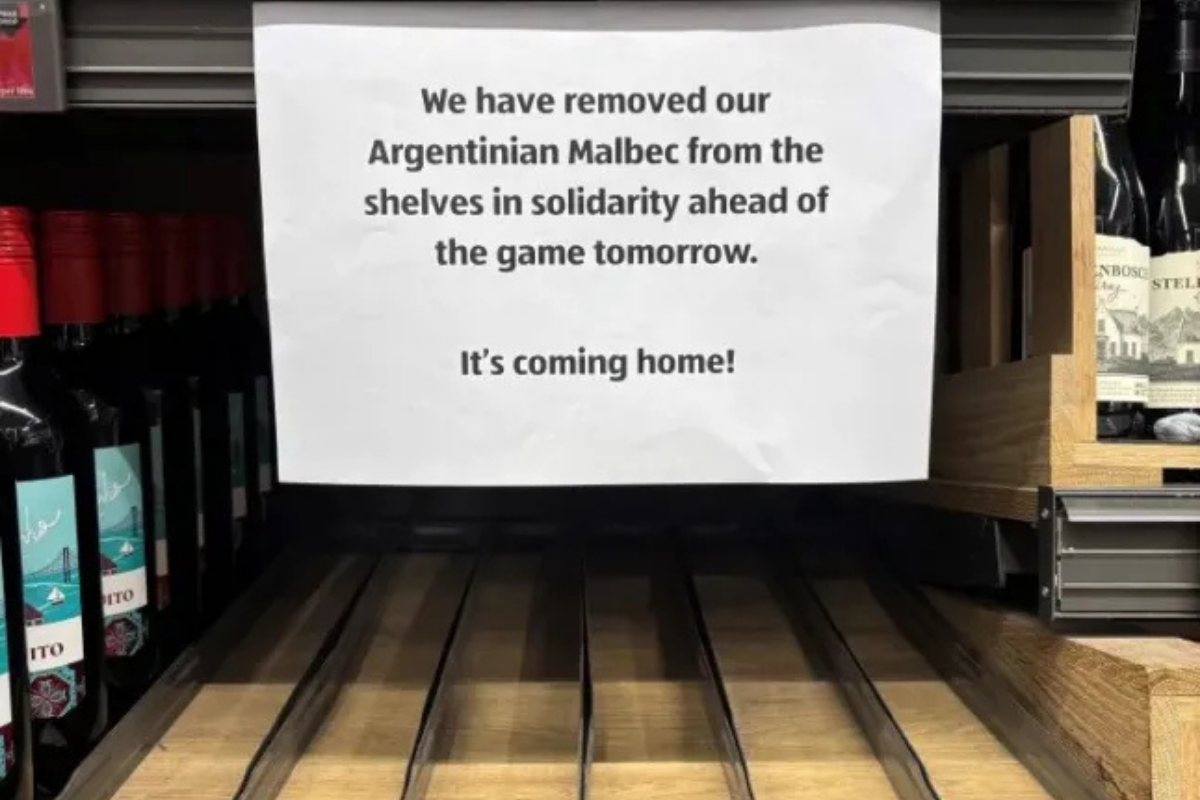
During the World Cup, on the occasion of the semifinal between England and Argentina, Aldi UK decided to temporarily remove bottles of Argentine Malbec from its shelves. As reported in an article by Metro UK, “Supermarket pulls Argentinian wine from shelves ahead of England’s World Cup clash,” the chain put up a sign in the wine section that read: “We have removed our Argentine Malbec from the shelves in solidarity, ahead of tomorrow’s match. It’s coming home!”, accompanied by an Instagram post joking that “the only thing that will not be coming home (with you, the consumer, editor’s note) is your lovely bottle of wine.”
It was not the only one. Uber Eats, the day before, had also published an ironic announcement in which it “suspended” the sale of Argentine steak, chimichurri and empanadas on the app, complete with limited availability for dulce de leche, only to clarify, through the company’s social media manager, that it was merely a joke and that nothing would actually change in the service.
What effects does it have, for a regular consumer, to find their own Malbec removed from the shelf out of “football solidarity” or to think that Uber Eats will not provide what may be someone’s favorite dishes?
Let’s say I am a loyal Aldi customer, suppose I regularly buy that Argentine Malbec and that I do not care about football at all. I walk into my trusted supermarket, the one where I am used to finding a certain product, and I find myself facing a sign informing me that that bottle, tonight, is not available because the company is rooting for England.
Well, at that point the problem is no longer football: it is that a company has decided to put a football quip before the service it usually offers me. So, next time, on principle, I will go and buy that Malbec at Lidl because Aldi has lost credibility. It is no small detail. A supermarket is not a sports gadget brand: it is a place where people go to stock up on products that, when needed, should be there, regardless of who is playing against whom.
Sports marketing works differently
During major football events, brands that know their stuff all focus on the same lever: bringing people together. Coca-Cola, with its World Cup campaigns, has always told the idea of getting together in front of the match, all together, drink in hand. Fonzies, historically, are the snack of evenings among friends in front of the TV, regardless of who is being cheered for. It is experiential marketing in the healthiest sense of the term: it creates a context of sharing, it does not restrict it.
What Aldi did, instead, setting aside the declared irony, is the exact opposite: a choice that excludes, that takes a stand between two products on the same shelf, that turns a potentially collective moment into a small product discrimination. And, considering the crisis the wine sector is going through, ironically taking it out on wine itself (and not even with just any product, but with an entire nationality of production, which is moreover growing) is a “marketing strategy” that can be summed up like this: adding insult to injury.
Not by chance, alongside it in the same Metro article, there is Waitrose, which calmly left all the Argentine Malbecs in their place, declaring that food and drink are “a great unifier” and that competition, if anything, should be left on the playing field and not on the wine shelves.
What if the match had been England vs Italy?
Without wanting to stress out the newly elected president of the FIGC, Giovanni Malagò, if in four years Italy were there in place of Argentina, out of “football solidarity” British supermarkets would have to remove Italian wine, pasta, oil and cheeses from their shelves. How many people would be happy?
Italian food and wine are among the most beloved in the world, probably also by a good slice of English fans. It is no coincidence that Italian cuisine has been officially declared Intangible Cultural Heritage of Humanity by UNESCO. So, to add a detail that is no small matter. Which brings us back to the starting point: there is a big difference between using major sporting events to bring people together and using them to exclude a product. And, with it, whoever buys it.
Post mortem
The World Cup, anyway, is over. Argentina eliminated England in the semifinal, then surrendered in the final to Spain, defeated 1-0. Let’s hope that the Malbec, in the meantime, has returned to its place on the Aldi shelves and that regular consumers are less rancorous than I am and have not gone to Lidl.
Key points
- Aldi UK removed Argentine Malbec from shelves before the England and Argentina World Cup semifinal.
- Loyal customers who ignore football may switch to rivals like Lidl and see Aldi as less credible.
- Inclusive campaigns work better: Coca-Cola and Fonzies build shared moments around football instead of excluding anyone.
- Waitrose kept all Argentine Malbecs in place, calling food and drink a great unifier.
- Italian products could face the same fate in an England versus Italy match, disappointing many customers.