At Wine Paris, the Be Spirits area drew far larger and younger crowds than the wine pavilions, highlighting a growing gap in accessibility and communication style. While spirits thrive on openness and inclusivity, wine risks being seen as elitist and defensive. The question is not about copying spirits, but about finding the courage to truly open up.
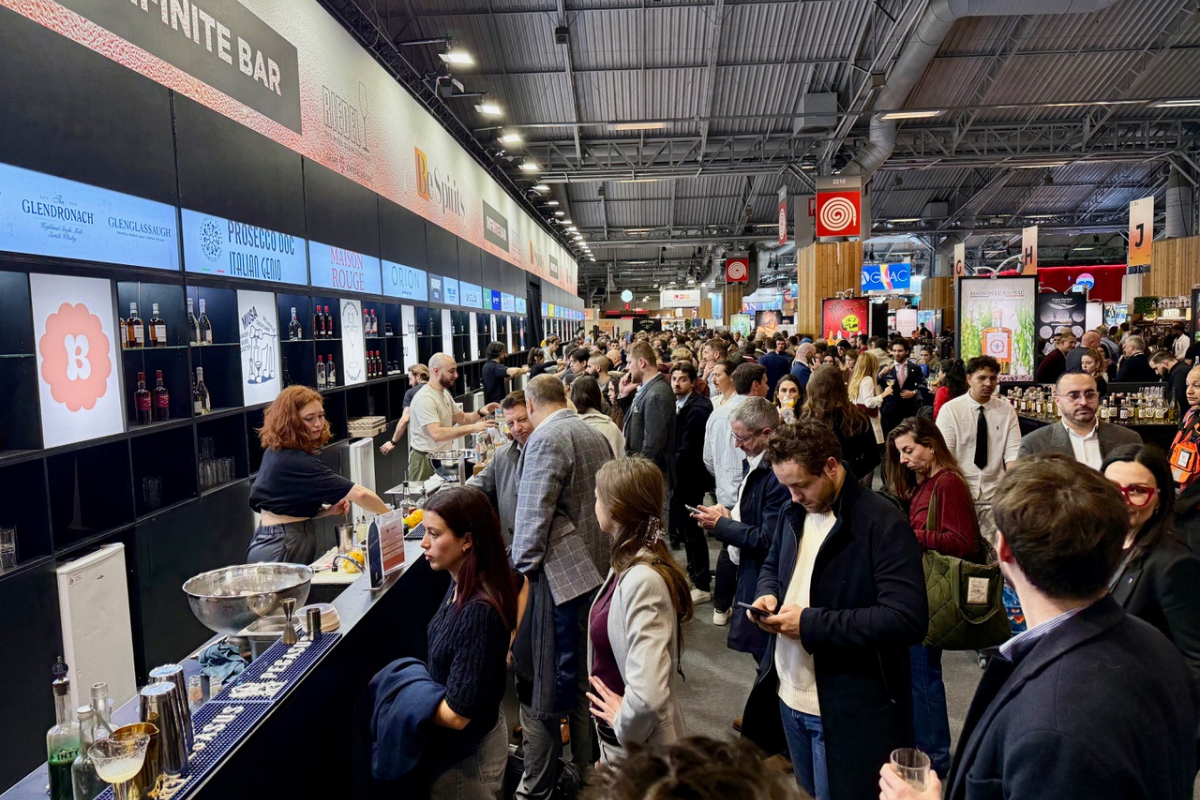
There was a moment, walking through the halls of Wine Paris, when the sensation was clear, almost physical: moving from the wine area to the Be Spirits section felt like the walk that, at school, separated recess from going back to class. On one side, the composed murmur, invitation-only tastings, elegant but often closed-off stands; on the other, a long counter teeming with people, cocktails served without barriers, music, young faces, curiosity, energy.
The success of the Be Spirits area dedicated to spirits and mixology was not just a matter of numbers — significant as they were, both in terms of exhibitors and especially attendance — but of atmosphere. A genuine crowd, in stark contrast with the dignified but decidedly more restrained presence in the wine pavilions. A disparity that says a great deal.
The first thing it says is obvious: the world of spirits is thriving. Market data speaks clearly, with consumption growing across most markets and for almost every category of spirits. Gin, rum, tequila, whisky, aperitifs: dynamic categories, capable of reinventing themselves, of tapping into languages and trends. In this landscape, cocktails like Gin Tonic, Americano, Negroni — and the endless variations of new mixology — are today more attractive than wine for a large segment of the public.
The second consideration is more unsettling. This growth in consumption, interest, and passion for spirits appears in open contradiction with the so-called health-consciousness trend, which seems to strike almost exclusively wine among alcoholic beverages. It is a paradox: while wine is often singled out as a symbol of consumption to be limited, spirits are enjoying a season of expansion, without suffering the same level of cultural and media pressure. “Wronged and beaten,” as the saying goes.
Observing Be Spirits, another figure was hard to ignore: the massive presence of young people. A cross-sectional audience, certainly, but with a strong representation of Gen Z and Millennials. An element that contradicts the narrative according to which young people are progressively losing interest in alcoholic beverages in general. Perhaps it is not alcohol itself that fails to interest them, but the way it is presented.
And here the first crucial question opens up: why do spirits appear so attractive today?
The answer lies not only in the product itself, but in the way it is presented. The very long counter at Be Spirits, where dozens and dozens of cocktails were served, was a manifesto of inclusivity. Easy, immediate, democratic access. Everyone could approach, taste, discover. The stands were open, welcoming, almost inviting by definition. Even the most prestigious players did not shy away from this logic. Emblematic, in this sense, was Aperol’s payoff: “Unique for everyone.” A powerful message, communicating exclusivity without exclusion.
Even the area dedicated to Armagnac — a historic and precious French distillate — offered a section with over fifty labels available for free tasting, including bottles aged more than twenty years. An extraordinary heritage made accessible, without psychological barriers.
The contrast with many wine stands was inevitable. Elegant spaces, but often perceived as reserved for the few. Tastings by appointment, filtered access, a technical language that risks becoming self-referential. It is not uncommon for even wine media professionals to find it difficult to access certain tastings. The result? A world that appears more closed in on itself than open to the visitor.
Hence the second question: can wine learn something from the world of spirits?
It would be easy — and wrong — to conclude that wine must communicate like spirits, turning trade fairs into a perpetual party with DJ sets and house music. That is not the point. Mixology, by its very nature, plays on entertainment dynamics that cannot be wholesale transferred to wine. Nor would it be desirable. Wine carries with it a generally more sober model of consumption, tied to food, to relationships, to moderation.
But there is a lesson we cannot ignore: stop taking ourselves damnably seriously. Or rather, pompously seriously.
Producing quality wines is a complex matter, requiring discipline, competence, and rigor. Seriousness is indispensable in the vineyard and in the cellar. But when this seriousness transforms into communicative heaviness, into elitism, into distance, it becomes commercial suicide. Moving from Be Spirits to Be Wine should not evoke the return to Greek or maths class after recess.
Wine must not surrender to excess, nor indulge in messages that suggest overindulgence. Moderation is an integral part of its identity. But moderation does not mean boredom. In fact, it is precisely in the right measure that wine can rediscover its narrative strength, freeing itself from the fear of being labelled exclusively as a “dangerous alcoholic beverage.”
In recent years we have witnessed a paradox: among all alcoholic beverages, the one constantly on the defensive seems to be wine itself. It is time to step out of this posture. Even in trade fair contexts, the wine world must show itself more open, more inclusive. Companies must not fear letting people taste, telling their story simply, engaging without barriers.
Celebration is inherent to the world of wine too. Conviviality is in its DNA. With one not inconsiderable advantage: the possibility of building solid relationships, getting home safely, living an experience that unites pleasure, culture, and responsibility. And then there is its narrative strength: no other product can tell the story of a territory, a community, a history the way wine can.
On that front, friends in the spirits world, we are and will always remain one step ahead.
But to truly be so, we must have the courage to open the doors. And, every now and then, the windows too.
Key points
- Be Spirits attracted far more visitors and energy than wine pavilions at Wine Paris
- Spirits are growing across markets while wine faces disproportionate health-related cultural pressure
- Young generations (Gen Z, Millennials) were massively present at spirits stands, challenging common narratives
- Wine stands were often perceived as closed, elitist, and difficult to access even for professionals
- Wine must embrace inclusivity and openness without losing its identity of moderation and cultural depth