Giuliano Bortolomiol, born in Valdobbiadene in 1922, transformed Prosecco from a local farmhouse wine into an internationally respected sparkling wine. Drawing on old farmers’ wisdom, he created the first Prosecco DOC Brut in 1960, won international acclaim in Montpellier, and helped found the Consorzio that secured the territory’s DOC status in 1969.
There is a black-and-white image that, if it existed as a photograph, would tell the whole story on its own: a young man on a motorcycle, weaving through the hills between Valdobbiadene and Treviso, bottles of his own Prosecco strapped to the luggage rack, ready to be uncorked for whoever wanted to taste. That motorcycle had a name, the “Guzzino,” and its rider had an idea that, at the time, sounded almost implausible: that Prosecco, a wine sold mostly from demijohns and consumed close to home, could become something the world would take seriously.
The rider was Giuliano Bortolomiol, and the idea would take him three decades, one war, a family confraternity, and a stubborn intuition borrowed from old farmers to prove right.
Born on 27 February 1922 in Ponteggio, a small hamlet of Valdobbiadene, Giuliano grew up in a family whose relationship with the vine went back generations, documents trace the Bortolomiol name in these hills to the mid-1700s, when an ancestor named Bartolomeo first worked the slopes above the Piave. By the time Giuliano enrolled at the Scuola Enologica di Conegliano, wine wasn’t a career choice so much as an inheritance. War interrupted his studies in 1943; he was conscripted, and his first task was simply making it back home safely.
He did. He finished his oenology degree and, once it was over, he took his first cellar jobs in Friuli and Puglia: useful years, though far from where he wanted to be.
In 1946, back in Valdobbiadene, he founded the Confraternita del Prosecco. In the bleak economics of the postwar years, its purpose was concrete: keep growers from walking away from vineyards that no longer paid, and rebuild a wine heritage that the war had left in disarray. Giuliano would later distil the spirit of that project into three words: duty, action, something. A kind of private manifesto: duty as loyalty to the land and the people who worked it; action as the willingness to risk everything to get a result; and that “something” as the spark of invention that keeps centuries-old tradition from calcifying into habit. It reads, in hindsight, like a job description for everything he did next.
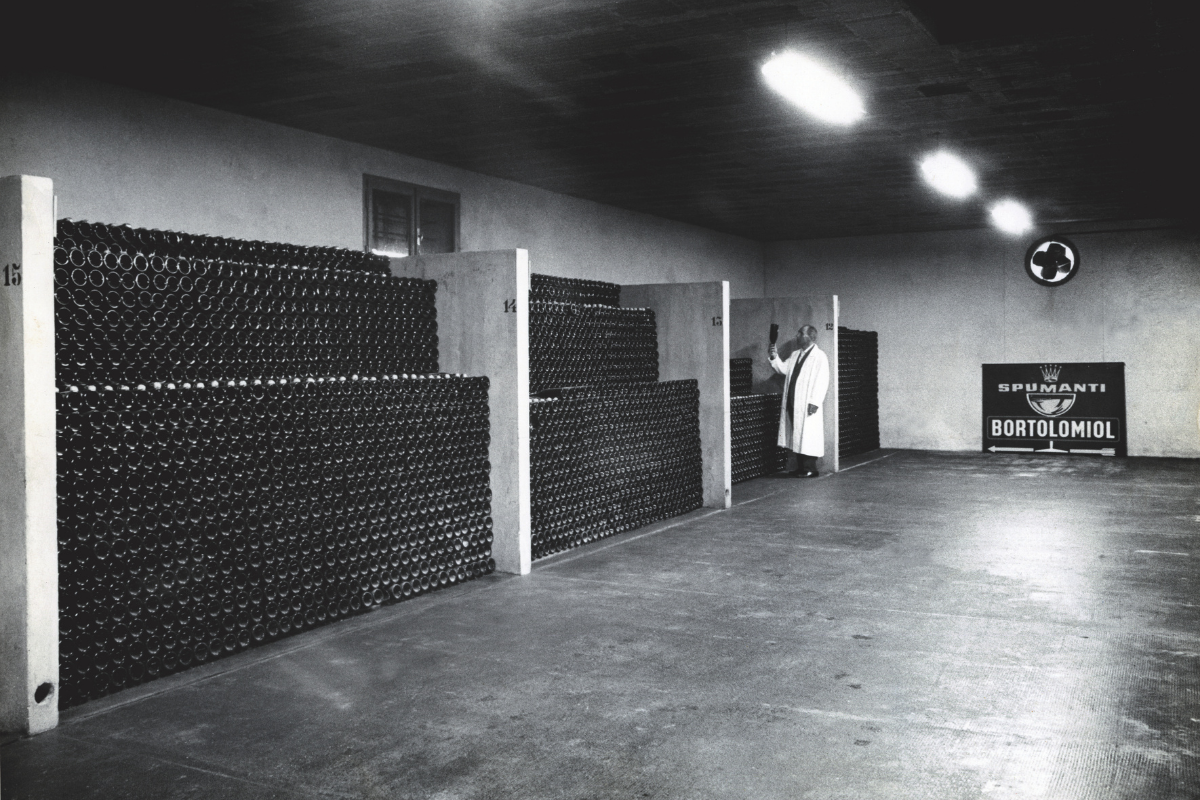
The Cantina Fratelli Bortolomiol opened officially in 1949, founded with his brothers Labano and Guglielmo. It’s also where Giuliano’s real obsession took shape. He put his growing expertise, equipment, and organizational instincts at the disposal of other winemakers, becoming one of the earliest and most skilled practitioners of the Charmat method in Italy, a reputation that made him one of the country’s most respected sparkling winemakers. But one ambition sat above all the others: a dry Prosecco, a true Brut, that didn’t sand down the grape’s character to achieve dryness but let it shine through it.
This was, by any measure of the time, a strange thing to seek.
Prosecco was sweet or Extra Dry by tradition, and critics considered a dry version of a naturally sweet wine close to a contradiction in terms. Giuliano’s answer came from an unlikely source: old Valdobbiadene farmers, who had noticed for generations that wine bottled in winter lost its residual sugars by the time spring arrived. Research, observation, and a fair amount of stubbornness turned that folk wisdom into a method. In 1960, Giuliano Bortolomiol created the first Prosecco DOC Brut of the territory.
Seven years later, the wine that critics had all but dismissed as a curiosity won the Gold Medal at the Concours International de Dégustation in Montpellier, the outside validation that turned a personal obsession into a landmark in the history of Italian sparkling wine. As he put it himself: “A good Brut demands more than a classic demi-sec. You have to start from the harvest, apply careful selection immediately, and keep selecting. Constant attention, during white vinification, in the immediate filtration of the musts, in fermentation, and finally in bottling.”
In 1962, Giuliano was among eleven producers who founded the Consorzio di Tutela del vino Prosecco di Conegliano e Valdobbiadene, laying the institutional groundwork that would earn the territory its DOC status in 1969. He remained a central figure in the district’s story until the end of the century, still opening bottles for anyone genuinely curious enough to ask how he’d made them, his own particular way of doing business, built on the belief that people needed to understand the work behind the glass before they could appreciate what was in it.
He didn’t leave behind an heir in the traditional sense; he left four. His daughters, Maria Elena, Elvira, Luisa, and Giuliana, took over an estate that has since become something rare in Italian wine: a company led entirely by women, carrying his standard of quality forward while opening new fronts of their own. As the Bortolomiol family put it: “Giuliano left us a great gift, the urge to always look ahead and imagine the future, caught between the traditions of our hills and a constant desire to improve.”
Sixty years after that first Brut, the wine remains the emblem of the winery that bears his name, proof, as Giuliano himself once said, that “this land holds something precious we still don’t fully understand“. He spent a lifetime trying to understand it. What his daughters do now is make sure nobody stops asking.

Key points
- Giuliano Bortolomiol founded the Confraternita del Prosecco in 1946 to save postwar vineyards from abandonment.
- In 1960, he created the first Prosecco DOC Brut, defying tradition with a genuinely dry style.
- Montpellier’s Concours International de Dégustation awarded his Brut a Gold Medal in 1967, confirming its quality.
- Bortolomiol co-founded the Consorzio di Tutela in 1962, helping secure DOC status for the region in 1969.
- His four daughters now lead the winery, continuing his legacy as a rare all-female-run Italian estate.