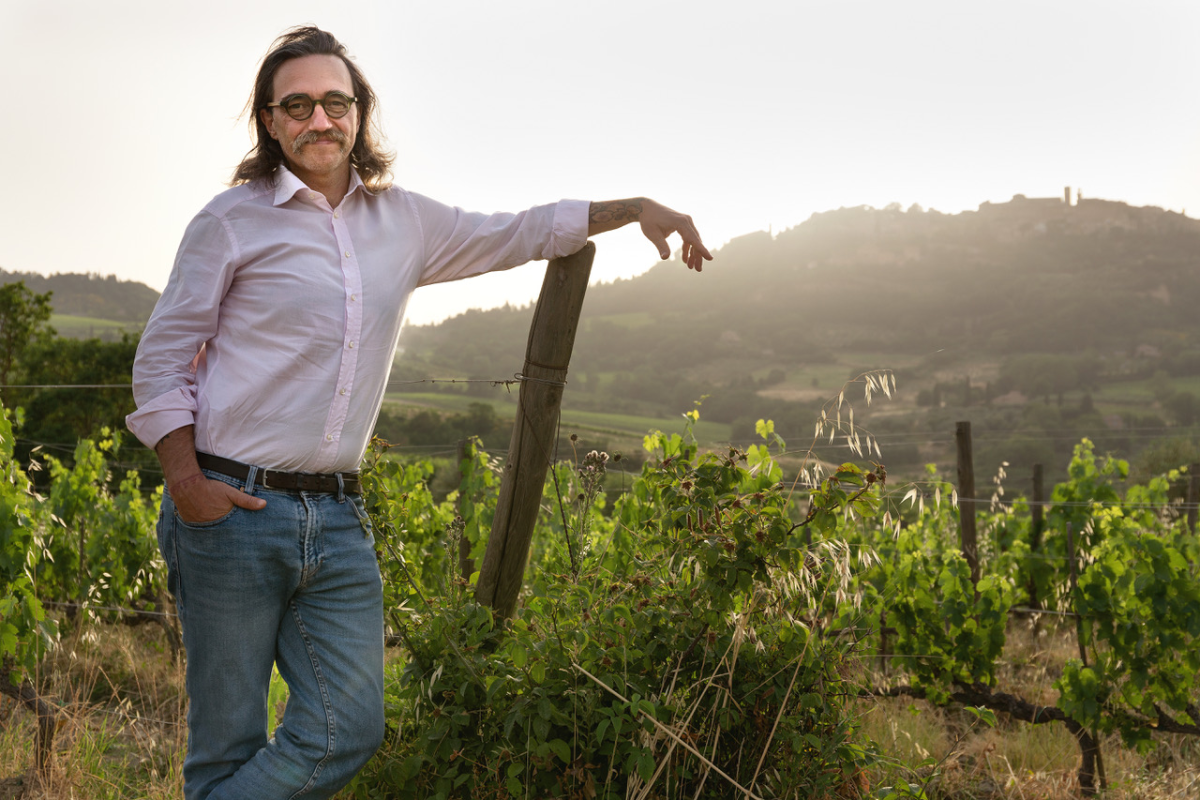
In this in-depth interview, Michele Manelli, founder of Salcheto and vice president of Equalitas, explains why clear, measurable global guidelines are essential for sustainability in wine. He addresses obstacles faced by wineries, the role of consumers, packaging innovations, and the importance of integrating social and environmental ethics for the future of wine businesses.
As part of the “Amorim Wine Vision” project, we continue our deep dive into sustainability in the wine world with an exclusive interview with Michele Manelli, founder of Salcheto and vice president of Equalitas. Manelli, a key figure in sustainable innovation, offers a clear view on how the wine sector is tackling this challenge, stressing the need for a clear and measurable global guideline.
Sustainability, according to Manelli, is no longer optional but a fundamental prerequisite, and its future depends on the sector’s ability to adopt credible, organized, and transparent models. Equalitas, which currently certifies over 20% of Italian vineyards, shows that companies move only when they find concrete and reliable tools. The interview also explores the role of consumers, packaging evolution, and the risk of greenwashing, highlighting how wine must integrate into a new business paradigm, balancing profitability with environmental and social ethics.
What is your current view on sustainability in the wine sector and how do you see it evolving over the next 10 years?
It’s a broad question, but I’d focus on two key elements: sustainability as a product prerequisite and the need for clearer, more measurable benchmarks. In the future, companies will have to adhere to more objective and comparable standards.
The topic is complex and views vary, but we must aim for harmonization through a global guideline. Equalitas is working toward this, having started nationally and now aiming for international scope. As happened with wine denominations, sustainability too will evolve towards shared codification. It’s a matter of planetary survival and human well-being.
In Italy, what are the main obstacles that wineries face in pursuing sustainability and what could help support them?
The biggest obstacle is the lack of clear tools for companies and consumers to guide investment and consumption choices. Equalitas represents a turning point—360 certified companies and nearly as many in the process, now covering over 20% of Italian vineyards, surpassing organic.
Companies moved only when they saw a credible model with market leadership. Next, we must test if it can succeed internationally.
Small companies struggle with culture and training. Larger firms have dedicated professionals, smaller ones often lack time and resources. The issue is not funding, but training and technology transfer.
Sustainability is often seen as costly. What are the most effective ways for wineries to balance sustainability and profitability?
If a company can’t monitor and manage its impacts, sustainability becomes difficult. Organizational models offer new insights and KPIs. Identifying issues enables data-driven investment choices.
We must stop talking about costs—these are strategic investments. Lightweight bottles reduce logistics and material costs. The real obstacle is lack of knowledge, not money.
Have you seen a change in consumers’ ability to understand sustainability in wine or is there still confusion?
Market research shows consumers prioritize sustainability. Organic remains the main reference, though it only covers part of the concept.
Awareness has improved, but consumer dialogue remains superficial, often tied to a romantic image instead of integrated systems. Still, after denomination (40%), sustainability (25–28%) is the next biggest factor—a big leap from a decade ago.
We’ve long thought profit came at odds with the environment and competitors. Today, business must proactively seek balance.
Salcheto has introduced ultra-light bottles and recyclable capsules. What’s next in sustainable packaging?
Packaging has a huge environmental impact, but wine is an experiential product, which influences packaging decisions. The cork and label design have symbolic value.
Only 2–3% of wine is aged or collected. The rest is consumed within 24–48 hours. Therefore, alternative formats like BiB, PET, brick, and KEG for HoReCa are gaining ground. The challenge is balancing environmental impact and user experience.
What partnerships have you built to promote sustainability and how have they shaped your vision?
We’ve been open and collaborative for 15 years. Participating in conferences and meetings has been enriching and inspiring. Working with CSQA helped us achieve great results. In the last decade, there’s been strong momentum to support sustainable economic and social development in line with the UN’s Sustainable Development Goals. These global shifts have been major sources of inspiration.
Beyond environmental aspects, what social sustainability actions should wine companies prioritize?
To regenerate resources, we must also put people at the center. A sustainability vision that separates environmental and social aspects is short-sighted.
Equalitas anticipated this by considering labor conditions along with ingredients and production chains. Workers are still exploited in vineyards, in Italy and beyond. Awareness of the social dimension is now well established.
What are the clearest indicators for consumers to identify greenwashing or social washing?
To avoid greenwashing, we need clear regulations. For example, “organic” must be certified in the EU, but “sustainable” can be self-declared.
A company might use recycled PET and renewable energy but still sell 1kg bottles or exploit labor. Transparency requires measurable standards and shared legislation. Culture, information, and training are essential to protect both consumers and the market.
Key points
- Sustainability must be a prerequisite with global, measurable standards.
- Small wineries need better training and support structures.
- Sustainability should be seen as a strategic investment, not a cost.
- Packaging innovation must balance impact and consumer experience.
- Social and environmental ethics must go hand-in-hand.