The Wine & Spirits Summer Tour reaches Manchester and ends up at Old Trafford, where elderly fan guides turn a stadium visit into a trove of personal stories. The author sees a lesson for wineries: visitors seek emotion and narrative over technical data, so hospitality depends on choosing people who genuinely love the place, while respecting neighboring producers.
I had said I would not be going back to it. On the subject, I mean. A few months ago, fresh from visiting the Bombonera, the Boca Juniors stadium in Buenos Aires, I had written about how certain stadiums have become tourist destinations on a par with, and often more than, prestigious museums and historic cathedrals. And about how wine companies should look closely at what some football teams have done better than anyone else: cultivating the myth.
Read also: Is a wine Bombonxera possible?
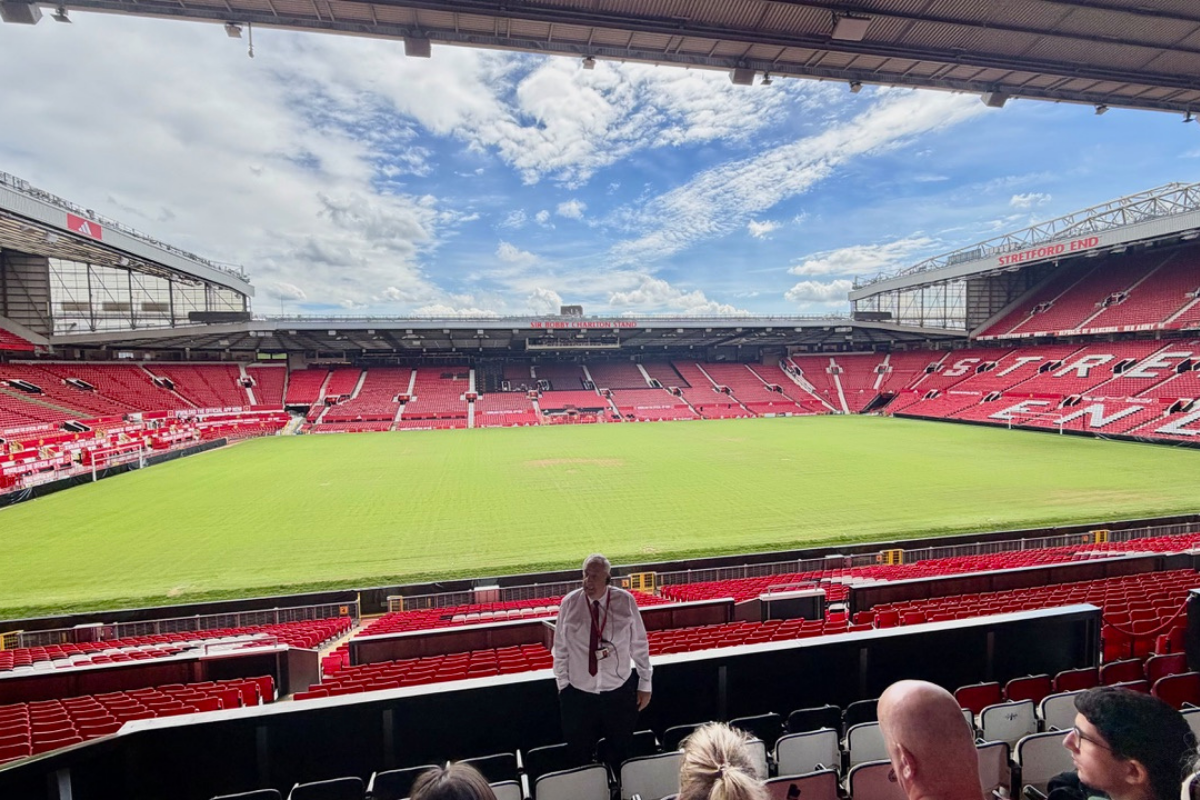
I thought I had exhausted the subject. Then came this edition of our Wine & Spirits Summer Tour, which took us all the way to Manchester in the camper. And when you are in Manchester with a son who is a football fanatic, perhaps even more than you, the trajectory is set: you end up at Old Trafford. Another place stormed by an impressive number of visitors every day of the year, match or no match. And there I realized there was still something to say.
The key lies in the guides
The visit lasts about an hour, but the real discovery is not the stadium: it is the guides. They are fans, almost all of them advanced in years. People who live that team with their hearts, not with a rundown. In the world of wine tourism, we call those figures hospitality managers. Inside, however, there was no script: there was a sea of anecdotes.
Our guide was called George, seventy years old. He told us about the first time he entered that stadium: six years old, his dad’s hand, the smell of freshly cut grass, the chants of a stand he would soon become part of. And then the match, of which he remembered every single detail, against the most feared enemy, Liverpool: 3 to 0 for them at halftime, and then the comeback, up to an incredible 4 to 3.
But the best anecdotes were those about the fans. Like the 46 seats reserved for disabled people, located in the best area of the stadium, and like that time, in a legendary derby with Manchester City, when Giggs scored in the last minute and a “disabled” man got up from his wheelchair and ran toward the barrier to shout his joy. Then, realizing he had given himself away, he shouted: “The miracles of Old Trafford!”
A stadium is not a place where you watch matches
This is the point. Thanks to George, that stadium stopped being the place where people go to watch matches and became the place where the vicissitudes of life take place. Childhood, fathers, friends, pranks, miracles. Exactly what a winery should be.
Because a winery too is not, or should not be, only the place where you go to see how wine is made. In our world, excesses of technicality have long since taken away much of the communicative effectiveness: degrees, hectares, macerations, barrels. Correct information that nonetheless leaves few traces.
Too often, in fact, we forget that people do not visit a winery only to receive information. They want to be moved, they want to meet a story, they want to sense that they have entered a place where something happened and where generations of people lived, worked, took risks, made mistakes, loved and built.
Authenticity cannot be acted out
The myth, however, cannot be invented at a desk. And passion cannot be learned simply from a hospitality manual. It may sound like rhetoric, that of “passion”. It is not. It is precisely because they are true fans that those guides manage to convey something.
Myth and passion can be communicated only if they are lived in an authentic, and therefore credible, way. Otherwise they become a sterile performance, and the visitor, who has seen plenty of performances, notices it within three minutes. This is where the game of winery hospitality is played: not in the quality of the slides, but in the choice of people. Whoever accompanies a visitor must be someone who truly loves that place.
A warning, though
Fandom brings risks with it. The main one is considering competitors as outright enemies. For our George, Manchester City can only be ignored or, even better, hated. This is advice I would never give to any wine hospitality manager. Our strength also lies in the territory, in the collective narrative, in the shared appellation: turning the neighbor into an adversary is the quickest way to shrink everyone. But that is Old Trafford, baby. There, a certain passion has to be tolerated. In the winery, no.
Key points
- Choose guides who genuinely love the place, because visitors quickly spot a rehearsed performance.
- Tell stories about people and memories, because visitors want emotion more than technical figures.
- Present the winery as a living place where generations worked, risked, loved and built.
- Treat neighbors as partners, because shared territory and appellation strengthen everyone.
- Cultivate the myth like football clubs, whose stadiums rival museums and cathedrals as tourist destinations.