In Val di Cembra, the Pelz brothers defy fleeting market trends to craft wines rooted in territorial identity and patience. Eschewing low-alcohol fads, they focus on longevity, championing mature releases, precision through screw caps, and the true potential of Müller-Thurgau. Their approach reveals a stark contrast between authentic winemaking and the region’s limited hospitality infrastructure.
Titolo: “Pelz, in Val di Cembra the mountain does not follow trends: our strength is making the territory speak”, Sottotitolo: “Among vintages released calmly, defense of Müller Thurgau and rejection of stylistic shortcuts, Michele Pelz describes a Val di Cembra that focuses on identity rather than adaptation.”
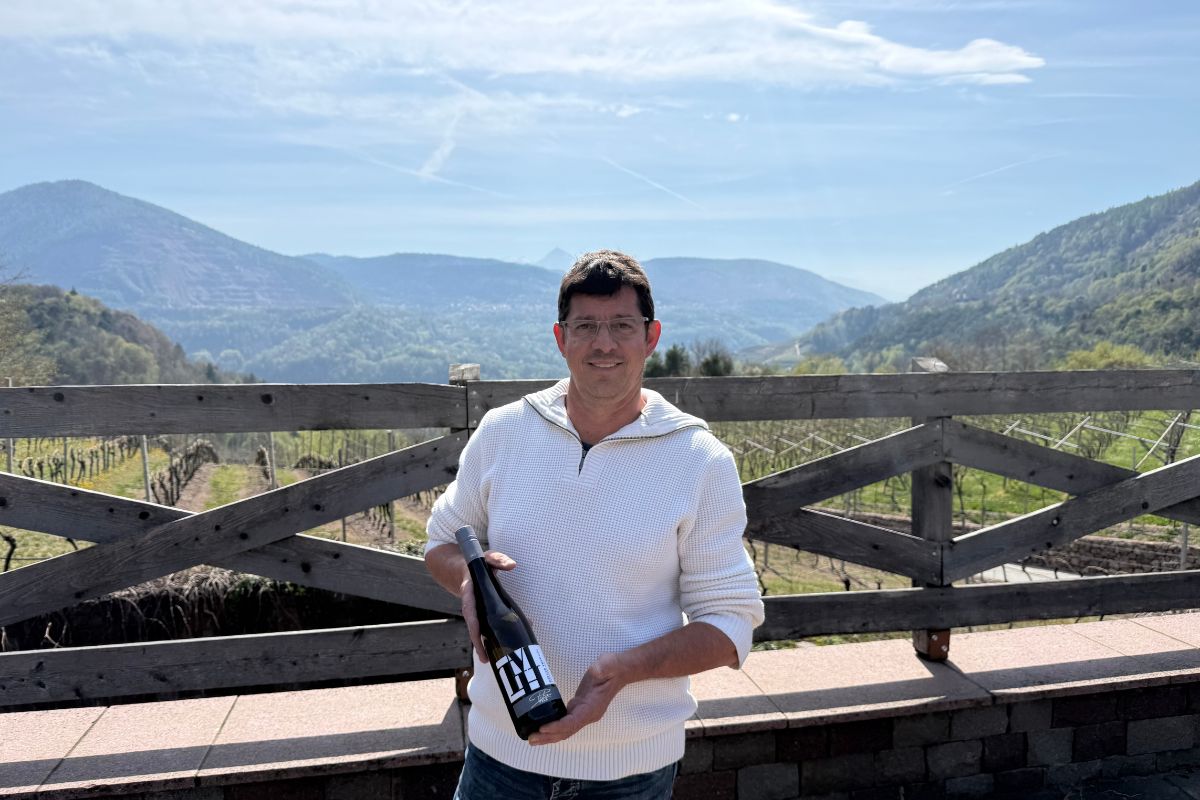
In a time when wine seems to increasingly pursue words like lightness, immediacy and easy drinking, there are those who prefer to remain faithful to a more identity driven trajectory. This is the case of the Pelz brothers’ winery in Val di Cembra, where mountain viticulture continues to be interpreted not as a stylistic shortcut, but as a work of precision, coherence and time.
Here the focus is not adapting to the trends of the moment, nor bending the wines to what the market demands in the short term. On the contrary, the direction is clear: to enhance the minerality, tension and above all the evolutionary capacity of valley wines. A philosophy found in cellar choices, in vintage management, in the use of the screw cap to preserve precision and consistency, but also in a rather clear vision of what it means today to produce quality in an extreme territory.
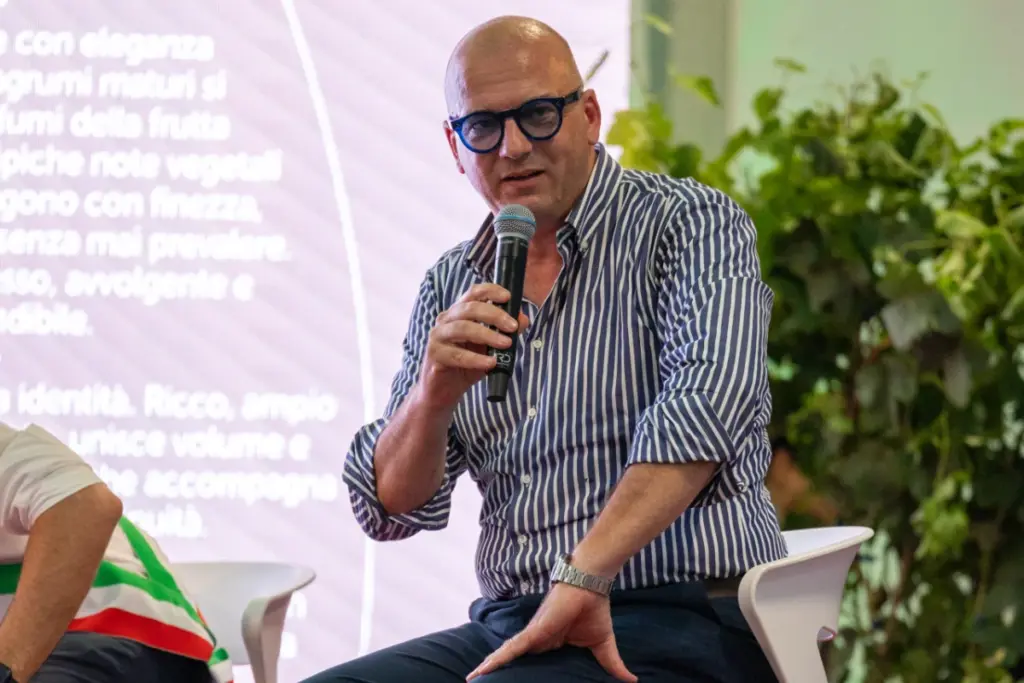
We talked about this with Michele Pelz, together with his wife Alessia, addressing topics ranging from the evolution of consumer taste to the role of Müller Thurgau, up to the structural limits of wine tourism in the valley.
In recent years there has been a lot of talk about leaner, less extracted wines, sometimes even with low alcohol content, have you changed your approach to meet this demand?
No, not in that sense. We have never thought of chasing the trend of dealcoholized or low alcohol wines. Our goal has always been to fully understand what this valley can give in terms of longevity, freshness and minerality. This is what we have been working on for ten years and we will continue to do so.
Besides, those who arrive at the winery do not necessarily look for lighter wines. They look for well made, coherent wines, with a precise identity. Ultimately the point is not so much the alcohol content, but rather the perceived quality and the honesty of the value for money. If you choose a clear qualitative path, the consumer understands it.
We are not a company that builds its wines based on the fashion of the moment. Even with Trento Doc, for example, we have chosen a commercially uncompromising path: we produce only one, and it is a zero dosage. We do not chase the easiest or most reassuring taste, but rather we look for people who recognize themselves in our philosophy, and this over time has rewarded us.
So today is there a public that drinks perhaps less, but spends better and looks for identity more than reassuring labels?
Yes, we see it clearly. Those who come to us do not look for an interchangeable wine. They look for a company, a history, a way of working. It is a public that wants to understand what is behind a bottle and that often appreciates the very fact that we have not conformed.
The customer who returns every year to the winery and stocks up does not return because they find an easy wine, but because they find consistency. This, today, is worth much more than any chase after the trend.
One of your most recognizable choices is to release vintages on the market that are not very young, especially for Riesling and Pinot Noir, why?
Because certain wines, simply, do not yet express anything truly complete when young. A Riesling that is too recent shows mainly the fruity component, but does not fully express its profile. We prefer to wait until the wine finds its balance and begins to truly bring out the characteristics of the grape variety and the territory.
Releasing more mature vintages is a choice that goes against certain market logic, but it represents us much more. It is a way of saying that time, for us, is not an obstacle, but part of the project.
On the technical side, you were among the producers who believed early on in the screw cap, how did this choice come about?
We started already in 2011, initially on Müller Thurgau and Kerner. At the beginning it was a test, but we wanted to understand if it could guarantee a more precise and constant evolution over time. For several years we conducted internal tests, comparing the same wine closed with a screw cap and with a cork stopper.
At a certain point the comparison was very clear: the screw cap gave us more uniformity, more safety and less risk of deviations. For those who also work on older vintages, it is a fundamental aspect. Knowing that all the bottles will evolve in a homogeneous way gives enormous peace of mind, both to us and to those who buy.
If we talk about the identity of Val di Cembra, what is the grape variety that in your opinion truly represents it?
For me it remains Müller Thurgau. The problem is that for years it was treated as a wine to be sold quickly, at a low price, without really putting it in the conditions to express itself. Thus it lost strength, credibility and centrality.
Meanwhile, many have chosen to plant something else, following what the market seemed to demand: Sauvignon, Traminer, Chardonnay. But the risk is that this way the territory stops recognizing itself in its wines. The Müller, if worked well, from the vineyard onwards, still has a lot to say, but it must be removed from the logic of simple fast rotating wine.
We believed very much in this. With a 2014 Müller Thurgau we obtained an important recognition, and for us it was a strong signal: to demonstrate that this grape variety, in purity, can withstand time perfectly and transform in a surprising way. When it evolves well, it changes pace: it loses its youthful sharpness and acquires depth and body, becoming a wine that is anything but banal.
Another increasingly central theme is wine tourism, what is changing in the requests of those who arrive at the winery?
The request for visits has grown a lot. And the interesting thing is that the perception of wine completely changes once people see the territory live. As long as they only look at the bottle on the counter, maybe a price can seem high. When instead they enter the vineyard, see the slopes, the effort, the management of the mountain, they understand everything in an instant.
After the visit, it is often the customers themselves who tell us that that price is more than justified. The real limit, however, is not the winery. It is the context. In the valley an adequate hospitality structure is still lacking.
We can offer a beautiful, concrete, authentic experience, but then the visitor clashes with a lack of services that is very simple to describe and very difficult to accept: few places to eat, few places to sleep, little flexibility.
Key points
- Identity over trends: Pelz rejects short-term market fads, prioritizing the minerality and longevity of mountain wines.
- Value of time: releasing mature vintages allows varieties like Riesling to express their true territorial depth.
- Technical precision: adopting the screw cap guarantees constant evolution, crucial for aging premium valley wines.
- Müller-Thurgau revival: cultivated with care, this grape overcomes its cheap reputation, showing surprising aging potential.
- Tourism challenges: while winery visits justify pricing, the valley suffers from a severe lack of hospitality services.