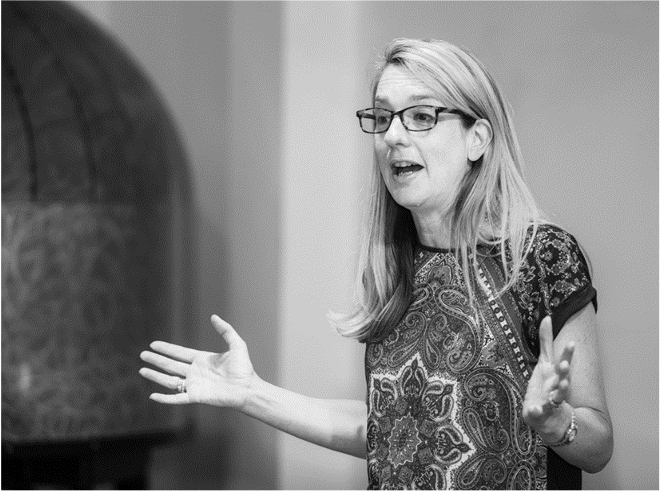
Lulie Halstead emphasizes the importance of understanding wine consumers and tailoring marketing strategies to their real needs. She advises abandoning biases and investing in consumer research to effectively build a wine brand. Her approach combines long-term brand positioning with short-term sales tactics, focusing on both consumer attitudes and behaviors.
Lulie Halstead is a highly influential figure in wine marketing and communication (and beyond) at the international level. A brilliant thinker, she is able to concretely influence the industry through her analyses and practical insights.
Non-executive director (NED) of the board of IWSR Drinks Market Analysis, co-founder of Wine Intelligence (acquired by IWSR in 2021), and an established academic, she has specialized through research in exploring the factors and elements that determine consumer purchase behaviors, aiming to uncover subconscious decision-making processes.
A prominent figure like her couldn’t miss in the “Amorim Wine Vision” project, where Halstead shared insightful reflections and practical methodologies useful for transforming theories into tangible practices. A rare and valuable approach for the wine industry.
In a recent article, you discussed the importance of deeply understanding wine consumers. Too often, marketing and communication professionals tend to voice their opinions rather than truly listening to the needs and desires of real consumers. What is your view on this, and what could be the keys to change?
It’s an interesting opening question. As humans, our tendency is to perceive the world through our own experiences: what we know and what’s stored in our memory.
Marketing’s role is to see the world through the eyes of our consumers, not our own, and that’s not an easy task.
What we need to do is leave our biases at the door and really perceive what consumers feel. For me, the key is to constantly listen to them, observe them, and keep an open mindset, remembering that large-scale consumer research can be expensive. As wine market operators, we often need to find alternative methods.
What might my advice be? Personally, I would continue to support and invest in serious, reliable research. Additionally, there are several ways that even a single marketing person in a winery can gather useful elements, dive deeper into them, and actively listen to consumers.
Here are some tips for marketers, entrepreneurs, and wineries:
Dedicate time to reading research and synthesizing consumer opinions from various sources. For example, I would recommend producing updated consumer trend reports for internal use within the company. This forces continuity and discipline in checking what’s happening in the market.
If you have agents or team members located in different parts of the world, another way to research would be to ask each one to visit three bars, three different types of stores, and three restaurants and report what they observe. This is a great way to build an overview and also involve your team and partners.
Whenever I’m in a bar, restaurant, store, or even on a plane (maybe this is why people think I’m a bit crazy), I talk to people and say, “Hey, it’s interesting that you just ordered that! What do you think of this product?” This way, you can gather real consumer insights simply by interacting with people you meet along the way and observing what ordinary people are consuming. If you can’t afford expensive research, talk to the person next to you at the bar! Have a conversation with the manager of a wine shop: what are people ordering today? Which wines are performing well? Which wines aren’t doing well, and why do you think that is?
Use your friends and network: gather a group of friends and invite them to your home or to a bar. Invite five people and say, “I’ll offer you a drink if you talk to me for an hour.” Listen to what they’re saying.
There are many practical ways to gather firsthand information from real consumers, moving away from your personal view.
I’d like to further explore what you call “creating value” or “delivering value” in the wine market, where the goal of a marketing and communication strategy is not just to increase sales or market share. Can you explain this concept?
For me, the result of creating value is increased profit, market share, and sales. But to achieve this result, the marketing strategy must be backed by research to understand what consumers truly want and what they’re willing to pay for.
If we consider the widespread opinion that marketing and communication are a mix of short- and long-term actions, we’ll see that value comes from promoting the long-term value of the brand while activating short-term sales; value comes from both sides. The strategy to achieve the result (profit, market share, and sales) takes these different elements into account.
Your current favorite definition of marketing is: “Marketing is the process of responsibly managing the identification, anticipation, and satisfaction of consumer needs in a profitable way.” How does this definition translate into concrete practices and measures?
Let’s break down this definition into three parts.
The first part of the definition speaks of the process of management, which clearly refers to marketing (the heart of a winery, if not any business or organization). Ultimately, marketing connects the right products with the right consumers at the right price so they’re willing to pay for it.
The next part of the definition focuses on “consumer needs”: if consumers don’t want or appreciate our products, there’s no business. That’s why it’s so important to understand what consumers appreciate.
As we know, in the wine industry, since growing grapes and producing wine every year is hard work, we tend to focus on that part of our activity; this means we need a consumer who understands and appreciates what we’re doing to keep our activities profitable.
Finally, I interpret the term “profitable” not only as the ability to make our business financially profitable but also to give it long-term stability and ESG (Environmental, Social, and Governance) value. That’s why I love this definition: because it encompasses these three areas.
In some key markets, including the UK, the percentage of regular wine consumers over 65 is increasing, while the percentage of young people aged 18-34 is decreasing sharply. How can effective and balanced communication strategies be found in this seemingly paradoxical context?
From an age perspective, the wine consumer population in most mature and established wine markets follows the population in general. For example, if we have (as in the UK and many other countries) an aging population, it’s not surprising that the wine-drinking population follows this trend.
At the same time, in addition to the aging population, we’re also seeing a lower proportion of young consumers of legal drinking age approaching wine. Unfortunately, this is a fact.
I think I would look at the issue a bit differently. In reality, not all people between 20 and 40 are the same. I think in marketing, sometimes we focus too much on chronological age as a differentiating factor.
Even though age certainly plays a role in defining our relationship with wine, it’s not the only factor that influences our perception. Some 25-year-olds may be deeply involved in the wine world, visit wineries, and be willing to pay premium prices, while others with similar age, income, and background may never have tasted wine. I think we generalize too much by talking about age; what we should seek in our “targeting” are similar attitudes and behaviors.
So, the point is: how do we communicate relevant messages related to attitudes and behaviors instead of simply thinking, “I need to target 25-year-olds or 65-year-olds?”
What we’ll discover is that the way we reach these people may be different. For me, this is the strategic choice of the communication channel. For example, our 25-year-old might spend more time on Instagram and TikTok than our 65-year-old, and our 65-year-old might spend more time on Facebook, read more newspapers, and watch more TV than our 25-year-old; there are different ways to find them, but the message for both would be the same.
This is the key difference: think about what unites people, why it’s valuable, and then, at the end, select the channel to reach them.
This situation is linked to the moderation and subsequent growth of no-low alcohol wines in major established markets. However, no-low wines have not yet attracted a broad audience, particularly regarding their taste profiles. What are your predictions for this segment?
As we well know, there’s been a lot of investment in the no-low wines sector, particularly in Australia, a pioneer in this field. We know that both the quality and taste profile of no-low wines are improving. However, for consumers, there are alternatives that seem more fun and accessible, more refreshing, more exciting, and often more “Instagrammable” than wine. No-low wine is certainly not the first thing that comes to mind for a consumer.
I believe the opportunities for no-low wines are not as strong as we might want them to be. My personal opinion based on observation and data is that the best opportunities lie in wines with an alcohol content around 7-9%, rather than those with a much lower content, especially when it comes to the taste profile. Although in many markets, these wines don’t offer the advantages tied to tax incentives.
Even wines that are naturally produced with lower alcohol levels have better chances of success. Consumers perceive them as great wines with the additional benefit of being slightly lighter, rather than being positioned exclusively as no-low products.
In terms of product types, the key opportunity for no-low wines lies in sparkling wines. They are more drinkable, and there are more consumption occasions for sparkling wines than for still wines.
The phenomenon of premiumisation is more evident in the sparkling wine sector and among organic, natural, and sustainable wines. This pursuit of “less but better” is also connected to sustainability and moderation. Do you think wine communication is effectively leveraging these levers to attract young consumers to the category?
Sparkling wine has become more accessible, both mentally and physically, to a wide segment of the population, including younger consumers.
It continues to represent celebration, sociability, and fun—these are the key factors and occasions when we like to consume alcohol.
As for sustainable and natural wines, the communicative advantage lies in the fact that they better align with the priorities of younger consumers who are more driven by ESG and sustainability. The disadvantage of communicating sustainability is that we’re adding another layer of complexity to an already complex category.
Essentially, we’re asking consumers to engage their “System 2” (where deep processing happens and takes a lot of effort) instead of their “System 1” (which involves quick, effortless decisions).
Since the wine industry provides complex information, what we often do is expect consumers to use their “System 2” to select wine, when in reality, most of us want to stay in “System 1” as much as possible, making quick and easy decisions that immediately satisfy our needs.
Going back to sustainable or natural wine, data shows that less than 10% of regular wine consumers in any market are willing to switch to “System 2.” This means we’re asking consumers to do something more complex than they’re truly willing to do.
Based on your observations, what do you think are the biggest challenges facing the wine sector in the next three years, and what key topics should wine communication focus on?
I think the biggest challenges will continue to be margins and profitability; this issue has become even more difficult over the past two years and will continue to be.
Other tricky issues are definitely government regulation and taxes on alcohol in general. As we know, wine is not immune to this external pressure, which is beyond our control.
From a consumption perspective, I think the key challenge will be the competition from a wider range of alcoholic and non-alcoholic beverages. What we know is that consumers select from an increasingly broad range of options: people try many different things, entering and exiting different categories, which is partly driving the reduction in wine consumption. In simple terms, consumers still like wine, but also many other drinks.
The last obstacle is surprisingly the lack of connection between wine and venues. This seems counterintuitive because, traditionally, wine is the preferred drink during meals in restaurants. I believe consumers are increasingly adapting to informal dining and a very different way of eating out. In this context, wine has become less relevant, less engaging, and less exciting, and bartenders are less incentivized to promote it (is it more engaging to be served a glass of wine or to have a bartender prepare a beautiful drink for you?).
What, then, should wine communication focus on? If I owned a wine brand, here’s how I would move:
- I would understand who my target consumers are, what they truly appreciate, why, and what they will continue to appreciate over time.
- I would build my wine brand around a key, central position that is relevant to those people. I wouldn’t try to be everything to everyone. I would make sure I’m something for someone. By the way: “Our production processes are the best, and our products taste really good” don’t fall into this scheme. That’s not a good positioning because practically every wine in the world tastes good nowadays.
- I would build a distinctive and visually memorable brand: it’s about becoming mentally available to consumers.
- I would focus on where my consumers are when they buy and consume wine and make sure to position myself in those places and contexts. Essentially, it’s about physical availability of the product.
Choosing which communication channels to use would be my final decision, definitely not the first one.
This interview was conducted in partnership with Amorim Cork Italia as part of the “Amorim Wine Vision” project – a network of thought leadership on technical and topical wine-related issues, spotlighting the original visions of industry entrepreneurs and managers.
Key points
- Marketing must focus on consumer insights, not personal biases.
- Effective brand positioning goes beyond product quality to target consumer desires.
- Wine communication should align with consumer behaviors, not just age demographics.
- Sustainable and natural wines must balance complexity with consumer ease.
- Wine brands should focus on becoming mentally and physically available to target consumers.