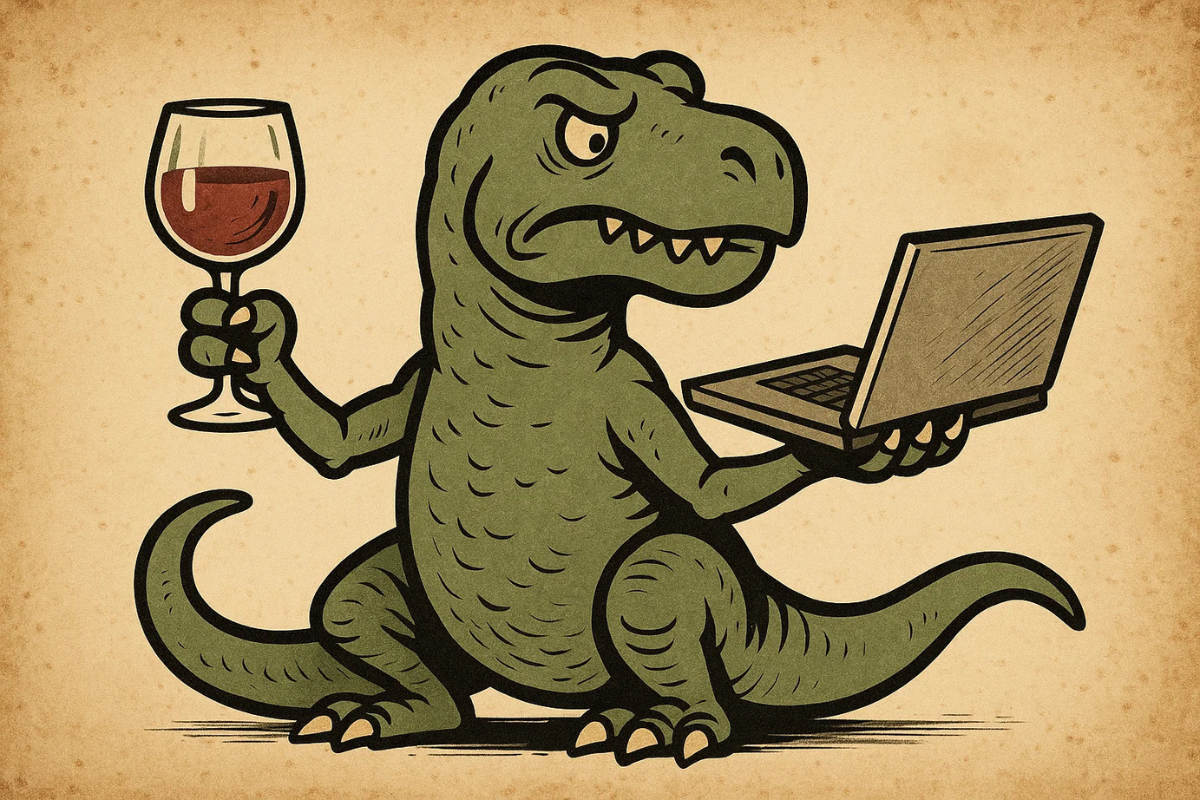
The current wine media landscape is obsolete, resembling dinosaurs on the verge of extinction. Stuck in self-referential loops and ignoring modern consumer needs, the sector lacks critical analysis and authentic storytelling. This analysis calls for an urgent evolution towards empathy, inclusion, and a new generation of voices to ensure the future of wine journalism.
On July 8th, during a lecture at the Alta Scuola Sanguis Jovis of the Banfi Foundation in Montalcino, I found myself reflecting on a topic that has been with me for over thirty years: wine media. Preparing my speech – titled “Where the story lives: the panorama of wine media” – I felt more like a paleontologist than a journalist.
Because observing the wine media landscape today unfortunately means looking more at the past than at the present. Or worse yet, the future.
This is not an accusation, let’s be clear. I have belonged to this world for a lifetime, I saw its importance grow, especially in the Nineties, when wine magazines and guides became decisive tools for affirming the identity of Italian wine in the world. But it is undeniable that today this system is experiencing a profound crisis of meaning, form, and function.
Wine media seem to have crystallized into an obsolete representation, incapable of conveying the complexity and new dynamics running through the contemporary wine world.
Today, they continue to speak only to themselves, or worse still, only to producers, in a sort of self-referential circle that leaves out the very person who should be the protagonist of the new narrative: the consumer. A consumer who is increasingly “secular,” transversal, curious but impatient with professorial tones, who no longer seeks scores but emotions, experiences, authentic connections.
We hoped that digitalization and the birth of new editorial platforms could represent a turning point. In part, this happened: blogs, podcasts, video formats, and niche newsletters were born. But often, even these new tools have merely replicated old models in more modern attire, without truly addressing the crucial issue: what does someone approaching wine today want? How do they want to be involved, told about, represented?
We once had voices like Soldati, Brera, Veronelli, who knew how to transform wine from a simple agricultural product into a powerful cultural symbol. Today, however, it is increasingly difficult to find narratives capable of combining depth, lightness, authority, and accessibility. The lack of a perspective capable of interpreting change, and not just describing it, is missing.
An even more serious absence is noted in the field of political-economic journalism of wine. There was a time when there were writers capable of analyzing wine markets and policies with a critical spirit, autonomy of thought, and competence. Today, however, this space seems desertified. Free voices are missing, capable of telling the truth even when it might be inconvenient. There is a lack of courage to report what isn’t working, to denounce inefficiencies, to suggest alternative paths with lucidity. Yet, never before have businesses needed authentic analysis, not useless flattery.
We need a new generation of wine journalists capable of interpreting the economic and political dynamics of the sector with honesty and depth. Specific training courses on this front would be not only desirable but urgent. Because today, we are truly close to the extinction of this type of voice.
Another great contradiction concerns specialized technical media. In Italy, we have excellent viticulture and enology magazines – authoritative, rich in content, attentive to scientific research – but their dissemination is incredibly limited. And it is paradoxical: in a historical moment when technical-scientific innovation is decisive for the survival of the sector, the dissemination of this knowledge does not find adequate space.
Our businesses, our technicians, our enologists – how do they keep updated? How can one imagine a competitive sector if it does not feed on knowledge? With over 30,000 winemaking companies and about 250,000 grape growers in Italy, technical magazines should have enormous print runs, not remain confined to small niches.
The truth is that our wine-related editorial system has lost centrality, authority, and, above all, the ability to listen. And without listening, there is no connection. Without connection, there is no future.
The “new media” of wine must be empathetic, not didactic; inclusive, not elitist; participatory, not vertical; curious, contaminated, capable of talking about wine while also talking about other things: travel, people, identity, emotions. Wine must return to being a life story, not a specialized subject.
It will be a difficult challenge, especially for those – like myself – who grew up with models that today seem to belong to another era. But it is a necessary challenge.
Because dinosaurs, sooner or later, become extinct. But those who know how to evolve can still write new stories.
Key points
- Traditional wine media are obsolete and disconnected from modern consumers.
- The sector speaks to producers, not consumers seeking authentic experiences.
- Critical political-economic wine journalism is nearly extinct.
- Technical knowledge dissemination is failing despite its importance.
- The future requires empathetic, inclusive, and story-driven media.