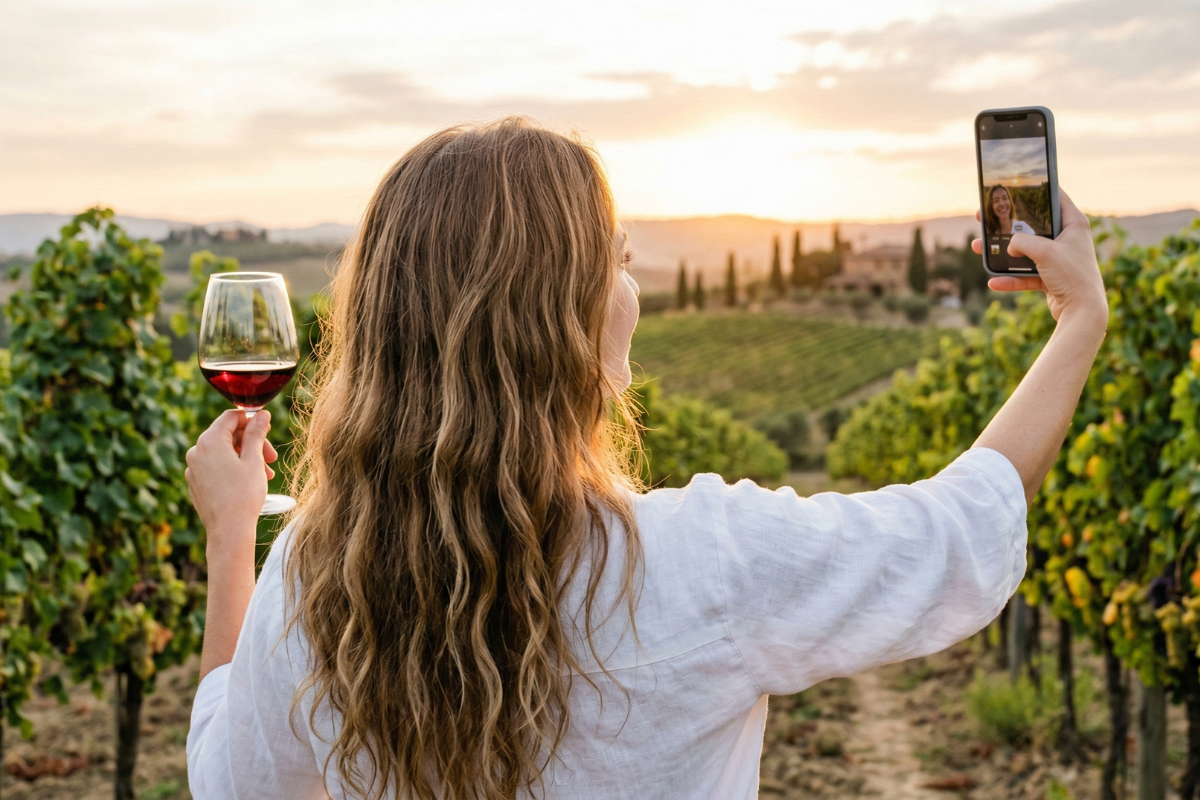
A February 2025 Rutgers University study claims that watching influencers drink on social media increases young people’s desire to drink by up to 73%. Yet real-world data consistently shows alcohol and wine consumption declining, especially among Gen Z. This article examines why the gap between momentary desire and actual drinking behavior matters far more than the headline suggests.
A study published on February 24th on the Rutgers University website, titled “When Influencers Raise a Glass, Young Viewers Want to Join Them” (Rutgers Health / JAMA Pediatrics), left me, I must confess, more than a little puzzled. I’d even say stunned.
According to this research, exposure to social media content featuring alcoholic beverages would increase the immediate desire to drink among 18-to-24-year-olds by 73%. Not only that: if the influencer is perceived as “trustworthy, honest, and competent,” the likelihood that the viewer would want to drink supposedly increases by as much as five times.
Now, while I have absolutely no intention of questioning the scientific rigor of the methodology — randomized experiment, publication in JAMA Pediatrics, national sample, and so on and so forth — one small, nagging problem remains: reality.
Because while we read that a few bottles in an Instagram video could “push” young people toward consumption, market data tells us the exact opposite story. Alcohol consumption is declining. Wine consumption, in particular, is going through an extremely difficult historical phase. And it is precisely among young people — the generation that lives on social media — that drinking is less central than it used to be.
Paradoxical, isn’t it? In the very era when Instagram and TikTok “shape culture,” consumption is falling.
The influencers who were supposed to save us
In the world of wine, the issue takes on almost grotesque dimensions.
For years we were told that influencers would change everything. That they would reach new generations. That they would build communities. That they would drive consumption. That they would “democratize” wine.
The result? Many of those who called themselves influencers are today communications consultants for some company, trainers on digitalization, freelance journalists, fixed-term brand ambassadors. Perfectly respectable professions, of course. But influencers capable of genuinely moving masses of young people toward systematic wine consumption — frankly, I don’t see any.
If a single “story” featuring a glass of wine were truly enough to generate a wave of consumption, wineries would be popping corks to celebrate. Instead, they are dealing with full warehouses, sluggish markets, and young people who are increasingly disinterested in wine.
The blind spot: desire is not consumption
The research itself acknowledges a detail that is far from trivial: it does not demonstrate that a momentary increase in desire translates into actual consumption. Let alone into habitual consumption.
In other words: I watch a video, I feel like having a drink. Fine. Then what?
Do I buy? Do I drink? How much? How often? Within what social, economic, and cultural dynamics?
Between the stimulus and the behavior lies a world shaped by disposable income, family upbringing, social context, cultural habits, health awareness, legal norms, prices, wellness trends, and an ever-growing range of non-alcoholic alternatives.
The great generational paradox
The article highlights an interesting finding: the prevalence of consumption is falling, but those who do drink tend to drink more. And perhaps that is where the real crux lies.
Because if young people drink less overall, but a portion of them drink more intensely — particularly spirits and cocktails — then perhaps the issue is social, not algorithmic.
There is a recurring tendency in our time: when a phenomenon is complex, we blame the platform, we blame social media. It’s reassuring. It’s straightforward. It’s narratively effective.
Far less effective is admitting that consumption behaviors are the result of cultural stratifications built up over decades. That the relationship with alcohol has changed for health-related, economic, and identity-based reasons. That Generation Z has grown up with a different sensibility compared to Millennials or Boomers.
I’m not saying that media exposure has no effect. It would be naive to claim otherwise. But between “influence” and “primary responsibility for the decline or excess in consumption,” there is a considerable gap.
If simply showing a glass were enough to make young people drink, wine would be living through a golden age. Instead, it is going through a phase of profound transformation and contraction.
And so, with all due respect for Rutgers, Harvard, and JAMA Pediatrics, allow me a touch of skepticism.
Do influencers make people want to drink?
Perhaps.
Do they explain consumption trends?
Oh, give me a break.
Key points
- A Rutgers study found that influencer content increases the immediate desire to drink by 73% among 18–24-year-olds.
- Despite social media’s reach, wine and alcohol consumption among young people is in a long-term decline.
- The study does not prove that increased desire translates into actual or habitual consumption.
- Generation Z has developed a distinct health-conscious identity that diverges from previous generations’ drinking habits.
- Complex behavioral patterns – income, culture, wellness trends – explain consumption far better than algorithmic exposure alone.