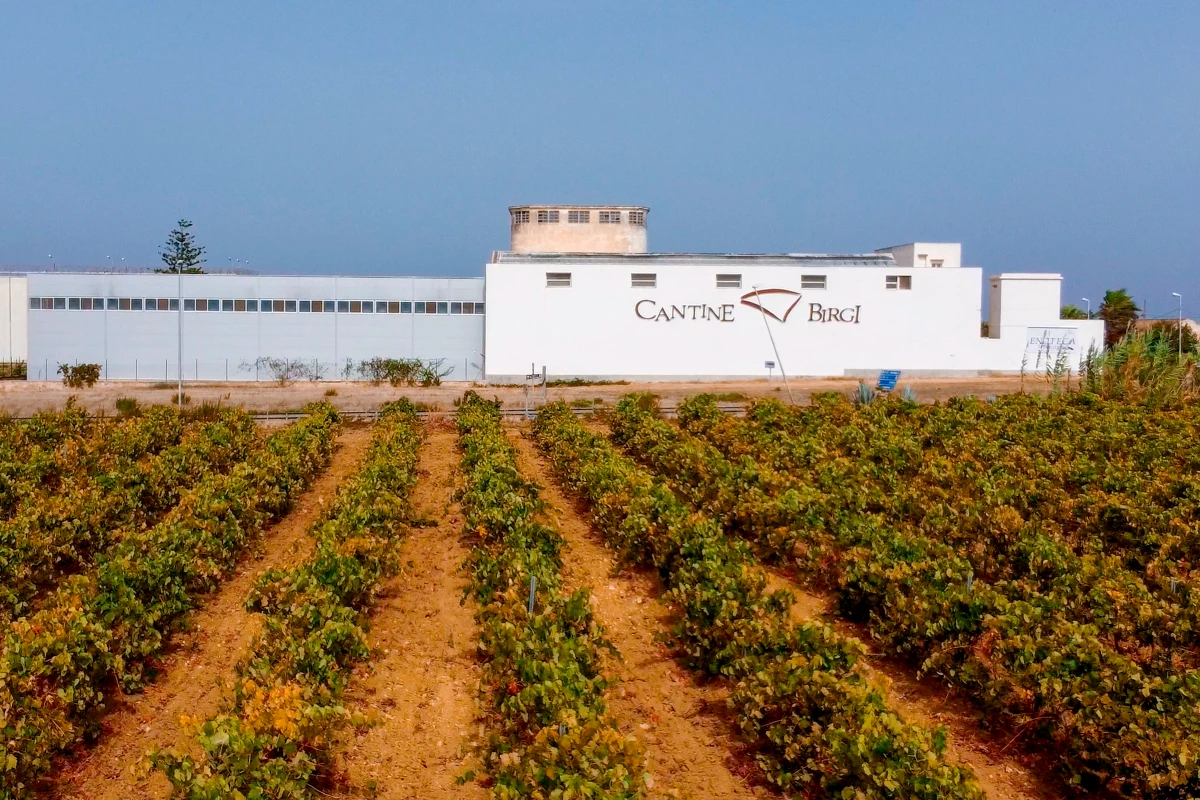
Cantine Birgi, a Sicilian wine cooperative founded in 1960, brings together about 1,000 members and 2,800 hectares of vineyards in the Marsala area. Through a short supply chain and shared rules, the cooperative links territory directly to quality, producing nearly 5 million bottles a year while keeping scale and authenticity aligned across its distinct wine lines.
There are stories in the world of wine that deserve to be told not for what they produce, but for how they produce it. Cantine Birgi, born in 1960 from the initiative of ten growers in western Sicily, is one of these. Today the cooperative brings together about 1,000 members who deliver around 300,000 quintals of grapes every year, coming from 2,800 hectares of vineyards spread between the coast and the inland areas of the Marsala countryside. A scale that, on its own, would be enough to define the company as a significant player in the Italian wine landscape. But it is the model that makes it interesting.
Sicilian wine cooperation has gone through difficult phases, often associated, rightly or wrongly, with undifferentiated production, quantity without quality, and a fragmented and not very transparent supply chain. Cantine Birgi has chosen the opposite direction, focusing on a simple concept: the territory is not a backdrop, it is the substance of the wine.And to defend that substance, shared rules, direct control, and a long term vision are needed, all things that a cooperative, when it works well, can guarantee better than many other business models.
Short supply chain is, in this sense, much more than a logistical choice. It means that from vine to bottle every step is tracked, verified, and documented. It means that members deliver quality grapes because they know that quality is recognized and rewarded. It means that the winemaker can work with authentic raw material, not with compromises. “Total control allows us to respond immediately and transparently to any market need,” explains commercial director Salvatore Marino. “This is a competitive advantage that cannot be improvised.”
With a production of about 5 million bottles a year, growing steadily, Cantine Birgi has shown that scale and quality are not necessarily at odds. The key lies in the ability to diversify without fragmenting: distinct product lines by category, designation, and territorial vocation, all traceable to a shared identity. An identity with a name and surname: Riserva Naturale dello Stagnone, Agro di Birgi, Sicilia DOC and IGP.
The future of cooperative wine in Italy probably runs through here, not by giving up the collective dimension, but by upgrading it. Cantine Birgi is proving it through facts, one vintage after another.
Key points
- Cantine Birgi unites about 1,000 members and 2,800 hectares of vineyards near Marsala, Sicily.
- The cooperative treats territory as the core substance of its wine rather than a backdrop.
- A short supply chain keeps every step tracked, verified, and documented from vine to bottle.
- Production reaches nearly 5 million bottles a year while quality and scale stay aligned.
- Distinct product lines, including Riserva Naturale dello Stagnone and Sicilia DOC, share one common identity.