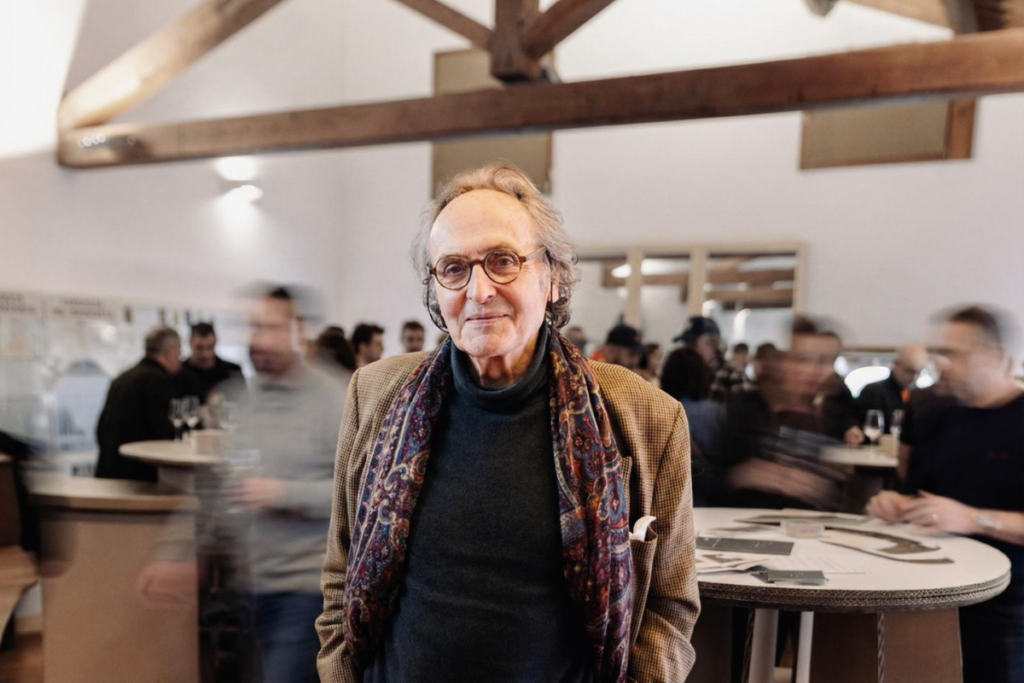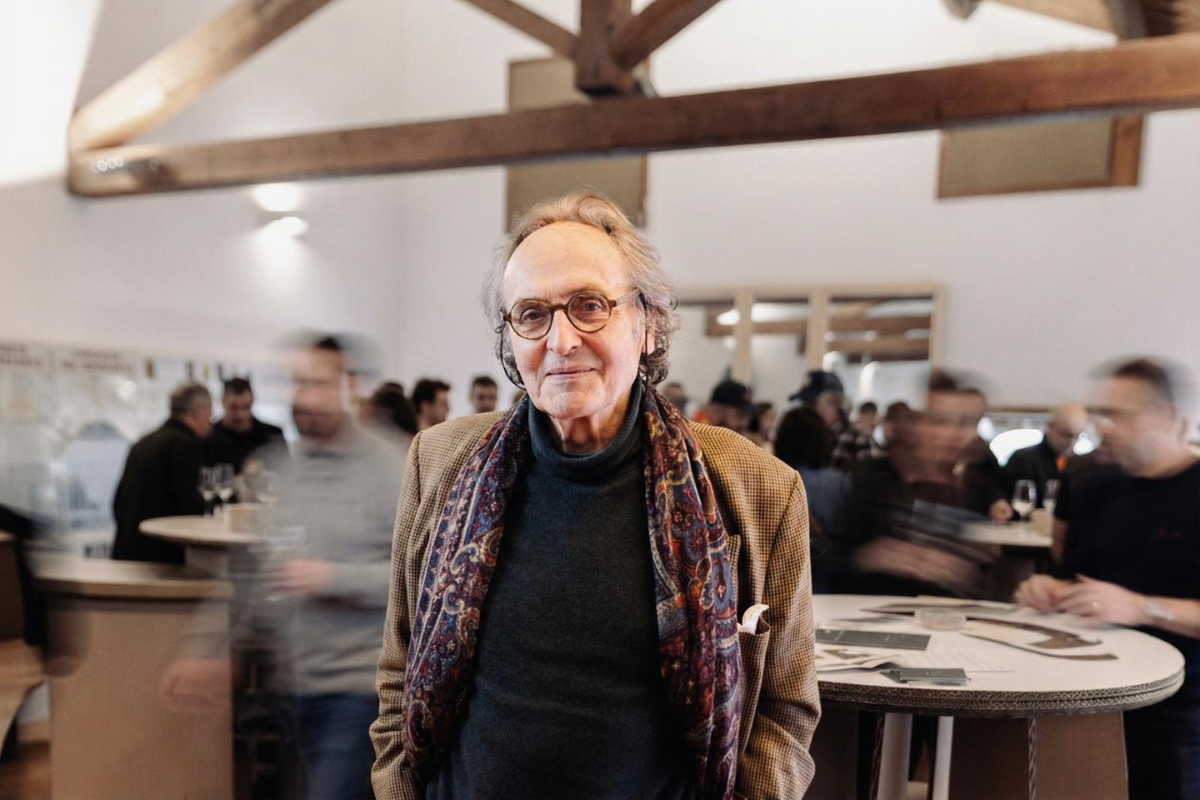
Nicolas Joly, biodynamic producer from the Loire and founder of Renaissance des Appellations, is a spokesperson for wine as an authentic expression of territory, life, and health. His is an unconventional voice that passionately supports the relationship between wine and the forces that give life to the Earth and defends the great diversity and originality that the wine heritage expresses.
Nicolas Joly, French producer from the Loire Valley and owner of the Coulée de Serrant estate, is recognized as a pioneer of biodynamic viticulture in Europe. We had the opportunity to meet him in Rome at a Renaissance des Appellations event, an association founded with the aim of protecting the integrity of wine and enhancing its ability to authentically express its place of origin.
In today’s wine landscape, where standardized narratives abound, it seems important to give space to unconventional voices that question the deeper meaning of producing wine. Nicolas Joly’s vision sees wine as a complex expression that integrates cultural, philosophical, and ethical dimensions.
Biodynamics can be considered a humanistic science that works with the living. How does it relate to contemporary scientific thought?
Biodynamics draws its strength from the supersensible world, without which the Earth would be lifeless. Without its connection first to the solar system and then to a stellar system, the Earth, our planet, is nothing—it has no life. Life on Earth is a gift of the solar and stellar systems; Steiner recreated an understanding of this so-called supersensible world that secretly lies behind the earthly world. Contemporary research, unfortunately, always starts from matter.
I often say, half in jest, that if you pass the cake of a great chef through the most modern research instruments, you will never recognize the “face of the chef.” Matter is the result of processes that, at their origin, are not on Earth. Such an understanding is not well regarded today, because it may indirectly lead to the awareness that the thousands of satellites we install around the Earth for our comfort and to sustain the laws of our economy interfere with more secret yet very concrete laws that give life to the Earth.
One of the pillars of biodynamics is the valorization of individuality: each estate as a unique and unrepeatable story. How important is it to defend singularity in a market that risks standardization?
The challenge of biodynamics is to move beyond this standardization which, despite multiple marketing efforts, cannot conceal its true identity. This is evident in the current wine crisis, where it has unfortunately become legally acceptable to “create good taste” in the cellar through the use of over 300 aromatic yeasts, sometimes genetically obtained, at the expense of the pure expression of a place’s originality—the very meaning behind the creation of controlled appellations of origin. This technology, presented as miraculous in recent decades, made it possible to obtain high scores, allowing prices to reach extremely high levels despite a very artificial taste. Thus emerged a wine presented as “perfect,” but in reality without charm, without healthy forces—somewhat like the image of a cold beauty derived from cosmetic surgery. All this happened over time, often in good faith on the part of winegrowers who did not realize the dead end they were entering. Today, the knowledge of the “flying winemaker” is available worldwide and is reflected in wines that are fairly similar, sold at 10 euros or less in large-scale retail: woody flavors, concentration through osmosis, flavors added through the selection of different yeasts depending on the country to flatter different consumer profiles, added roundness, and more.
These so-called “technical” wines have required massive investments in cellars, which have become “factories” instead of remaining “maternity wards.” A lack of understanding of the secret laws of life means that such cellars benefit less from those forces that naturally lead to fermentation and the evolution of wine; this has increased the use of artifices: overly rapid fermentations through temperature control—whereas a natural fermentation can last six months—forced malolactic fermentations, and more.
What we try to do is simply to return to the great meaning of an AOC, when wise people tried to give legal protection to the great diversity that nature can offer, if it is understood in depth.
Biodynamics aims to encourage the vine to nourish itself from the original forces of the place where it grows. How does this translate concretely into daily work, both in the vineyard and in the cellar?
This step has been taken in recent years: consumers are tired of “perfection”, which can be imitated by almost anyone, and are seeking the pure expression of a place and the life forces it conveys. This is where biodynamics leads, if practiced sincerely and not for advertising purposes, with the same legal drifts in the cellar—drifts that always occur at the expense of taste and the expression of place.
The biodynamic approach is closely linked to the relationship between wine and health. How does it relate to the hygienist approach that today stigmatizes wine consumption?
Health in nutrition is a very concrete matter and can only be achieved by understanding the secret laws of life: recognizing why a plant is medicinal, when to harvest it—the flower in the morning at dawn, the root in the evening—possibly under which planetary or stellar background (as in the work of Maria Thun, now widely known), and so on. This knowledge of herbalists, somewhat secret yet very real, is now almost nonexistent, for reasons linked to the pharmaceutical industry. We almost no longer even have the right to speak about the healing virtues of plants. The more these underlying aspects are understood and put into practice, the more food will be charged with life, and the fewer human beings will be ill—something that runs counter to many very powerful economic interests. Illnesses are almost always linked to a deficiency of vital forces.Speaking of wine, a true wine is a “medicinal” wine, naturally in small doses, as noted by Americans with the “French paradox.”
Beyond the agricultural aspect, biodynamics strongly insists on the relational dimension: collaborators, visitors, clients. How are these principles concretely translated into the organization and daily life of your estate?
In reality, it is a whole: when a philosophy is shared, an atmosphere is created in which everyone fulfills their role not only with the head and the arms, but also with the heart. Not everything is perfect, but these more or less deep understandings create bonds. Also with those who come to the estate to learn.
The Renaissance des Appellations movement promotes a specific way of building a network and a supply chain. At a time when we believe wine needs sharing and synergies more than ever, on what principles is your approach to networking based?
With my daughter Virginie, we created Renaissance des Appellations a long time ago so that wine lovers—who often ignore, like many sommeliers still do, the extent to which wine has been legally “denatured”—can first become aware of it and then gain access to authentic taste. I would add that one must be wary of so-called “natural wines,” toward which consumers have sometimes rushed out of respect for nature, in good faith. In reality, until very recently these wines were not subject to any legal constraints, and I have seen quite a few winegrowers, eager to “capture” the organic wine market without its constraints, choose the term Natural Wine, which allowed the use of herbicides, systemic products, and more. In France, legislation has changed in recent years, at the request of genuine defenders of Natural Wines, who simply wanted to free themselves from the sometimes excessive legal constraints of AOCs.
What importance do you attribute to communication in making the biodynamic philosophy known and understood, and which forms of communication seem most credible and effective to you for this purpose?
It is a difficult issue for specialized wine magazines. The greatly increased profitability of “technological” wines has made substantial advertising budgets available. This has significantly limited the possibility of denouncing the denaturation of taste that these technologies often entailed. Advertisers would have protested by withdrawing their advertisements, endangering the survival of magazines, which rely primarily on advertising. It is still the case today, of course, in every country.
Key points
- Biodynamics aims to enhance the individuality, the originality of a place, and the expressiveness of its wines.
- The consumer seeks authenticity, seeks wines that are an expression of a territory and its vital forces, and does not seek standardized and perfect wines.
- Renaissance des Appellations was created to safeguard the integrity of wine and to guide the enthusiast in the search for an authentic and identity-driven taste.