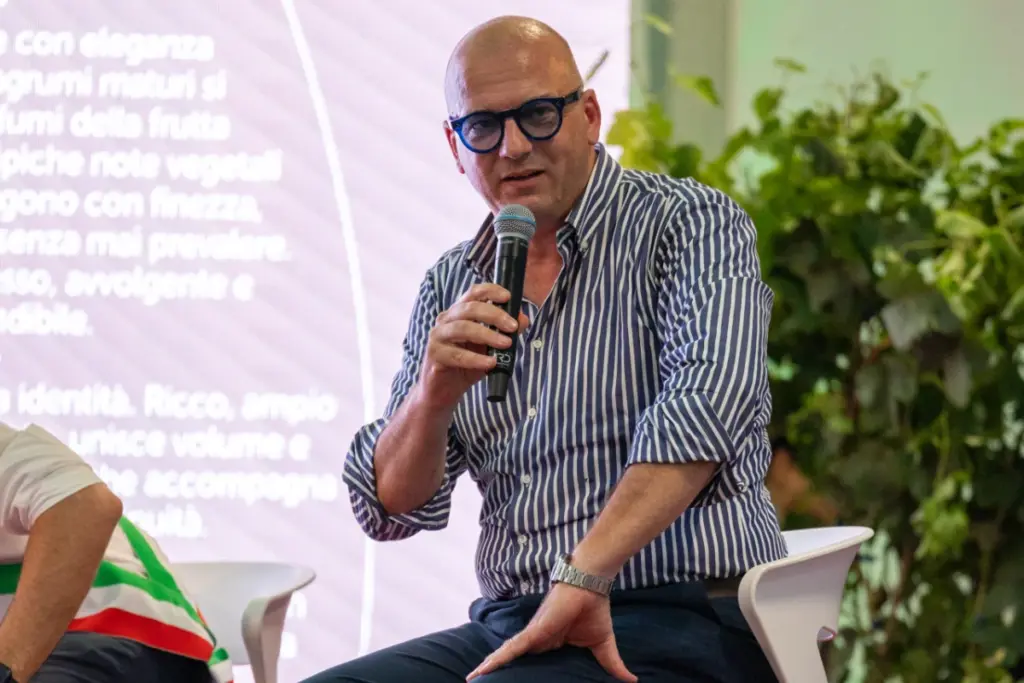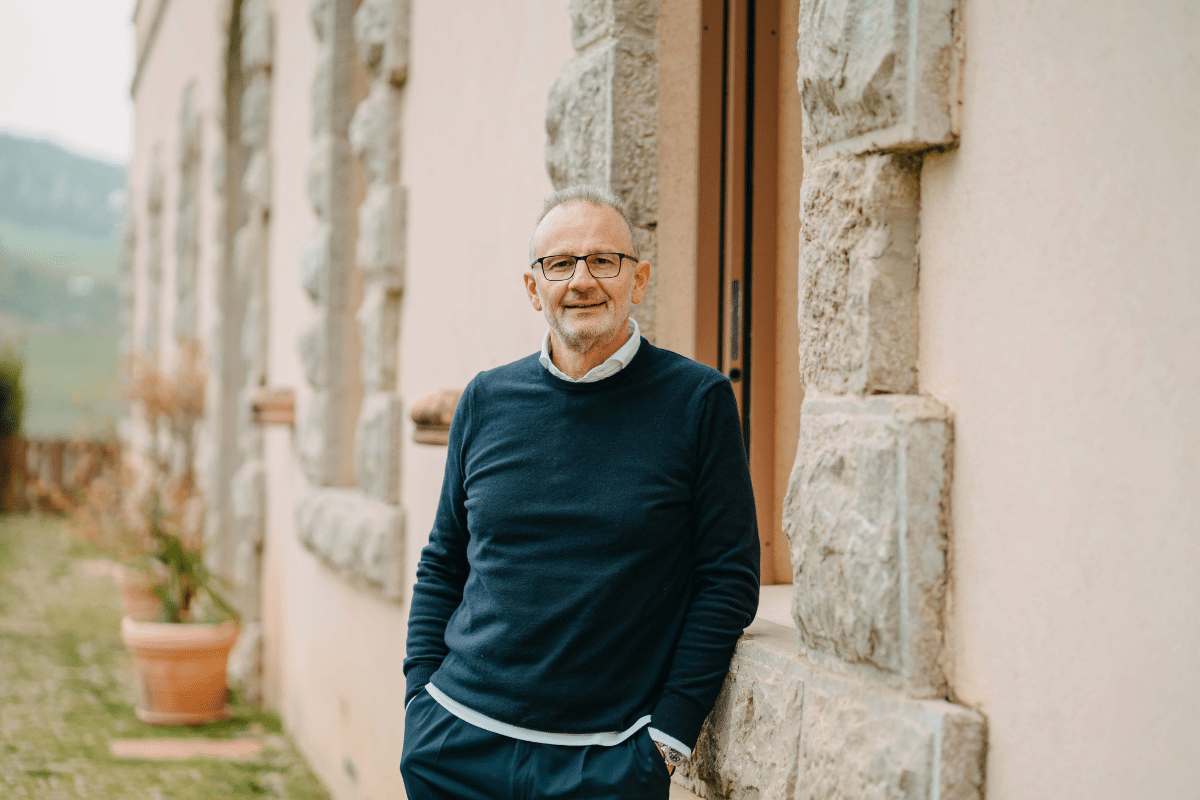
At Vinitaly 2026, Dante Bonacina – CEO of Baglio di Pianetto and former General Manager of Ca’ del Bosco – argues that wine has grown too technical and self-referential. Wine needs to return to its true nature: a relational gesture, a pause in the rush of daily life, a simple invitation to slow down and genuinely connect with others.
There are moments during trade fairs, rare ones, in truth, when the background noise fades and the pace slows, and there are encounters that leave you with the feeling of having talked about wine only on the surface. With Dante Bonacina, at the recent Vinitaly, through wine we talked about time, proximity, language, and relationships. And from this pause we believe some useful reflections have emerged for re-reading, and in certain respects rethinking, the way we relate to wine today, from those who produce it to those who pour it into a glass, all the way to those who choose it to enrich a moment of their day.
Dante Bonacina joined Baglio di Pianetto in 2023, after a career built at the very top of Italian wine, including 25 years at Ca’ del Bosco, where he also served as General Manager.
You have lived in this sector for many years, at the heart of leading organisations: wine is going through a particular moment and seems to constantly have to justify itself. From your vantage point, what is happening?
What is happening, in my view, is that at a certain point in its history wine began speaking an increasingly complicated language, as if it had to be continuously judged, analysed, classified, with the consequence of turning something deeply human into a technical exercise. And so we lost its relational value. That is why I say wine doesn’t need to be defended; wine has always been here. Rather, it needs to be brought back among people, with a comprehensible, inclusive language, one capable of creating connection instead of distance.
It is plain for everyone to see that we have been getting the approach wrong: for years the sector spoke mainly to itself. And through an excess of technicalities, codes and increasingly specialised jargon, wine ended up distancing people somewhat. Of course wine, like every sector, has its own identity vocabulary, but sometimes it seems as though, faced with a glass, there is almost a fear of making a mistake. Wine is not a quiz to pass. These excesses have in reality created a deafening silence around wine; wine, let’s say it plainly, has at times become deadly boring. I take some of the responsibility myself, having quite a few years in the sector; I firmly believe that today what is needed above all is the courage to simplify.
Wine is first and foremost about relationships, about being together. I believe we have anaesthetised the simplest and most human gesture: that of conviviality. Today we are extremely good at describing a wine, much less good at truly living it. Certain moments have value precisely because they serve no purpose other than to be lived. A long dinner, a shared bottle, a conversation that slows down. These things seem apparently useless, yet they are fundamental.
Time is a theme you feel strongly about: you recently spoke of the need for “a slow dance for wine.” Where does this metaphor come from and what reflections can it inspire?
We live in a culture that constantly rewards speed, performance, efficiency. But human contact works differently. It requires presence, listening, time. It is a continuous practice. And in my view wine can still play this role: creating spaces where people truly stop. After all, pouring a glass also means saying: “let’s take a moment.”
In my youth I worked as a DJ and I observed people closely, watching how they gathered and spent time together. With some experience I began to sense when the music needed to slow down and completely change the atmosphere: with the slow dances, people stopped performing and began to genuinely seek each other out. And at heart wine, when it expresses the best of itself, does exactly this: it creates a space in which people pause and can come closer again.
People are constantly looking for occasions to be together. You see it in wineries, in venues, in the simplest moments. They look for experiences that serve no purpose other than to be lived. And perhaps this is the most revolutionary gesture today: pouring a glass as an invitation to take a moment, to create a space for the other. A small gesture, but deeply human.
And perhaps wine, like music, can still teach us that connection is not a waste of time. The greatest gift one can give another is time, a resource that always seems to be running out.
What are the responsibilities of producers today?
First of all, the responsibility to remember that wine is not only a product. The culture of the vine has accompanied territories, landscapes, communities, identities. Behind a bottle are places, people, stories, and delicate balances that wine has helped preserve.
That is why I believe that today, within companies, a profound reflection is needed at every level, starting with the way we communicate. For years we perhaps overused certain languages; now we must have the courage to change our vocabulary and speak clearly to people again, especially to the new generations.
Responsibility also means promoting moderation. Addressing the importance of conscious consumption with maturity, without losing sight of the cultural and relational value of wine.
The role of sommeliers should also evolve, in your view?
Yes, certainly, I believe sommeliers can play a much more effective role if they return to being guides in knowledge: people who help others approach wine without intimidation. We need ambassadors, not “judges.” People capable of conveying the pleasure of conviviality and sharing, not only technical expertise. Wine doesn’t need to be made more difficult: it needs to be made more alive and liveable.
Because limiting oneself to listing “ingredients” is like reading a score without hearing the music. Wine, like a piece of music, has to be felt: how it moves, what atmosphere it creates, what emotion it leaves behind. Technical descriptors belong to one language; emotional forms, on the other hand, are universal. And it is there that wine truly speaks to people again.
How much of these reflections is reflected in Baglio di Pianetto’s recent choices?
When I joined the company I found the energy of a project that was eager to evolve deeply. From there a significant transformation began, almost a complete change of skin. And within this journey a very simple question was born: what kind of wines are needed today? Fascinating wines in the most immediate sense of the word, wines capable of truly fitting into people’s lives.
I never imagined I would work on a sparkling wine at Baglio di Pianetto. But then, together with owner Gregoire Desforges, winemaker Graziana Grassini and all the team, we realised there was a need for a wine that could speak a language anyone could understand. So Shùmè was born: a blend of Sicilian grapes grown at 700 metres above sea level, breathing in the marine “sciuma”, a fresher, more convivial, more immediate wine, with a lower alcohol content, that anyone can grasp, designed to be shared without much explanation. Even the name points in that direction: it doesn’t need artificial intelligence to be understood. After years of searching for ever more sophisticated ways to stand out, perhaps today we must have the courage, not to take a step back, but a step towards people: a wine that takes itself a little less seriously, yet capable of creating spontaneous and memorable connections.
Key points
- Wine lost its relational value by becoming overly technical and self-referential.
- The sector needs the courage to simplify its language and reach people directly.
- Pouring a glass is a human gesture, an invitation to slow down and connect.
- Sommeliers should be ambassadors of conviviality, not judges of technical knowledge.
- Shùmè, Baglio di Pianetto’s new sparkling wine, embodies accessible and joyful sharing.