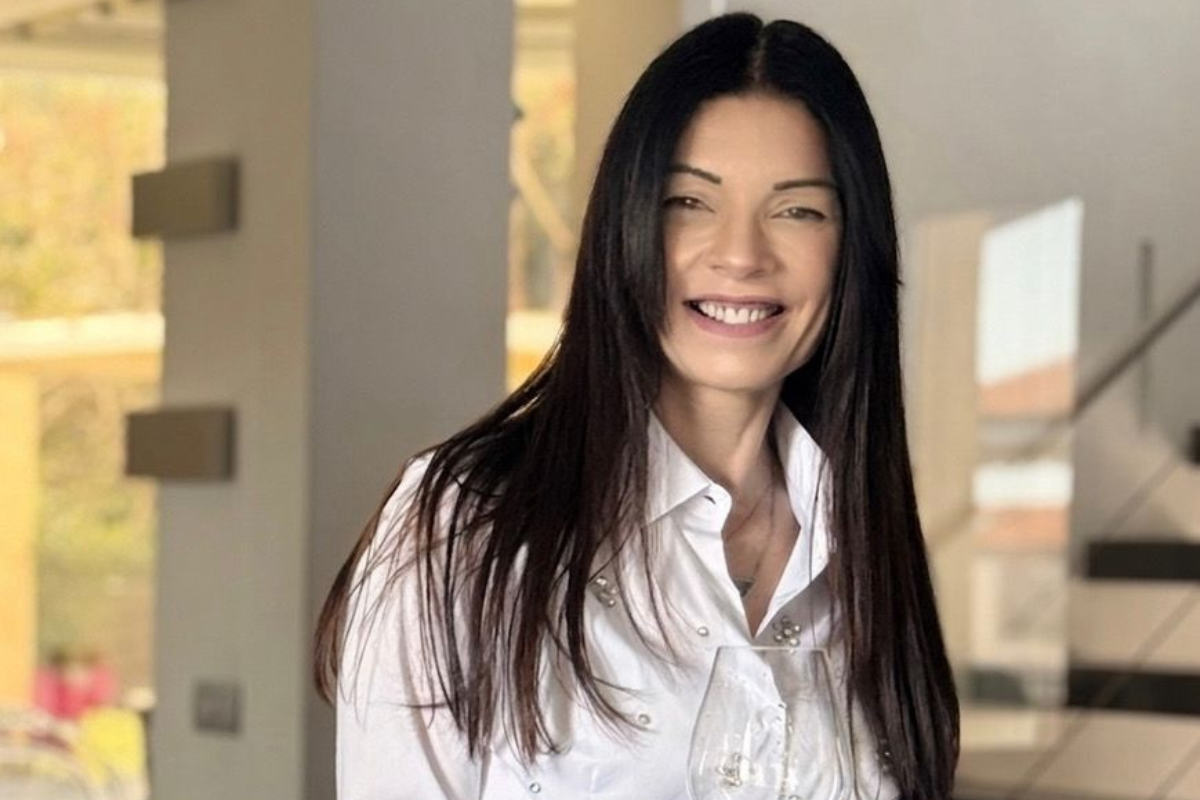
Simona Geri, sommelier and content creator known as The Wine Setter, challenges the way Italian wineries communicate online. In this interview, she critiques outdated websites, self-promotional language, and the worn-out Dolce Vita aesthetic, arguing that authenticity, long-term editorial planning, and concrete storytelling are the only strategies that still work today.
Simona Geri grew up surrounded by wine, a father from Bolgheri, a grandmother who ran a restaurant on the island of Elba, and a cousin with a small vineyard in Castagneto Carducci, where she used to help with the harvest as a child. Yet at twenty, wine meant little to her. “At twenty we were all about Negronis,” she says candidly, setting the tone for a conversation that is anything but stuffy and, for that very reason, very real.
The turning point came around her thirties, with her first food and wine trips to Sicily and visits to wineries, necessary to better understand the territory. Then a trip to Burgundy that, as she puts it, was her Road to Santiago. While working as a manager at a transport company, she began her sommelier training, a path that proved invaluable when, after the 2008 crisis, at just over forty, she found herself out of work.
And that is how The Wine Setter was born.
At the time, very few people were talking about wine on social media. She entered almost by chance, but from the start built an editorial project with a clear identity: speaking to people in a simple and direct way.
Nine years on, The Wine Setter is a recognisable project, with collaborations that come more readily from France than from Italy. Why? We interviewed Simona Geri and asked her directly.
How do you maintain the balance between the technical authority of a sommelier and the more dynamic languages of social media? What is the distinctive aspect of your communicative approach?
I always put myself in other people’s shoes. I am very curious and interested in many things: art, literature. I also follow accounts that have nothing to do with wine. If I follow an account about an impressionist art museum and it only uses technical terms, I will never go to see the artworks in that museum. But if it tells the story of the person who painted a particular picture, I become much more engaged. It is a bit like wine: if you talk to me about pH, malolactic fermentation, malic acid, you are giving me technical information. But what does a novice care about? They want to know if it is good or not.
For instance, I always say I am not a fan of aromatic grape varieties, which will therefore never be my first choice at a restaurant. But if there is an exceptional Gewürztraminer, I describe it objectively. I might never buy it myself, but I do not let my subjective opinions take over when I talk about it, because I am aware that my palate is not the same as yours. That is why I use terms like “balanced”, “savoury”, “easy-drinking”.
I still see this old-school sommelier language that is now completely outdated. People talk about pH, malolactic fermentation, technical details that the end user simply does not care about. I hear phrases like “here you can detect the salt of the Himalayas”… Have you ever smelled Himalayan salt? How would you even know what it smells like?
What is the most common narrative mistake or communicative error you see Italian wineries making when trying to position themselves online?
Aside from the fact that Italian winery websites, a good 80% of them, are not up to date. And then almost all of them have a phrase I would love to see banned, and I even know it by heart: “Our wines reflect the territory and are a union of tradition and innovation.” It is a phrase I see even from PR agencies managing these companies. Tradition, innovation and wines that reflect the territory: it means everything and nothing, it is a phrase from the Eighties.
What is more, many Italian winery websites are self-congratulatory. But you should not be the one telling yourself how good you are, others should be saying that. Some websites are also not very intuitive: the technical sheets are often missing, there is a lack of precision, and many times you cannot even figure out which town they are in. A map needs to be included to explain exactly where you are located within, say, the Chianti Classico, because otherwise nothing is clear.
Is there one element that can determine the success of a wine marketing strategy today?
Stop the self-promotion and stop making comparisons with other territories. We Italians are good and we do not need to suffer from performance anxiety when compared to others.
People always talk about this Italy-France rivalry, but I have never seen a French counterpart make a comparison with Italian wines.
Wineries also need to understand what truly lies behind an editorial plan. It is not a single post that gives you visibility: it is a three, six, nine-month plan, with targeted campaigns and a community to build loyalty with. It is very difficult to make all of this understood. In the meantime, there are many content creators publishing content in exchange for bottles, but that means investing in communication.
I personally buy a great many wines with my own money to keep my profile active and to share what I enjoy with my community. But it is frustrating to see what is out there, barter deals and cookie-cutter reviews agreed in advance with the clients and therefore not particularly truthful. It is quite demeaning for those who work with professionalism.
How can Italian wine be communicated abroad, moving beyond the “Dolce Vita” stereotype towards something more contemporary and concrete?
The Dolce Vita stereotype persists because we keep exploiting it. Look at various corporate accounts – not only wine companies – and look at the videos and photos: everything is glossy, everything is fake. And unfortunately, or fortunately, this kind of communication no longer works. The younger generation has grown tired of this image. Instagram was created for beauty, for carefully curated photos. But now there is a weariness of seeing everything perfect. We are not perfect, we are imperfect. The fermentation process needs to be shown without making it look polished. If a video does not come out perfectly, that is fine.
After so many years of glossy photos, a little more sincerity is called for. A piece of content does not need to embody perfection to be consistent.
Enough with the photos of the Fiat 500, the fountain, the convertible, the scarf and the beautiful woman. Wine is not this Rio carnival. It is undergoing a profound transformation: tariffs, China pulling back, markets shifting, wineries full of unsold stock. If the same imagery from the Eighties keeps being used, there is not much of a future in that.
Moving from criticism to proposals: is there an Italian winery communicating in the right way today? Give us a concrete example.
I will give an example from Spain, because in my view Spain is currently one step ahead of everyone. The winery is called Ysios Winery, and it is a truly extraordinary place – it has been listed among the most beautiful wineries in the world – yet in their social content there is nothing self-congratulatory and the winery itself is barely visible.
In one of their recent reels, you see a young woman, reasonably Gen Z, dressed with simple elegance, explaining wine in a direct manner: she talks about the altitude of the vines, shows the grapes, presents everything. No gloss, no self-promotion. The editing is perfect, but it does not give you that sense of artificiality. It is clever, it is not long and it is not boring.
It needs to be seen to be truly understood, but it is exactly what I was talking about: content where the winery becomes a context, not the absolute protagonist. Where the person on screen can explain something concrete without making you feel like you are reading an Eighties brochure.
That, for me, is communication done well.
Key points
- Italian winery websites are largely outdated and filled with meaningless clichés about tradition and innovation.
- Self-promotional communication is counterproductive: credibility should come from others, not from the brand itself.
- A successful wine marketing strategy requires a structured editorial plan spanning months, not isolated posts.
- The Dolce Vita stereotype has lost its appeal, especially among younger audiences who favour authenticity.
- Spanish winery Ysios is cited as a benchmark: direct, unpolished content where the product speaks for itself.