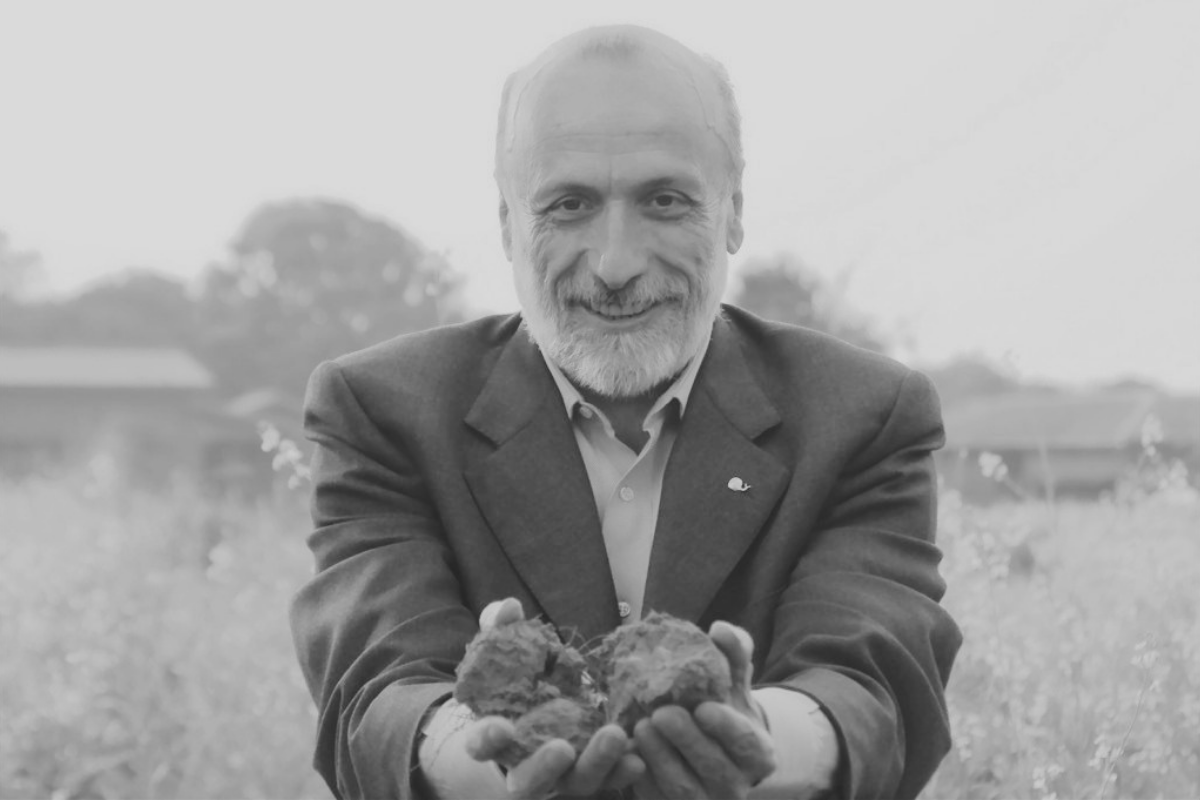
Carlin Petrini, founder of Slow Food and Terra Madre, passed away leaving behind a demanding and complex legacy. This piece reflects on the gradual fading of his founding vision, the idea of food as a political act and calls for the courage to relight that original flame, rather than settling for its memory.
There is a very easy, and in some ways insidious, way to avoid concretely applying the ideas – and above all the projects – of visionaries: simply calling them visionaries.
If people start calling you a visionary, it’s time to worry, because it means they see you as someone projected into the future, and rarely does anyone commit to making your projects, your visions, happen in the present.
It is, in short, the best way to postpone concrete, important choices indefinitely.
Carlin Petrini, who passed away last week, was considered a visionary by just about everyone.
Fortunately, for all of us, throughout his intense life he managed to bring to life quite a few projects, from Arcigola to Terra Madre, from Slow Food to the University of Gastronomic Sciences in Pollenzo.
Quite an achievement, without a doubt.
Yet every great project inevitably requires a long journey, a constant evolution to fully develop and capitalise on its potential.
One could argue that every great project, as it is born, simultaneously generates a legacy that cannot be carried forward by its creator.
If that is true, and for me it is, though I don’t expect everyone to agree, Petrini’s legacy began long ago, not now that he is gone.
And it has been an extremely complex and demanding legacy. Everyone who, in some way, took on the responsibility of carrying it forward understood this from the very beginning.
A legacy so “weighty” that advancing it requires not only the right people, but also an adequate environment in which Carlin Petrini’s many projects can take root in a meaningful and concrete way.
We cannot, at this moment of great sadness over the loss of a key figure in our agri-food world, and at a time of great difficulty for the sector, avoid asking ourselves how much of the “good, clean and fair” has actually been realised, and how consistently it features in the agenda of our production system.
How much of that original Slow Food spirit, which led to the birth of the Salone del Gusto and then Terra Madre, is still alive and vital?
When I think of the emotion and enthusiasm of walking through the pavilions at the Lingotto in Turin, I cannot help but notice that much of that feeling has been lost over time. And I don’t believe it is simply a matter of nostalgia for the past.
Nor do I think it was an inevitable evolutionary process. I believe that vital and virtuous process came to a halt for various reasons – reasons that deserve genuine analysis, not to be dismissed with superficial conclusions.
I am told that over time the Salone del Gusto and Terra Madre have lost their pioneering energy, but that something new has taken their place.
Well, someone explain to me what that something new is,
because perhaps I have missed it.
The truth is, I fear we have all lost something, and not just since we lost our Carlin Petrini.
I believe he had long been aware that the extraordinary fire he had ignited – surrounded by a few loyal and talented friends – had been dimming for some time.
And then, as only truly intelligent people know how to do, he did not take refuge in criticism of the present, but sought and suggested new paths.
Of course, we can say today that his thinking and his works, his projects, are in some measure continuing , all true, but what I see missing is the courage to relight that original flame: to give a voice once more to those on the margins, to reinvigorate food communities, to escape what he once called, in an interview many years ago, “food pornography”, the festival of pots and pans.
Today, more than ever, it is essential, vital, to reaffirm the concept of eating as a political, social and economic act.
Ideas that carry even greater weight in an era as complex and, in some respects, dramatic for agriculture, including our beloved wine, today searching for a new light, new meaning.
That light which Petrini managed to kindle in his Bra, in those Langhe hills that were once poor, and then became rich.
But if we have long since forgotten that poverty, and are not even grateful for the wealth we gained – thanks also, and I would say above all, to men like Carlin Petrini – then it will be very difficult to find new paths, to relight that fire.
Key points
- Calling someone a visionary is often a way to delay taking their ideas seriously.
- Petrini built landmark projects – Slow Food, Terra Madre, Pollenzo – that now need courageous stewardship.
- The original pioneering energy of Salone del Gusto and Terra Madre has faded over time.
- Eating as a political act remains a vital concept, especially amid today’s agricultural crisis.
- Without gratitude for past progress, finding new directions will be very difficult.