Port of Leith Distillery, built across eight vertical floors on Edinburgh’s historic port, turns a lack of space into a defining brand story. Founded by two university friends, it prioritizes flavor over efficiency, sources barley from a single farm, and offers immersive tours, proving that product tourism can build a producer’s identity long before the whisky itself is even ready.
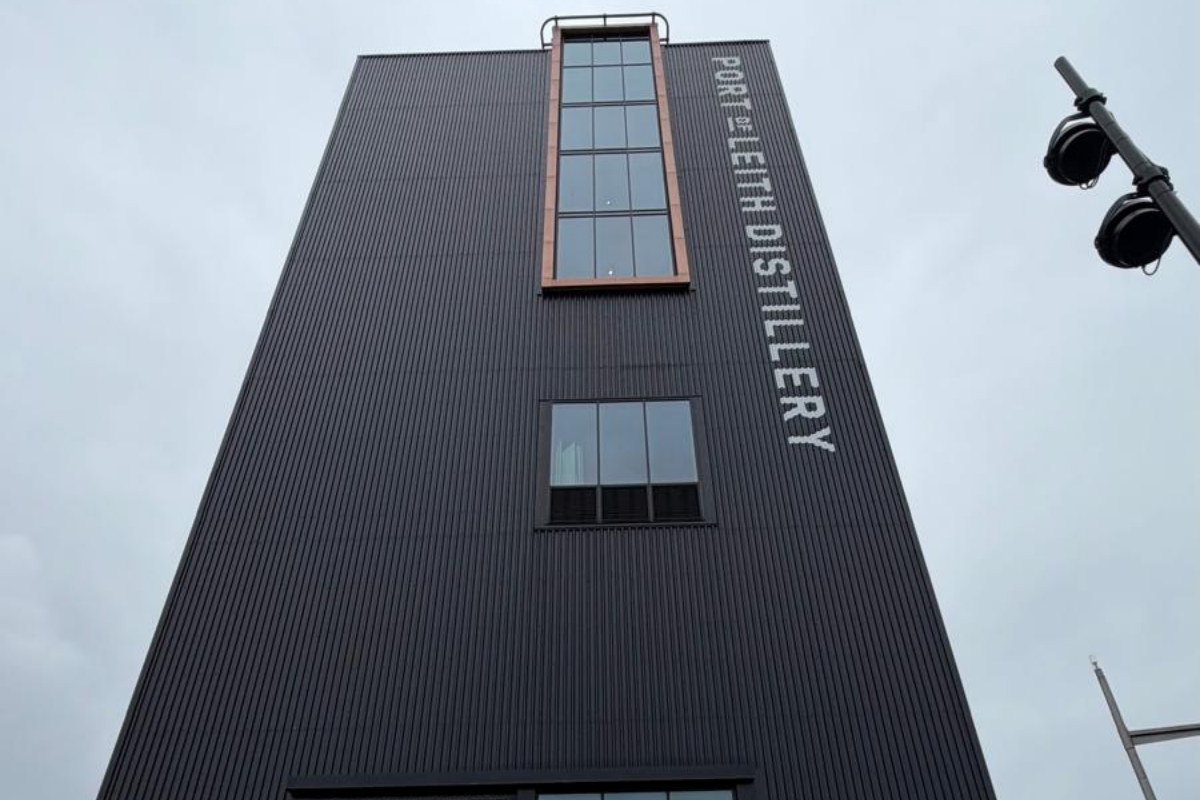
On the port of Leith, which for two centuries was the commercial belly of Edinburgh, stands a building that no one would call a factory. Eight floors of glass and concrete, with a bar open to the public on the top floor and a shop on the ground floor. In between, distributed vertically as no one had ever dared before, a real working whisky distillery: Port of Leith Distillery. It is one of the most interesting distillate tourism experiences in Europe today.
Two friends, a university, eight years
The story begins as many stories that will become interesting begin. Two friends, Patrick Fletcher and Ian Stirling, meet at university. They study different things, but share the same question: what does it really take to make a good Scotch whisky? What they decide to do, before distilling a single drop of alcohol, is to start studying.
They commission a research study from Heriot Watt University in Edinburgh on how to design a distillery that is legally compliant with Scottish rules but at the same time optimized for maximum variety of flavor, rather than for maximum production efficiency. These are two opposite goals, and most distilleries choose the second because the market rewards it.
Barley from a single farm
The obsession with geographic specificity shows in every production choice. Scottish law does not require the use of Scottish barley for Scotch whisky: it can be imported from half of Europe, and this cuts costs. Port of Leith does the opposite. It buys all its own barley from a single farm, Upper Bolton Farm, just outside Edinburgh.
Verticality as story
When the two founders look for a place to build, they find no horizontal space available in Leith. The port is being transformed, prices are rising. The solution, which would have been banal elsewhere, becomes iconic here: building vertically. Eight floors, each floor a phase of the process, gravity flowing down from grain to glass.
A model that everyone said was impossible and that has become the world’s first vertical distillery. No other one in the world works this way.
The fact that an economic constraint became the brand’s identifying feature is the thing that wine should copy first. Port of Leith shows that a constraint, if told well, becomes the distinctive trait.
The sensory experience
The tour lasts ninety minutes and is an experience one takes part in. During the course, one personally fills a miniature bottle of new make spirit directly from the still, labels it by hand, and takes it home. The distillate is tasted in five different forms: the new make just out of the still, a sample from a maturing cask, an expression with Port influence, another with Sherry influence, and finally the Table Whisky, the young blend that today represents the commercial face of the brand.
The naming of the Table Whisky is the project’s second stroke of genius. The term does not exist in Scottish regulation. It is not a category. It is a positioning invention, built by borrowing directly from wine vocabulary. Table wine, table whisky. Whisky to drink during meals, not at the end as a contemplative ritual. Whisky drunk the way wine is drunk.
This move should also make the wine world reflect, but in the opposite direction. If Port of Leith uses wine vocabulary to make whisky accessible, many Italian wineries do the opposite: they use technical and ceremonial vocabulary to make wine inaccessible.
Port of Leith has not yet produced a sellable single malt. The first casks have been maturing since 2023 and the first serious whisky will not be released before 2027 or 2028. Yet, it is already today one of the most imitated distillate tourism experiences in the world. It understood before anyone else that product tourism does not serve to sell the product, it serves to build the producer.
Key points
- Two founders commissioned university research before distilling a single drop, prioritizing flavor over production efficiency.
- Eight vertical floors replaced horizontal space, turning an economic constraint into the brand’s defining identity.
- Single farm barley sourcing reinforces the distillery’s obsession with geographic specificity and authenticity.
- Table Whisky naming borrows wine vocabulary to make whisky approachable for everyday drinking, not ritual.
- Product tourism builds the producer’s reputation years before any sellable single malt actually exists.