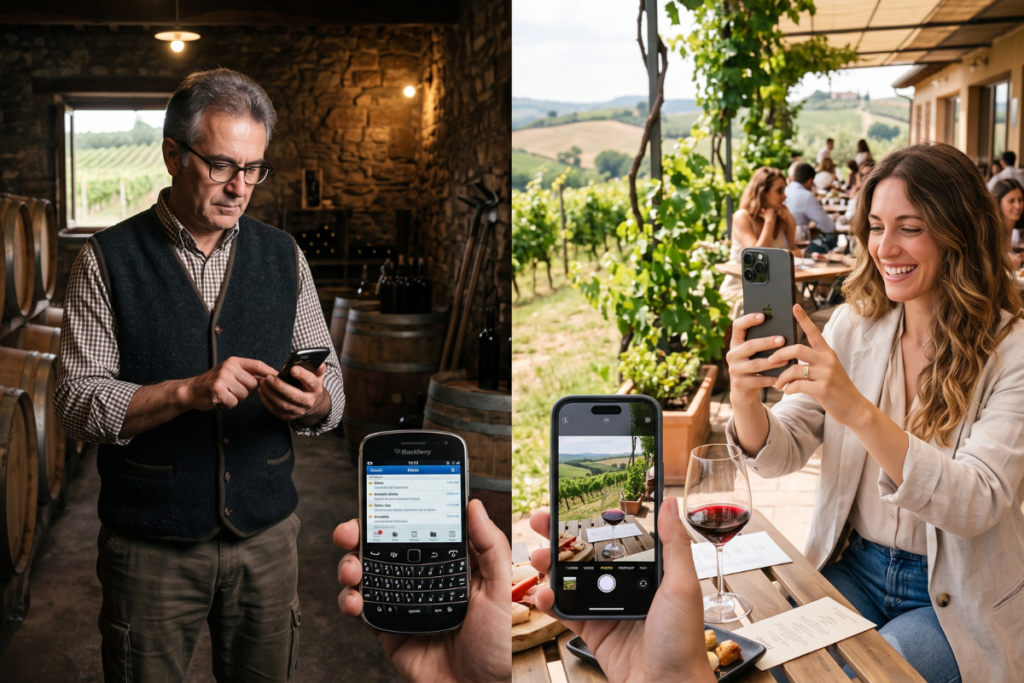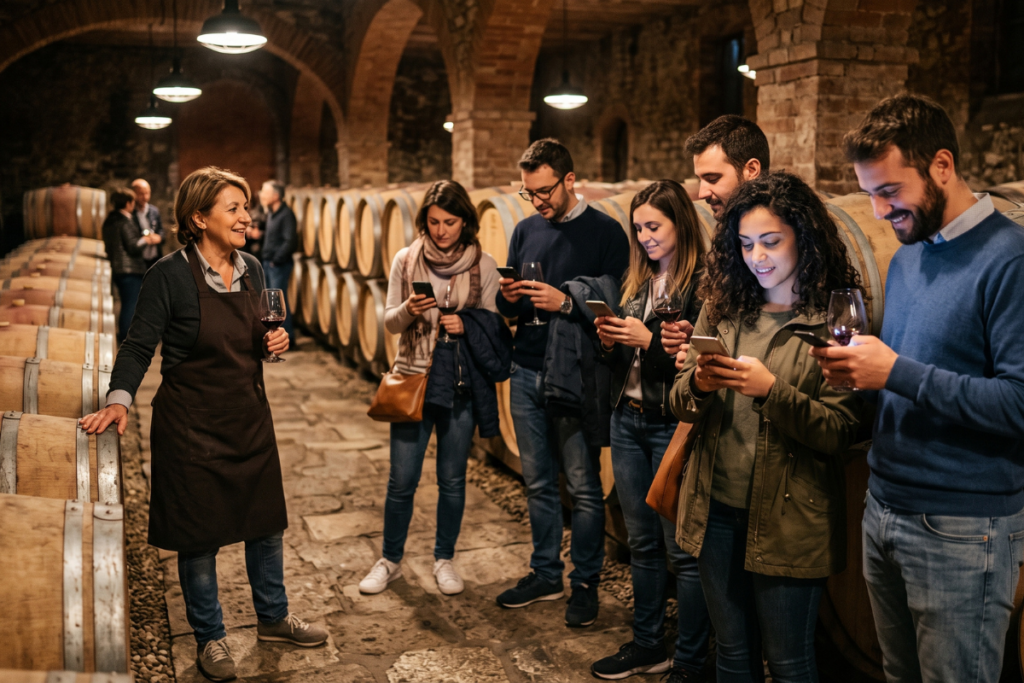
This article challenges the idea that Generation Z acts as a single demographic block. To succeed in selling wine to Gen Z,wineries must segment this group into three distinct age brackets. Each bracket requires a tailored approach regarding communication, product formats, and hospitality to build relationships and drive sales.
From 14 to 29 years old, Generation Z is far from a single target. Wineries need a different communication, format,and hospitality approach for each group. We carefully read the Wine Searcher article, Want to Sell Wine to Gen Z? Use Gen Z, and among the things that struck us, and that we will explore shortly, one immediately made us reflect.
This was the idea that Gen Z members are unaware of life before smartphones. We stopped right there, because the undersigned writer, born in 1997, right in the first year of the generation, knows very well what life was like before smartphones, having received her first one in high school. One could object that it is an isolated case, a purely personal delay.
However, until elementary school, the smartphone was practically absent, or in any case it was not widespread. This anecdote made us think: which Gen Z is the article talking about? The article cites three interesting paths to attract young consumers: changing the communication, changing the product format, and rethinking hospitality.
These are certainly sensible levers to bring younger people closer to wine, but the point is another. The article adds little new information compared to what the sector has been repeating for years, and it does so with the confidence of someone who treats a generation as a single person.
Generation Z includes those born between 1997 and 2012, encompassing fifteen years of births. Inside there are people who are almost thirty today and kids who are fourteen. This alone shows how fragile the idea of a single Gen Z target truly is. Those born in 1997 ask themselves adult questions regarding a stable job, renting or buying a house,and maybe having children.
Those born in 2012 are in middle school. They lack an income and they lack the legal drinking age. Putting everyone in the same profile is convenient but lacks strategic vision. Hence our thesis emerges: each of the three levers should rest on intragenerational targeting. Rather than a single Gen Z, we have at least three.
The oldest group falls roughly between 24 and 29 years old, born between 1997 and 2002. They act as full fledged consumers who work, have an income, go out to dinner, give gifts, and travel. Here the communication can afford to be more informative and focus on the product, territory, and price. The format can be a bottle to share at home,alongside hospitality designed as a winery experience for adult guests.
This is the demographic where work translates most rapidly into sales. The middle group is between 18 and 23 years old, born between 2003 and 2008. They hold the legal drinking age but have limited budgets and a social life made of evening outings, events, and aperitifs. For them, lighter and more practical formats make perfect sense, such as cans, low alcohol options, and ready to drink products.
Communication on social media also works well for them, and SEO remains a part of the strategy, but it is no longer the only game. Today we must also work to appear in artificial intelligence answers, relying on clear, solid, and citable content. As for hospitality, accessible ticket events that remain fun and informal are entirely sufficient.
The youngest group is between 14 and 17 years old, born between 2009 and 2012. Here the narrative completely changes. They remain outside the consumer base since they lack the legal age to drink alcohol. Thinking about how to engage the youngest, therefore, avoids direct marketing. It means working on culture, territory, and family to bring them closer to wine as agriculture, landscape, and craft, perhaps even as a possible career path.
This stands as a long term investment that could eventually translate into conscious consumers. This approach requires avoiding product communication and invitations to consume. We might only make exceptions for alcohol free options or some mocktails. Therefore, talking about Gen Z without distinguishing the groups is an error that risks costing money in a sector with increasingly careful marketing budgets.
A campaign designed for twenty eight year olds fails to speak to nineteen year olds, and the one for nineteen year olds feels completely out of place for a fourteen year old. In the United States the share of Gen Z buyers grew from 9% to 14% according to the Wine Market Council. This figure confirms the generation is present and growing, but alone it fails to explain who these consumers are or how to reach them. The answer requires us to stop treating fifteen years of births as a single demographic block.
Key Points
- Segmenting the generation allows wineries to target specific age groups with distinct communication and hospitality strategies.
- Adults aged 24 to 29 respond well to traditional formats, winery experiences, and informative product storytelling.
- Young adults aged 18 to 23 prefer lighter formats, informal events, and strong digital visibility including AI answers.
- Minors aged 14 to 17 require cultural education focused on agriculture and territory, completely avoiding direct marketing.