Johnnie Walker’s ninety-minute distillery tour turns brand history into immersive theatre, using storytelling, sensory rooms, and a personalized cocktail bar guided by a digital wristband. The experience offers valuable lessons for Italian wine tourism, which often prioritizes technical correctness over emotional storytelling and rarely lets visitors discover their own preferences instead of being corrected.
The tour begins with a young man, played by an actor in nineteenth century costume, who comes on stage telling the story of the boy John Walker, who loses his father. The dramatization is explicit.
This move should sound both familiar and bold to anyone who works in wine. Familiar because every winery has a family story to tell. Bold because almost no winery has the courage to tell it the way Johnnie Walker does: theatrically, dramatically, with the same boldness as a good musical. The dominant belief in Italian wine tourism is that the story should be told soberly, technically, with restraint.
Their story begins in 1819 with a boy named John Walker. He is fourteen years old, has just lost his father, and his mother inherits a farm she cannot manage to keep. The family sells it. With that money, she opens a small grocery shop in the town of Kilmarnock, in the south of Scotland. John, still little more than a child, finds himself running it.
In the back room of the grocery shop, John begins doing something no one else was doing. He buys whisky from different distilleries and blends them together. In the eyes of purists it is an illegitimate act: whisky was meant to be drunk as it was, straight from the still, with all its imperfections of vintage and cloudiness. John blends it because he wants to obtain a product that is more stable, more balanced, more predictable. He wants to serve a customer who does not understand whisky but who wants a good drink every time. This gesture, which today we would call blending, is the birth of the modern whisky industry.
Over the years, his heirs progressively built on this intuition an empire that today sells more than 200 million bottles a year in every country in the world.
The multisensory sensory experience
The tour lasts ninety minutes and is organized into themed environments. Each environment represents a moment in the brand’s history.
The room dedicated to the four regions of Scottish whisky is the most didactically significant moment. The visitor stands at the center of a circular space with four corners, each representing a macro region: Islay with its smoky whisky, Speyside with fruity and honeyed notes, Highlands with softness and chocolate notes, Lowlands with floral freshness.
After exploring the four regions, the visitor physically understands what it means to say that a whisky is from Islay or from Speyside.
The personalized bar: when technology serves the person
The most technologically ambitious moment of the tour is the Journey of Flavour Room, which begins with a sensory test. At the entrance, each visitor receives a digital wristband. Through a series of guided choices, scents to smell, colors to choose, images to associate with, the system builds a personal aromatic profile. Each visitor is assigned one of four flavour profiles: fruity, spicy, smoky, fresh.
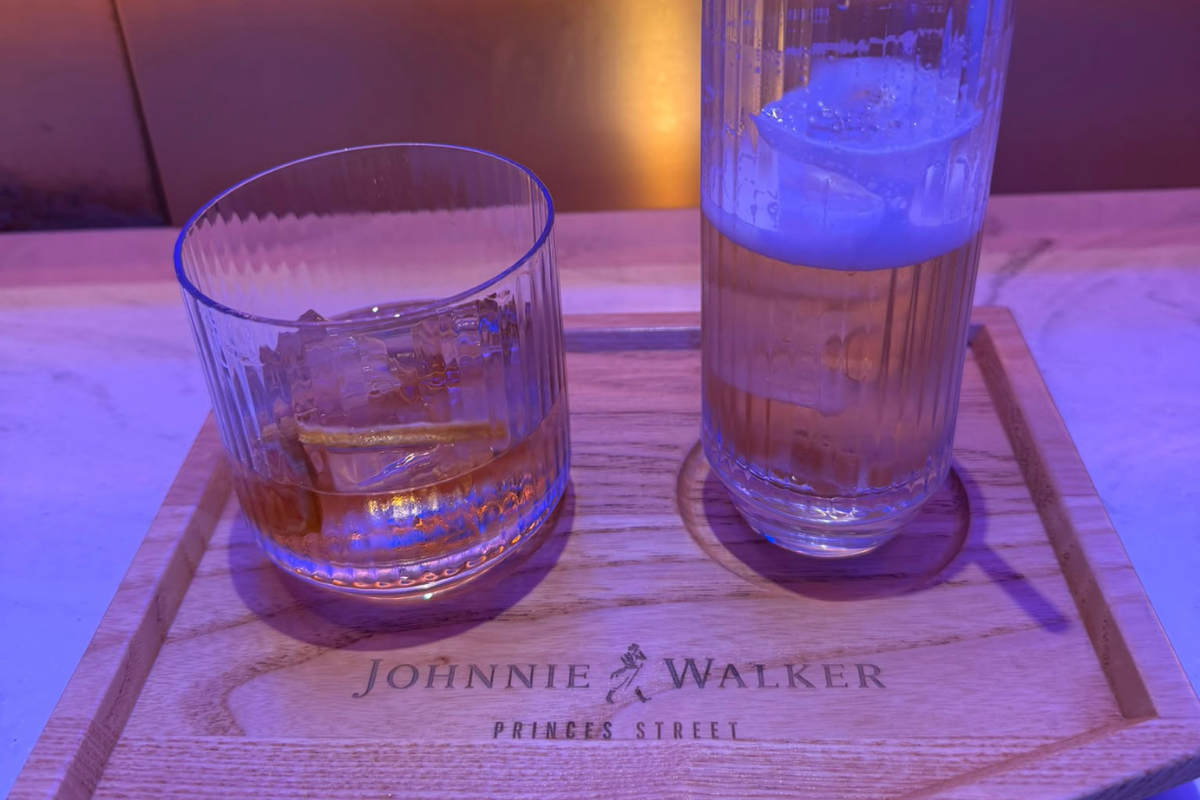
At the end of the tour, the visitor enters the bar. He stands in front of a machine that reads the wristband. It recognizes the profile automatically. It prepares a personalized cocktail with Johnnie Walker, mixed according to the sensory tastes detected during the experience. The cocktail is delivered ready to drink.
The implicit message is that whisky has no single right way of being enjoyed.
This communicative move, applied to wine, should be mandatory. Italian wine suffers from the opposite problem: the dominant communication teaches the consumer a correct way to drink, a correct pairing, a correct temperature, a correct glass.
There is another strategic aspect worth noting. The Johnnie Walker tour is aimed at a global mass audience, with different cultural backgrounds, different levels of expertise, different expectations. Conveying a century and a half of brand history, four geographic regions, dozens of aromatic nuances, in ninety minutes is a monstrous communication challenge.
What Italian wine can learn, what it cannot copy
It would be naive to suggest that every Italian winery should replicate the Johnnie Walker model. The financial investment runs into tens of millions of pounds, and the scale of the brand supports operations that no artisanal producer could afford. But some lessons are transferable even on a small scale.
- Tell the family story as a theatrical tale, not as a chronicle. The best stories are those with conflicts, sacrifices, gambles. Italian wine has thousands of stories like this, and tells very few of them well.
- Personalize the experience even with minimal tools. An aromatic profile detected at the entrance, even through a paper questionnaire, can guide the whole tasting that follows. The visitor feels recognized.
- Stop correcting the consumer. Teaching does not mean saying what is right. Teaching means helping the person discover what they prefer. Johnnie Walker sells in 180 countries because it has learned to accompany. Italian wine sells everywhere thanks to its quality, but grows less than it could because in many cases it still patronizes.
Key points
- Storytelling and drama make Johnnie Walker’s brand history unforgettable, unlike sober, technical wine narratives.
- Personalization technology, like the flavour wristband, lets each visitor discover their preferred taste profile.
- Multisensory rooms representing whisky regions teach through experience rather than lecturing visitors about correctness.
- Avoiding correction of consumer preferences builds trust; teaching should guide discovery, not dictate rules.
- Small scale replication is possible through paper questionnaires and theatrical family stories, not costly technology.