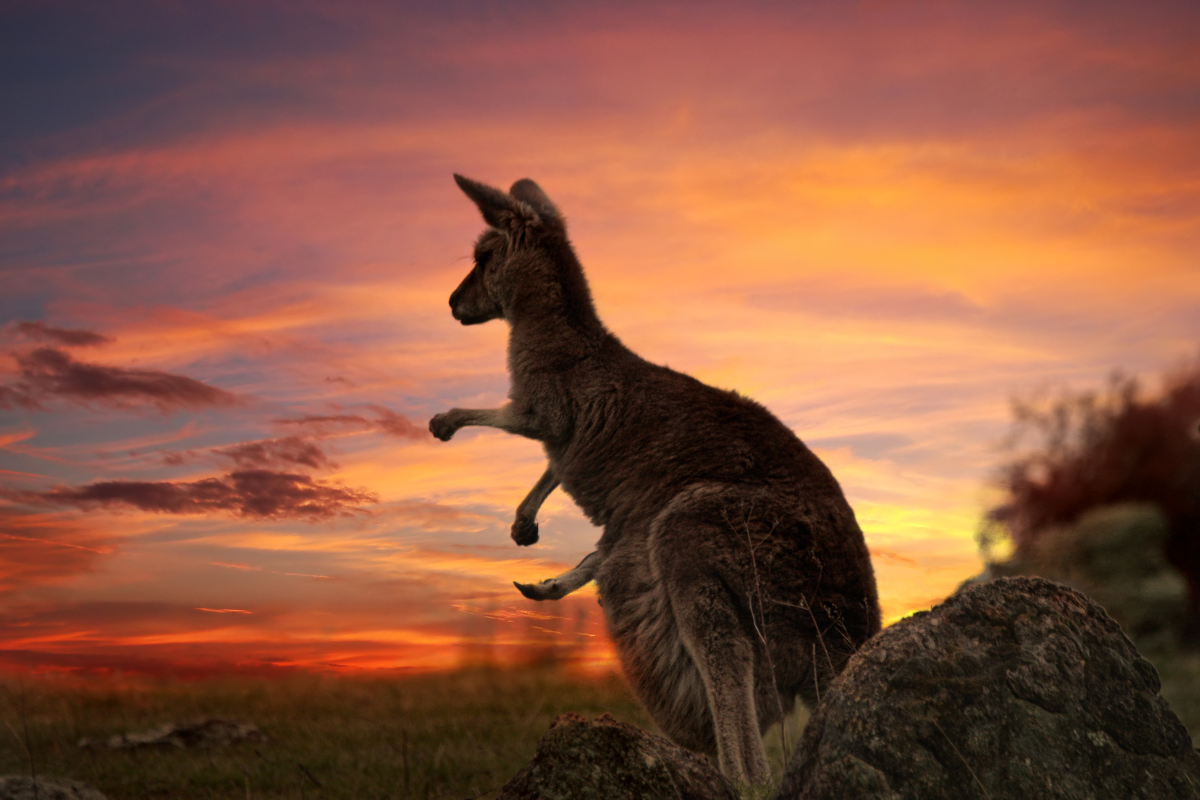
Kangaroos in Australia are a metaphor for the wine world: their resilience, adaptability, and ability to symbolize Australia as a brand offer lessons in leveraging the “Made in Italy” brand, understanding markets, and embracing teamwork. With courage and knowledge, both kangaroos and wine producers navigate challenges, emphasizing the power of unity and identity.
Seeing kangaroos in Australia is not easy. This may sound like a paradox considering that this vast country, 23 times the size of Italy, is regarded as Kangaroo Country.
When I spent three years in Australia 35 years ago, spotting kangaroos in the wild was not straightforward either. I remember that after spending a week in Melbourne, I decided to take a car ride into the so-called Australian bush to finally observe free-roaming kangaroos in their preferred habitat. I drove for many hours without spotting a single one. Then, finally, just before entering the Great Ocean Road, I saw a very small one (a wallaby) grazing quietly in a traffic island. Perhaps it had been strategically placed there by the Victoria Tourist Office.
Over time, I did see many kangaroos, particularly in the Red Centre, the red desert dear to Aboriginal Australians, who, like kangaroos, have faced a constant disruption of their habitat due to the expansion of what we dub, often without justification, as Western civilization.
But if seeing kangaroos was already challenging back then, during this new Wine Tour in Down Under, I encountered even fewer despite traveling over 3,000 kilometers across New South Wales, Victoria, and South Australia with the Apollo camper.
I’m not a professional ethologist, though I excelled in ethology exams during my veterinary studies, earning a perfect score. Based on observation, there are three main reasons why kangaroos are harder to spot in Australia: first, being an immense country, kangaroos have plenty of space in the bush to stay out of sight; second, much of the land near urban areas and roads has been cleared to make way for grazing pastures for cattle and sheep, whose numbers have surged dramatically in the past decade; third, kangaroo meat has become increasingly sought after, leading to more frequent hunting.
So, what can the current state of kangaroos teach us about our wine world?
First and foremost, resilience. Despite the challenges, official statistics suggest there are still between 55 and 60 million kangaroos in Australia, about twice the country’s human population, showcasing their exceptional adaptability.
A ranger near Uluru (the iconic red mountain in central Australia’s desert) explained that as drought advances, kangaroos have migrated to areas with greater water availability. Reflecting on how much of our wine exports are concentrated in just five countries, the kangaroo’s lesson becomes evident.
Kangaroos also provide another valuable lesson: they remain an outstanding Australian brand. They may be difficult to spot, but no image represents authentic Australian identity better than the kangaroo.
This serves as a reminder of how much we have yet to capitalize on the “Made in Italy” brand for our wines. We get lost in a sea of confusing messages, hundreds of denominations, and local rivalries, often failing to leverage the extraordinary potential of the “Italy” brand.
During this Wine Tour, I again observed the remarkable reputation Italy still enjoys. In every winery we visited, when we mentioned we were Italian, the response was always the same: “Oh Italy, what a beautiful country!” Those who had visited dreamed of returning, while those who hadn’t regarded Italy as their dream destination.
If only we Italians were more aware of this…
Finally, kangaroos teach an essential lesson to our wine producers and everyone involved in the wine sector: courage. Living in a challenging environment with human intervention, droughts, and wildfires demands enormous bravery.
Kangaroos thrive by following two fundamental rules: deep knowledge of the territory, understanding its risks and opportunities (as they say in Australia, “if you want to find water, follow a kangaroo”); and teamwork.
The metaphor is clear: How well do we understand our production areas, markets, and target consumers? How often do we engage in teamwork to strengthen competitiveness?
You already know the answers, and it’s time to act… together.
As I finish writing this editorial in the stunning McLaren Vale, the sun sets over the vineyards, and from the window of our Apollo camper, I see eight kangaroos curiously observing us.
Key points
- Resilience and adaptability: Kangaroos symbolize survival and adapting to environmental and human challenges.
- Brand power: The kangaroo remains Australia’s most recognizable and effective symbol, a lesson for leveraging “Made in Italy.”
- Unity and strategy: Success in both wildlife and wine depends on teamwork and understanding territory and consumers.
Australia Wine Tour: read all our articles:
- Barossa Valley: the secret to boosting direct sales is changing the cultural approach to wine
- Yarra Valley: the wine tourism model that can inspire the future of Italian wineries
- Australia wine tour: five key lessons from Canberra Valley and King Valley for the future of Italian wine tourism
- Adelaide Hills and the art of direct sales: lessons from Penfolds
- Australia and wine: a lesson in inclusivity and hospitality
- Mornington Peninsula: wine tourism born from the heart and vision