This editorial explores Argentina’s viticultural identity beyond the “New World” label, highlighting its deep-rooted scientific foundations. Following the 2026 Wine Tour, the analysis focuses on the pivotal role of the Italian scientific legacy—specifically Carlos Spegazzini and the School of Conegliano—in shaping a technical, territory-driven approach that defines Argentine wine today.
This editorial stems from our first 2026 Wine Tour in Argentina. Originally designed to closely observe the evolution of Argentine wine tourism, the journey led us to question the categories we often use too casually when discussing wine. Between wineries, vineyards, and conversations, it became evident that Argentina escapes the reassuring—and reductive—definition of the New World.
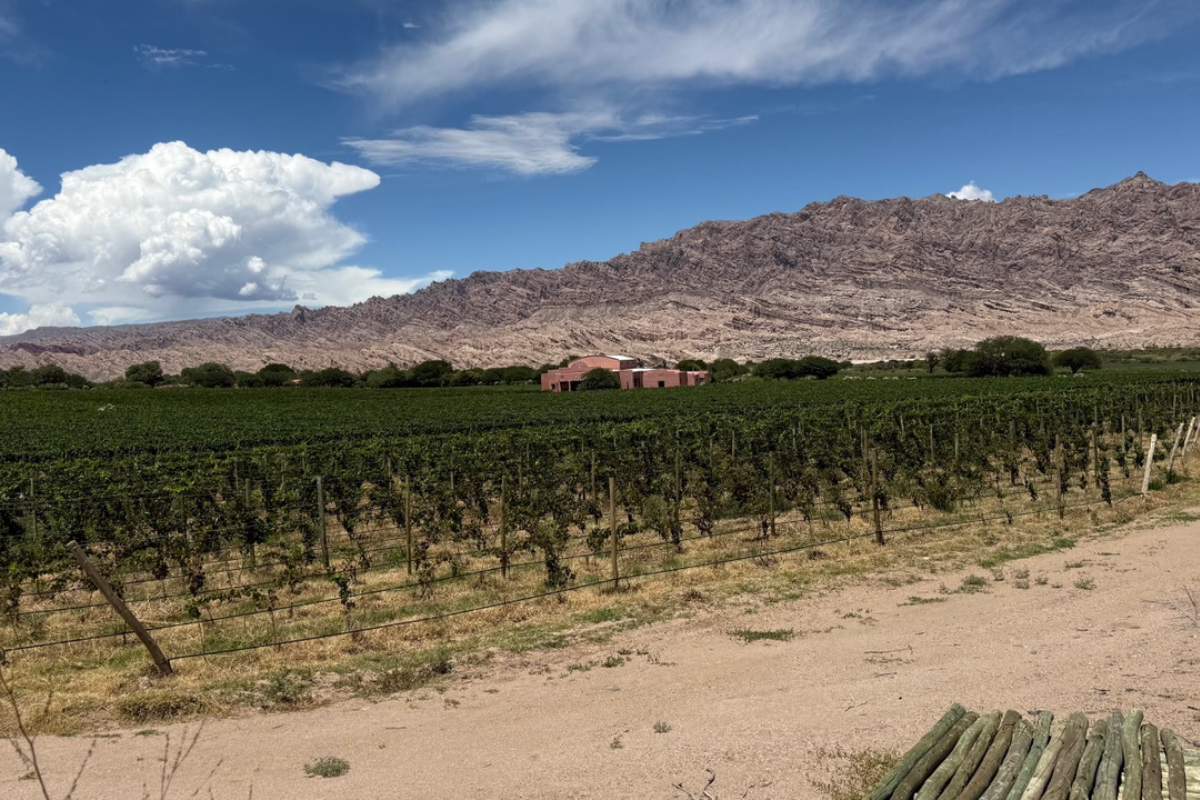
The route took us from the vast vineyard landscapes of Mendoza to the Salta region, where vines grow in extreme conditions, even above 3,000 meters above sea level. These places are very different, yet linked by the same idea of viticulture: an agriculture that does not seek stylistic shortcuts but works on the deep relationship between environment, technique, and time.
By observing this coherence, rather than chasing a single grape variety or a recognizable style, we began to understand how the narrative of Argentine wine requires a change in perspective. Argentine viticulture is not young in the sense it is often understood. It did not emerge in recent decades as a response to the global market, nor as a quick imitation of European models.
Its roots delve into a longer history that took shape between the late nineteenth and early twentieth centuries, when the country chose to build its wine system on solid technical and scientific foundations. This transition coincided with one of the most complex moments for European wine, marked by the phylloxera crisis, allowing Argentina to develop without those traumatic fractures that forced restarts elsewhere.
In this process, the Italian contribution appears decisive. It was not just due to the widespread presence of immigrants, but the arrival of structured knowledge—a culture of viticulture as a scientific discipline. The figure of Carlos Spegazzini is central in this sense, having trained at the Royal School of Viticulture and Enology in Conegliano before bringing a method based on observation and experimentation to Argentina.
It was not about transferring models mechanically, but about building knowledge in the field, in a territory that demanded new solutions. The School of Conegliano represents much more than a training reference; it is the symbol of an Italian tradition that considers viticulture an applied science capable of interacting with agronomy, botany, and landscape management.
This approach took root in Argentina with surprising speed and contributed to the birth of a local wine teaching system that would train generations of technicians and enologists. Today, one often feels they are facing an idea of viticulture that is more “thought out” than instinctive, more constructed over time than guided by the urgency of immediate results.
It is also for this reason that Italian influence, on a scientific and methodological level, seems to have had a deeper impact than the French one, which is often cited as the main matrix of modern viticulture. In Argentina, wine is not born from stylistic imitation but from a technical setting that privileges understanding the territory. This approach speaks Italian, despite expressing itself in a completely different context.
This reading finds authoritative confirmation in the work of Julieta Gargiulo, a historian of wine culture and founding academic of the Academia Argentina de la Vid y el Vino. In her book, she reconstructs Italy’s role in the formation of Argentine viticulture, showing that this presence is not a marginal detail but a structural component of the industry.
Returning from the trip, what remains is the feeling that Argentine wine should be narrated with greater attention to its roots. It is not a “new” territory that suddenly found a voice, but another world built with patience and method. Contemporary wine tourism is not a narrative artifice but the natural expression of a history that has had time to settle.
To truly understand Argentine wines, one must stop placing them in convenient categories and start reading them as the result of an autonomous trajectory. This trajectory passes through Italy and its idea of viticulture, continuing today between Mendoza, Salta, and the Andes to speak a language that is neither ancient nor new, but simply coherent with itself.
Key points
- Argentina represents an autonomous wine world rather than just a “New World” market imitation.
- The Italian scientific legacy, rooted in the School of Conegliano, provided Argentina’s technical viticultural foundation.
- Carlos Spegazzini introduced a methodology of experimentation and adaptation essential for extreme high-altitude environments.
- Historian Julieta Gargiulo confirms that Italian influence is a structural pillar of Argentine wine identity.