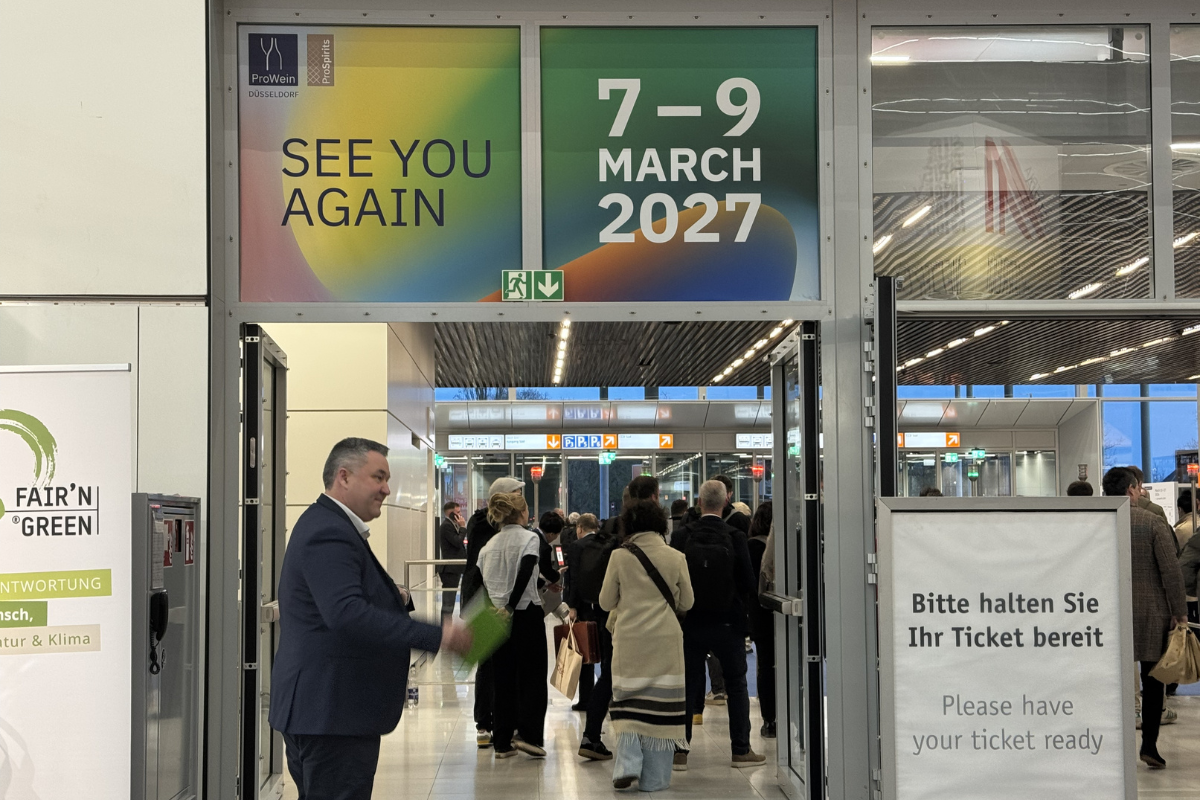
Prowein 2026 was smaller, more selective, and – according to those who were there to work – more genuinely useful. Against a backdrop of declining German wine consumption but growing import value, the fair revealed a sector at a crossroads: companies either adapting with strategy and consistency, or reacting with fear and losing ground fast.
If there is one thing that Prowein 2026 has made unmistakably clear, it is that the problem is not that the fair has become smaller (Prowein 2026: scaling down without losing meaning or value). The problem, if anything, is that for years it was too large for what companies truly need today. But this is a reflection that Wine Paris should also inevitably make if it wants to avoid collapse within a few years. And perhaps this is precisely the point that many still struggle to accept.
Yes, the numbers are lower. The exhibitors fewer. The international presence more selective. But the feeling, speaking with those who were there to genuinely work, is that this edition was, in some ways, more useful than many others in the past.
Less scenography, less presence “out of obligation”, fewer companies participating because “everyone else is there”. And more real meetings, more time, more substance. Which is exactly what a B2B trade fair should be — one that, let us remember, is not a stage.
Continuing to judge this Prowein by the standards of ten years ago is a sterile exercise. It does not help us understand what is happening; it only serves to keep us anchored to a past that will not return.
The point is that today the market demands something different. And Prowein, for better or worse, has begun to adapt. And this is not a sign of weakness. It is a sign of intelligence.
Within this scenario, however, a theme is emerging with ever greater force: Germany. A market that for years was a certainty today appears to be one of the most complex to interpret.
The data is fairly clear: in 2025 the German economy is essentially stagnant, with GDP still contracting after years of difficulty. But it is above all on the wine front that the picture becomes interesting. Germany continues to be one of the world’s leading markets, but consumption is falling. In 2025 it stands at approximately 16.3 million hectolitres, down 1.7% on the previous year, with a negative trend that has been ongoing for several years. Per capita consumption is also declining.
This is the figure many see. But it is not the only one. Because alongside this decline in volumes, there is another number that tells a different — and perhaps more interesting — story. Overall wine imports in 2025 grew in value by 4.7%, reaching approximately 2.6 billion euros, while volumes fell by 0.6%. In other words: less wine is being bought, but it is being paid for more.
And this, in a market like Germany’s — historically very price-sensitive — is far from a negative signal. On the contrary. It is probably the most interesting signal of this phase. Because it means that even in a context of uncertainty and caution, part of the market is moving towards higher quality, towards more careful selection, towards a form — perhaps still tentative — of premiumisation.
And this concerns all the major suppliers. Italy remains the leading partner with over 1 billion euros in exports and a share exceeding 40%, growing both in value (+8.6%) and in volume (+1.8%). France too is growing in value (+6.7%) and in volume (+2.2%). A sign that, despite everything, the market is not grinding to a halt. It is transforming.
And perhaps the real mistake is continuing to read it through old categories. But the point is precisely this: we are not facing a collapse. We are facing a change. And this change is not only in the numbers. It is in the attitude.
Because Germany today appears a more worried market, more introspective, less sure of itself. As if it were still trying to understand what role it wants to play in this new economic phase. And this is clearly perceptible at the fair. You see it in behaviours. You hear it in conversations. You find it even in seemingly marginal details such as the transport strikes during Prowein’s days, which by now almost seem to have become part of the backdrop.
It is a country going through a delicate phase. And considering how much weight it carries for Italian wine, it is hard not to watch it closely. Within this scenario, the 561 Italian companies present tell a different story. Not one of resistance. But of evolution. Because today, those who are at Prowein are not there out of habit. They are there because they have decided it makes sense to be there. And that is an enormous difference.
Because participating in a trade fair is no longer an automatic reflex. It is a strategic choice. And the companies that have understood this are, in most cases, the same ones navigating this phase most effectively.
Walking the stands, the feeling was fairly clear: the sector is dividing. On one side, companies reacting with fear or anger, and in wine, these two reactions are causing more damage than any crisis. On the other, companies that are trying to adapt, working markets with logic, not chasing a new destination every year “to try their luck”, building strategies over time instead of changing them every six months.
This feeling is confirmed not only by impressions gathered at the fair, but also by the data from the ProWein Business Report. The picture that emerges is very clear: today, success increasingly depends on the ability to stay close to the market, build relationships, adapt one’s product portfolio, and invest in marketing and positioning.
While the difficulties are equally evident and shared: weaker demand, price pressure, rising costs. It is not one person’s problem. It is everyone’s problem. And it is precisely for this reason that instinctive reactions – constantly changing everything, breaking established relationships, chasing every opportunity without direction – are becoming the real limitation.
Because this is not a passing phase. It is a structural one. And the companies that are working today are those that have understood this. They are the ones that are not afraid, that do not waste time complaining, that have wines consistent with the market, that invest in communication, and that, above all, have stopped believing that simply “making the product” is enough to sell.
They are also the ones that have understood that total delegation to the importer no longer works.
If there is one thing that Prowein 2026 has highlighted, it is precisely this: wine is entering a more mature phase. Less superficial enthusiasm, fewer illusions, fewer shortcuts. More work, more strategy, more awareness. And in this sense, this edition – smaller, more sober, less spectacular – has perhaps been one of the most honest in recent years. Because it has removed excuses. And today, in a market like this, that is exactly what is needed.
Key points
- Prowein 2026 was smaller by design, making it more focused and productive for real business.
- German wine consumption fell to 16.3 million hectolitres, but import value rose 4.7%, a premiumisation signal.
- Italy leads German wine imports with over €1 billion and a 40%+ market share, growing in both value and volume.
- Companies participating strategically are outperforming those reacting with fear or constant pivots.
- Wine is entering a structural, mature phase: success now requires strategy, consistency, and active market presence.