Inside Speyside Cooperage, the only cooperage in the UK open to visitors, twenty six coopers rebuild over one hundred thousand whisky barrels a year by hand. Their craft reveals that sixty percent of a whisky’s flavor comes from the wood, not distillation, and offers a model of authentic, artisanal storytelling that Italian wine tourism could learn from.
In the heart of Speyside stands a cooperage. The only cooperage in the United Kingdom open to visitors. Founded in 1947 in a shed that looks like an ordinary workshop from the outside, Speyside Cooperage repairs and rebuilds over one hundred thousand barrels a year for Scotch whisky distilleries, and for a growing number of international clients. Inside, twenty six coopers work at a trade that has remained almost unchanged for two hundred years, and they tell a truth the whisky industry took centuries to recognize: the flavor of whisky is not born in the still. It is born in the barrel.
Sixty percent
The technical figure that opens the entire tour is the one that strikes the most. Ask the senior cooper where the character of whisky comes from, and he answers without hesitation: “At least sixty percent of the flavor, the color, the aroma of a mature whisky comes from the barrel. Not from distillation.”
If sixty percent of the final product is decided by the choice and treatment of the barrels, then the smartest investment for a whisky producer is not in the distillery, it is in the wood. Macallan understood this before anyone else, today investing forty percent of its production budget in barrels, a ratio without precedent in the industry.
The craft of the hands
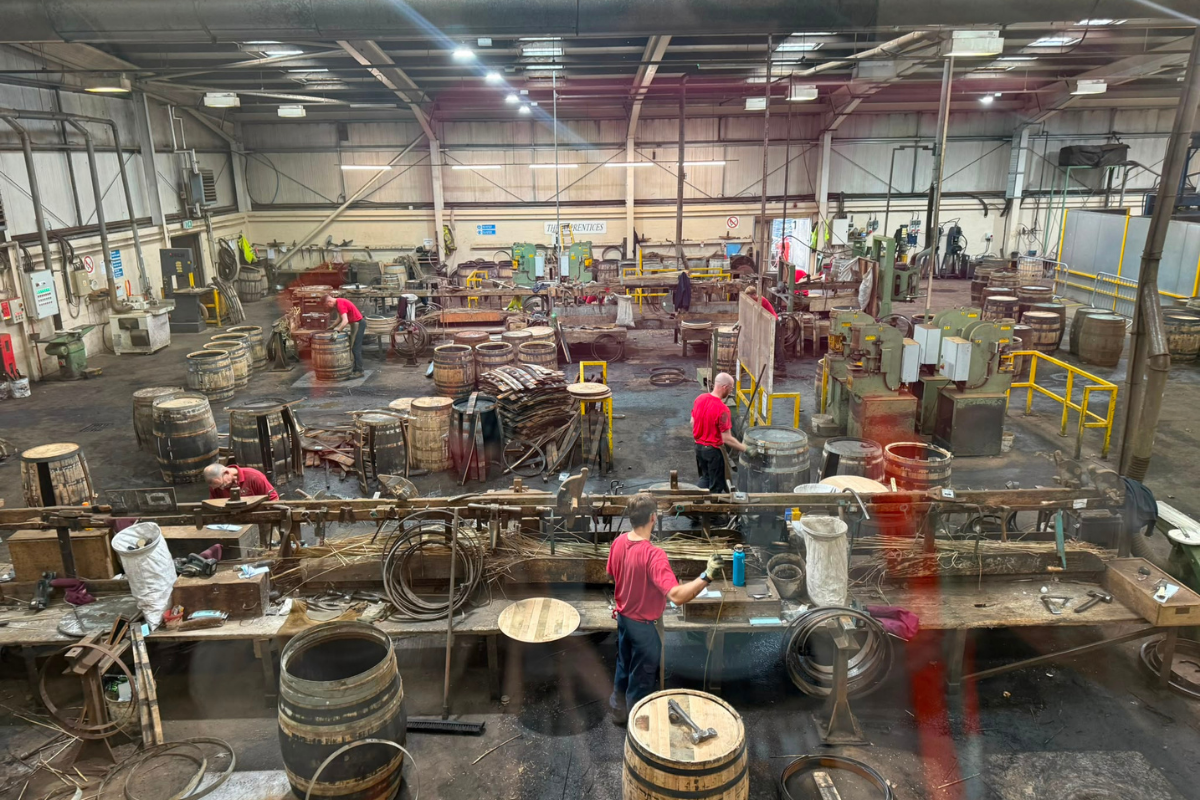
At Speyside Cooperage, the visitor enters the main shed and finds a scene that seems out of time. Twenty six men work each at their own bench with hammers, axes, planes, metal hoops. The sound is that of blows on wood, iron against oak, hoops settling into place.
Each cooper is responsible for his own barrel from start to finish. There is no division of labor as on an assembly line. One man opens the old worn out barrel, inspects it, decides which staves to replace, prepares the new ones, positions them, closes it, fits the hoops, chars the interior, tests it again, seals it, checks it holds. The standard time to regenerate a barrel is about fifteen minutes of active work per unit, spread over a daily cycle. The world record for building a new barrel from scratch is three minutes, set here at Speyside Cooperage, beating the previous record of seven minutes by four minutes.
The visitor who watches the coopers at work is not behind a window. They are inside the shed, two meters from the hammers. The noise is loud, the smell is of burnt wood, the heat from the toasting stoves can be felt on the cheeks. It is an active workplace where the workers keep their own rhythm while explaining what they are doing. The visitor asks questions, the coopers answer without stopping their hands. This coexistence of productive spectacle and real production is the hardest trait to reproduce, and it is precisely what makes the experience unrepeatable.
The life cycle of a barrel
One of the most formative moments of the tour is the explanation of the life cycle of a whisky barrel. A new barrel is almost never used directly for Scotch whisky. By law, but above all by choice of flavor, Scotch whisky is aged in used barrels, never virgin ones. The reason is that virgin wood releases too much tannin and too much color too quickly, producing an unbalanced whisky.
Used barrels come mainly from two sources. Ex bourbon barrels come from Kentucky, where by law bourbon must be aged in new charred oak barrels, which are then discarded after a single use, and bought cheaply by the Scots.
The cooper explains what no manual tells you: high quality Spanish sherry barrels are almost exhausted as a global resource. Sherry production has been declining for decades, and the large bodegas no longer make barrels just to resell them to the Scots. The result is that today whisky producers buy barrels made specifically for them, filled with sherry for two or three years just to condition them, and then resold as “ex sherry.” The market has industrialized what was once a byproduct.
Oak as territory
The most valuable technical explanation comes when the cooper opens up the subject of wood. Not all oaks are the same. American oaks (Quercus alba) have a very tight grain and release little into the liquid, producing whiskies that are light, delicate, with notes of vanilla and coconut. European oaks (Quercus robur, Quercus petraea) have a more open grain and release much more, producing whiskies that are dark, rich, with notes of dried fruit, chocolate, spices.
The cooper explains that a single oak tree, grown in the same forest with the same climate and the same exposure, produces ten different barrels. Why? Because the trunk grows in a spiral, and the staves cut from different positions of the trunk have slightly different grain, slightly different density, and will therefore release into the whisky in a slightly different way. Ten barrels from the same tree will produce ten different whiskies. This explains why single cask whisky, aged in a single barrel rather than blended, has such variability and costs much more.
Toasting as a signature
One of the most theatrical moments of the tour is toasting. The barrels are placed over an open stove and the inner wood is exposed to fire for a time that varies from twenty to forty five minutes, depending on the distillery’s request.
The cooper explains that toasting is not cooking the wood, it is caramelization of the internal sugars of the oak. The heat breaks down the cell walls and transforms lignin into complex aromatic compounds: vanillin, guaiacol, syringaldehyde. It is these molecules that pass into the whisky over the following ten to twenty years of maturation. A light toast produces delicate, floral whiskies with notes of honey. A medium toast produces balanced whiskies with notes of caramel and vanilla. A heavy toast produces bold whiskies with notes of coffee, dark chocolate, peat.
Then there is charring, which is a further level. The wood is burned until it forms a black crust of carbon just a few millimeters thick. This crust acts as a filter, absorbing unwanted aromas (sulfur, aldehydes, sulfur compounds) and releasing complex sugars. American bourbon barrels are all charred. Spanish sherry barrels are not.
The economic value of barrels
The cooper told us an illuminating anecdote. At Macallan, some barrels are transported by truck under police escort because the insured value of a single thirty year old Macallan barrel exceeds the standard insurance of the hauliers. A driver was forced to refuse the rest stop required by driving time regulations because the police ordered him not to stop on the highway with that cargo. Only within the protected perimeter of the distillery was he authorized to rest.
The apprentice cooper
The last memorable element of the tour is the explanation of the apprenticeship. Becoming a cooper at Speyside Cooperage requires four years of apprenticeship with an experienced master. In the first two years you learn to prepare the staves, handle the hoops, recognize quality wood. In the third year you begin building barrels under supervision. In the fourth year you become independent.
But the real test is the test of tests, a final exam in which the candidate must build a barrel from scratch, within a set time, which is then tested for watertightness. If the barrel leaks, the apprentice is not failed, but must rebuild it the next time, with his own hands, in front of the master. The senior cooper explained that the true pedagogy of the trade is not the lesson, it is the mistake repeated until it is corrected. “On the first day of work you make mistakes. On the second day you make fewer mistakes. On the third day you start to work.”
What wine can learn
The lesson of Speyside Cooperage for Italian wine tourism can be summed up in five concrete points.
The first: show the piece of the supply chain that no one ever shows. Every winery has at least one production phase it considers “less interesting” for the visitor. Many of these phases are precisely what the contemporary visitor wants to see, because no one tells their story.
The second: make artisanal work visible. The contemporary visitor is hungry for productive authenticity. Watching twenty six men work wood with their hands is more memorable than any multimedia presentation.
The third: connect the craft to its transmission. The four year apprenticeship described by the coopers moves the visitor. Italian wineries with family stories of generational transmission have exactly this asset, and rarely place it at the center of their storytelling.
The fourth: show the mistake. The most credible way to convey high quality is to show how difficult it is to achieve. The cooper who explains that mistakes happen in the first days is more convincing than any winery that claims never to make mistakes.
Key points
- Sixty percent of a whisky’s flavor, color and aroma comes from the barrel, not distillation.
- Coopers work solo, handling each barrel from start to finish without any assembly line division.
- Scotch whisky ages only in used barrels, since virgin oak overwhelms the spirit too fast.
- Sherry barrels are scarce, so producers now commission and pre condition casks specifically for whisky.
- Mistakes are the lesson: apprentices rebuild failed barrels by hand until they get it right.