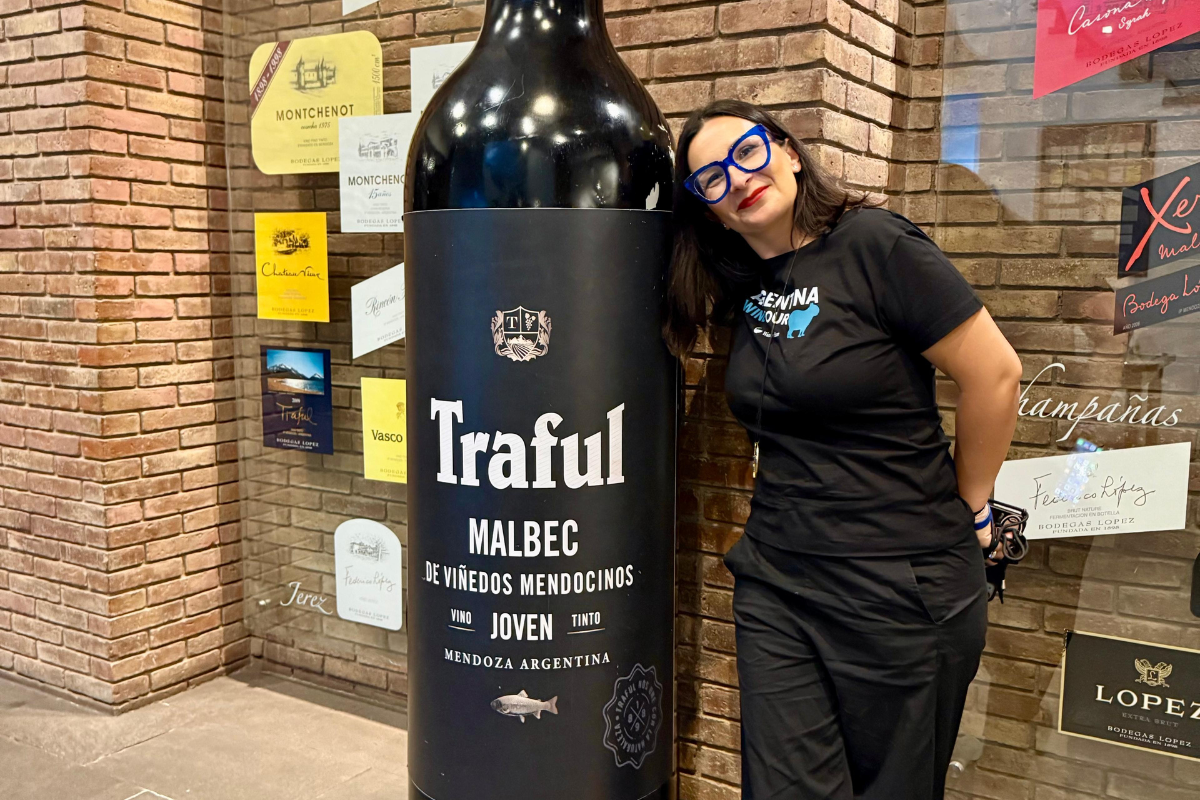
Studying international wine tourism models isn’t about emulating distant countries, but acquiring data to anticipate critical issues in our wine system. Comparison with abroad becomes a training investment to build new economic sustainability for Italian hospitality.
There’s a question that cyclically returns to the Wine Meridian editorial office: “But why do you keep doing wine tourism tours abroad?” Often, however, it’s not a real question. It’s a disguised accusation, a convenient simplification, sometimes real bad faith.
There are those who think we travel around the world to copy models that cannot be replicated in Italy. Those who imagine hidden sponsorships from foreign companies. And then there’s the saddest idea of all: that we do it to say that “they’re better abroad” and that we, here, are incapable of doing things properly.
In all these cases, the point is always the same: the profound meaning of our international missions has not been understood at all.
We don’t travel to idolize other models. We don’t travel to copy. And we don’t travel to demolish Italian wine tourism. We travel to understand.
The first value of our tours is knowledge-based. We go to territories where wine tourism, data in hand, is today more economically sustainable compared to Italy. Not because they are “better,” but because it works better: more visitors, more flows, more direct revenues, greater ability to sell experiences with continuity.
This is a fact. Denying it doesn’t make Italian wine tourism stronger, it only makes it more fragile.
We go to these places to understand what’s behind the numbers: how they sell, what they sell, why certain prices work, which mechanisms make the experience sustainable over time. And also what their limits are. Because those who think our tours are a sequence of enthusiastic visits have understood nothing: the comparison is continuous, critical, often uncomfortable.
And this is where the greatest value lies: learning not only from what works, but also from what doesn’t work. Understanding others’ mistakes before making them ourselves. Anticipating critical issues that in Italy we often pretend not to see.
Copying has never been our goal. Taking inspiration, yes. Comparing ourselves, yes. Broadening our perspective, always.
It’s worth clarifying another point: we self-finance these tours. They are part of our annual training investments and are not the result of sponsorships. They are work, study, field analysis.
Those who fear these trips fear only one thing: that questions are more uncomfortable than answers. We continue to travel precisely for this reason: to ask better questions and help the sector finally ask them, without fear.
If you are one of those professionals who don’t fear comparison…
For those who are truly interested in improving, and not in staying still defending comfortable certainties, a two-hour digital deep dive signed by Wine Meridian will be held on January 28th. It’s an opportunity to get into the details: concrete insights, field observations and useful tools to design the 2026 wine tourism season with greater awareness.
Key points
- International tours serve to understand economic sustainability models, not to copy them
- Field analysis helps anticipate critical issues before they affect Italian wine tourism
- Tours are self-financed training investments, not sponsored trips
- The goal is to ask better questions and improve the sector through comparison
- Confrontation with international models provides concrete tools for strategic planning