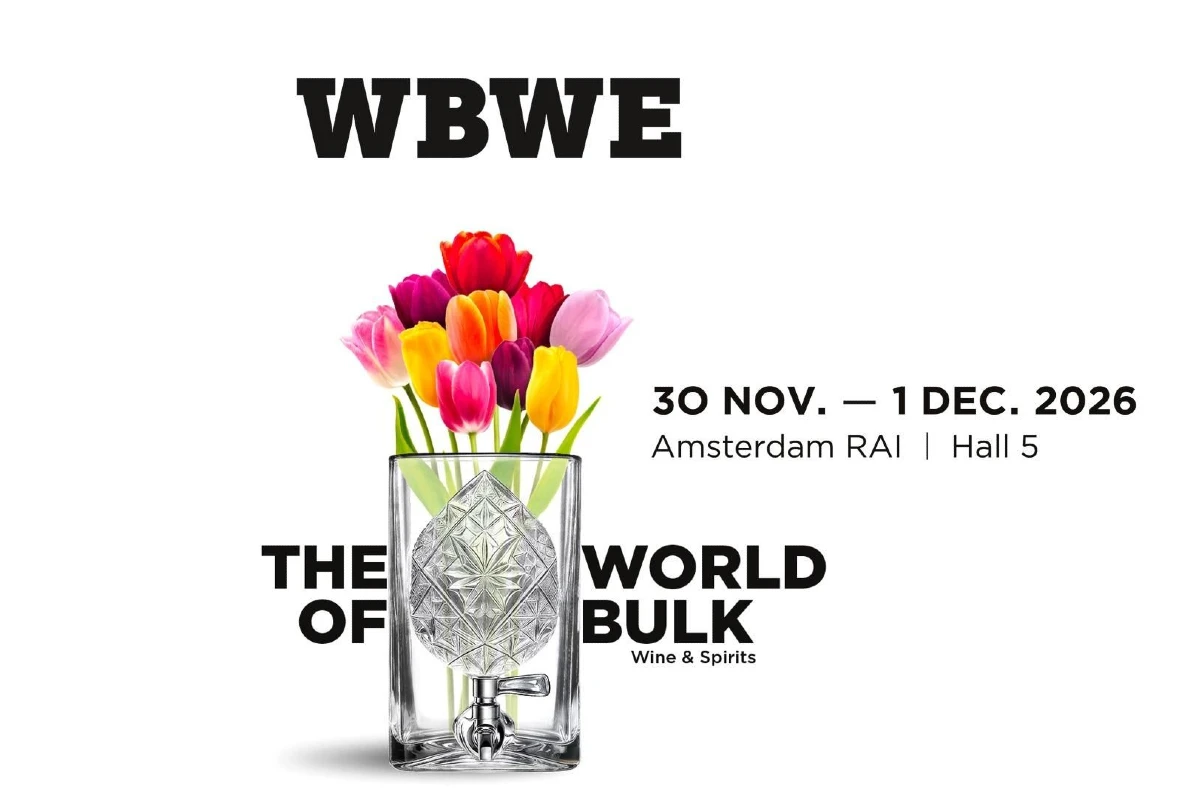
WBWE 2026 returns to Amsterdam from November 30 to December 1, spotlighting the resilience of bulk wine, now 34.2% of global trade volumes. Spain and Italy lead exports as sustainability, new markets and product diversification reshape the industry’s future.
The international wine market is facing a complex structural transition. Amid shifting historical consumption patterns and inflationary pressures, companies across the supply chain are being called upon to quickly redefine their commercial geographies. In this constantly evolving landscape, one segment is showing extraordinary resilience: bulk wine. The latest macroeconomic data show that bulk wine now accounts for 34.2% of total volumes in world wine trade, establishing itself as the true logistical and economic backbone of the sector.
While traditional bottled wine channels recorded a sharper decline (-3.1% in value), the bulk wine market moved along a path of marked resilience, limiting variations to a marginal -0.3% in value. It is against this backdrop of stability that the entire sector looks ahead to its next key appointment: the new edition of the World Bulk Wine Exhibition (WBWE), taking place from November 30 to December 1, 2026, at the RAI exhibition center in Amsterdam, once again organized by Vinexposium.
The numbers behind a global market to engage with in Amsterdam
To understand the importance of taking part in the Dutch event, it is enough to look at the economic scale of the global flows that converge here. We are talking about total business worth 2.59 billion euros, for a volume handled that reaches 32.99 million hectoliters.
Despite a slight and physiological contraction in volumes (-2.3%), overall value holds up thanks to a 2.1% increase in the average export price, which rose to 0.79 euros per liter. This increase reflects a gradual and tangible rise in the average quality of the product.
For producers and wineries looking to expand their reach, booking a stand at WBWE 2026 means positioning themselves directly in front of a highly qualified audience of more than 2,150 professional operators and buyers from over 60 international markets. The fair offers a proven matchmaking service that allows more than 1,000 pre-arranged business meetings to be scheduled, optimizing time and guaranteeing a concrete return on commercial investment.
Having an exhibition stand therefore goes beyond a simple visibility choice, serving as the most efficient tool for entering the circuits of major global bottlers and retail private label projects.
The geopolitics of large volumes: Spain and Italy at the center of the stage
The geographical structure of the bulk wine trade shows an established yet dynamic balance. Spain confirms itself as the undisputed leader in volumes, controlling around a third of global supply and exporting more than 6 million hectoliters worth 302 million euros in the first half of the year.
Right behind, Italy plays a leading role in terms of value and stability, holding a solid position among Europe’s top performers with revenues of 155 million euros. The Italian production system shows notable commercial strength, outpacing longstanding southern hemisphere competitors such as Australia, Chile and South Africa, and closely trailing New Zealand, which reaches 158 million euros thanks to higher average prices.
In the current scenario, even complex markets such as the United States show that declines in bulk wine are considerably smaller than the losses recorded by bottled wine. This means that for Italian and European companies, taking part in WBWE 2026 represents a privileged gateway to forming long term industrial agreements and stabilizing company revenues.
New trends and diversification: what buyers are looking for
Taking part in the upcoming Amsterdam edition offers a unique opportunity to map out in advance the trends that will guide consumption in the coming years. WBWE has evolved well beyond its traditional role as a hub for blending or generic wine, recording extraordinary momentum toward product diversification and quality segmentation, including:
- Bulk spirits now account for 6% of the fair’s total exhibitors, driven by emerging centers of excellence such as rum production in Mauritius.
- New wine growing geographies: the exhibition will see the consolidation of unusual and fascinating producing nations such as Lebanon and Panama. The Lebanese case is emblematic, with the planting of international grape varieties (Syrah, Tempranillo) driving a profound agricultural and social conversion of complex territories, offering economic redemption fully integrated into the legal circuits of the global wine trade.
- Priority segments for large scale retail: strong attention will be devoted to organic production, large volume appellation wines and, above all, bases for Ready to Drink (RTD) products and low alcohol or dealcoholized wines (No Low alcohol), key pillars for reaching younger consumers.
Sustainability and logistics: the real competitive lever
Beyond the crucial price fluctuations, the true driving force of bulk wine lies in environmental sustainability and logistical efficiency. Transporting wine in large volumes using modern flexitanks, then bottling it directly in destination markets, drastically reduces the carbon footprint of the supply chain, removing the dead weight of glass over long distances.
This has become a binding requirement for the major state monopolies of northern Europe and for leading North American buyers. The green transition of global wine inevitably depends on these strategic choices. Actively taking part in WBWE Academy‘s in depth sessions will allow operators to gain the technical and commercial skills needed to ride this change.
How to take part
Vinexposium’s organizational machine is already running at full capacity for the event set for November 30 to December 1, 2026, in Amsterdam. Booking exhibition space early secures the best positions within the RAI fair pavilions and greater visibility in the official matchmaking catalogs.
Likewise, for buyers, distributors and retail purchasing managers, registering early as visitors guarantees priority access to meeting schedules and the chance to plan a targeted and effective presence. In a global market that leaves no room for improvisation, Amsterdam confirms itself as the essential crossroads where efficiency meets profitability.
Key points
- Bulk wine now represents 34.2% of global wine trade volumes, showing strong market resilience.
- WBWE 2026 takes place in Amsterdam from November 30 to December 1, gathering global operators.
- Spain and Italy lead bulk wine exports, controlling major shares of value and volume worldwide.
- Flexitank logistics and sustainability are driving competitive advantage across the bulk wine supply chain.
- New markets like Lebanon are joining diversification trends alongside RTD and low alcohol wine segments.