Prowein 2026 opened in Düsseldorf with significantly fewer exhibitors than in past editions, prompting some to call it “Bonsai Prowein.” Yet the first day proved that scaling down does not equal losing value. Italian producers showed resilience and strategic clarity, while the fair itself signalled a broader shift toward leaner, more targeted B2B wine events.
There are those who, with a certain irony, have already renamed it “Bonsai Prowein.” Fewer numbers, fewer exhibitors, a more selective international presence. Yet the first day of the Düsseldorf trade fair demonstrated something very different from what some had feared: it is possible to scale down without losing meaning, value, or usefulness.
In fact, this edition – decidedly more contained in numbers – seems to testify to a truth that the wine world should by now accept: trade fairs cannot exist disconnected from the real dynamics of markets and the new needs of businesses.
We cannot keep repeating that the world is changing and then expect everything surrounding wine to remain unchanged, hoping for a return to past glories. On this point, I was struck by the comment of an Italian producer I met among the stands: “Fabio, if we consider this Prowein as a first new edition, I am totally satisfied.” And perhaps that is precisely the point.
From now on, we should learn to consider new initiatives in our sector as blank pages, to be read and judged with fresh eyes. Continuously viewing them through the lens of the past is not only wrong, but above all useless — it only ends up draining our energy.
If instead we try to observe what is moving forward, it is clear that we find ourselves facing scenarios that are still partly unclear, not always easy to interpret. But the worst reaction would be to respond with fear or irrationality. In the coming days we will publish an interview with a well-known international importer who shared a very lucid concern: the most dangerous thing he is seeing in the sector today is reckless agitation in many wine businesses.
Companies that change long-standing partners only to go back, that try a little of everything without a clear, multi-year strategy. And it is hard to disagree. Because the most dangerous reactions in moments of transformation are often two — fear and anger — and it is not uncommon for them to move together.
Fortunately, at least on this first day of Prowein, these feelings were barely perceptible. It is true that some buyers from North America and Asia were absent. But Europe made itself heard decisively. And this perhaps also suggests another reflection: the future could increasingly speak the language of more regional fairs, specialised in specific market areas and aimed at more defined target audiences. This is not necessarily bad news. It is simply a snapshot of a world that is changing.
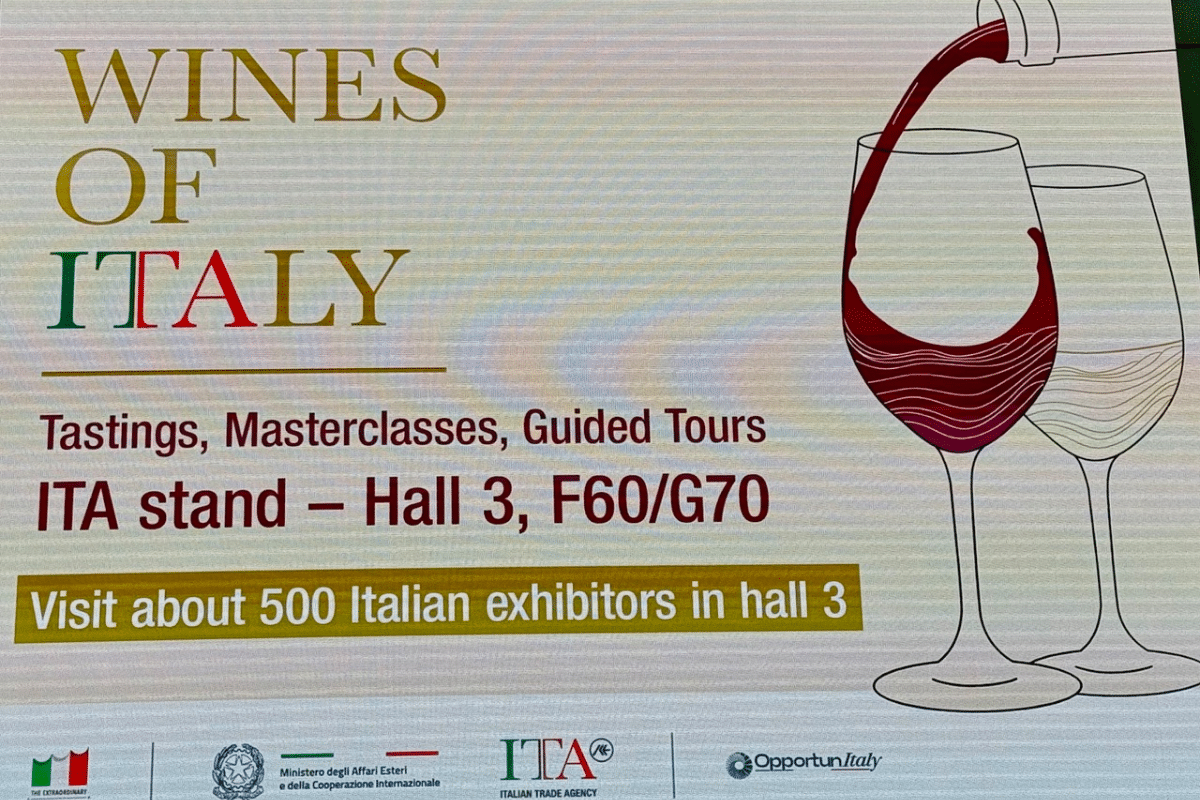
If we look at the Italian numbers, the shift is clear: in just a few years the count went from around 1,700 exhibitors to just over 500. Some read this figure as the downfall of Prowein to the advantage of Wine Paris. But that would be a shortsighted reading, and above all an unhelpful one. The topic of so-called “wars between trade fairs” also appears increasingly anachronistic today. It is wine industry gossip that leads nowhere.
The real question should be a different one: understanding how to make B2B wine events increasingly functional, useful, and coherent with the market, rather than limiting ourselves to sterile numerical comparisons. If we think that size is all that matters, it means we are still thinking with our minds turned toward the past.
For this reason I leave this first day of Prowein — which some had already described as a possible de profundis for the historic Düsseldorf fair — not only refreshed, but realistically optimistic. The majority of Italian producers I met here in Germany represent a front of Italian wine that is not merely resilient. It is a front that does not stop in the face of difficulties, that continues to be enterprising without losing prudence, capable of choosing what is useful and distinguishing what is less so.
But above all, another element emerges that is worth highlighting. The selection that is inevitably crossing the wine world as well — after almost forty years of extraordinary growth — hits hardest those who remain still. Those who wait for the return of a past that will not come back, or those who hope exclusively in external help to start again. Fortunately, this is a minority. And the first good news from this Prowein is that this minority was nowhere to be seen here.
Key points
- Prowein 2026 demonstrated that a smaller trade fair can still deliver real business value.
- Italian exhibitors dropped from 1,700 to just over 500, reflecting a major structural shift.
- European buyers showed up strongly, compensating for absences from North America and Asia.
- The biggest risk for wine companies today is reacting with panic rather than clear long-term strategy.
- The future of wine fairs likely lies in more regional, specialised, and targeted B2B events.